Learn more about our work packages!
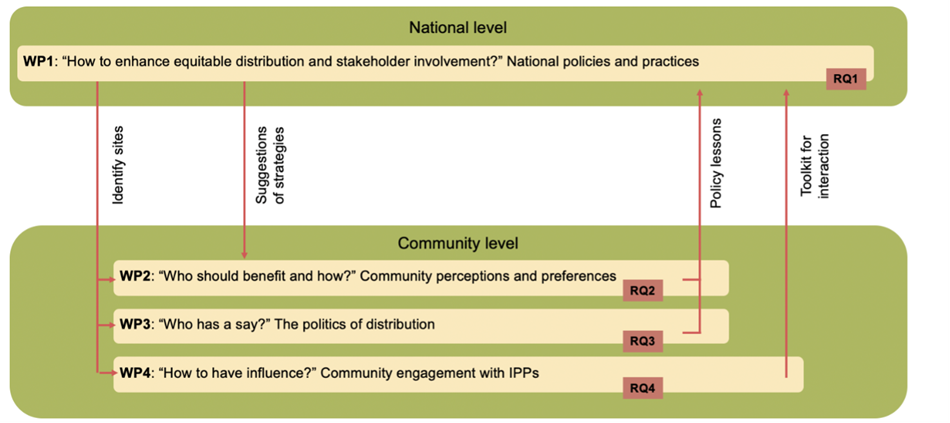
Here you can learn more about the four research strands that make up COM-PRES, together covering everything from mapping national policies and hearing what communities actually want, to unpacking local power dynamics and co-developing more inclusive models of engagement. Each work package tackles a distinct piece of the puzzle of how renewable energy investments can be shaped to reduce inequality and strengthen social development in South Africa.
WP1 National policies and practices
How to enhance equitable distribution?
Work package leader: Jacob Ulrich
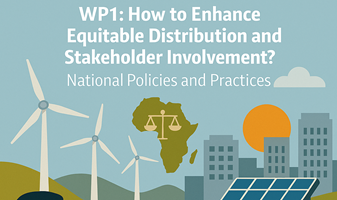
WP1 sets the national stage. It opens with a systematic literature review on private-sector social interventions in renewable energy, followed by a comprehensive mapping of all REIPPPP projects in South Africa — categorised by the level, type and impact of their social development activities. This scoping feeds directly into site selection for the other work packages.
Economic modelling will estimate the total social development funding flowing through REIPPPP nationally, and explore how alternative allocation strategies — including direct dividend payments to communities — would compare. Throughout the project, WP1 convenes an Advisory Panel of industry, government and civil society stakeholders and hosts national policy dialogues to translate research findings into actionable recommendations. It also delivers a Master's-level short learning programme on evidence-informed decision-making for practitioners.
Research question: How can national policies and practices be amended to enhance the equitable distribution of resources and productive partnerships between energy companies and communities?
WP2 Community perceptions and preferences
Who should benefit, and how?
Work package leader: Jeremy Seekings

WP2 shifts the lens to individual community members and asks: what do people actually want from renewable energy investments near them? Two mature REIPPPP project sites are selected for comparable case studies, each involving surveys of 300 respondents, focus-group discussions and individual interviews.
A core task is to explore how community members weigh individual benefits — such as cash transfers — against collective goods like schools, clinics or roads. Respondents are also asked about their preferences regarding representation and inclusion in REIPPPP governance. Particular care is taken to include those whose voices are often marginalised, especially women. Six community members are trained in survey methods. Findings directly inform national policy dialogue through WP1.
Research question: How do individuals within communities formulate and aggregate preferences with respect to distribution of the social development benefits?
WP3 The politics of distribution
Who has a say?
Work package leader: Anthony Kaziboni

WP3 zooms into the municipal level to unpack the power dynamics that determine how social development benefits are distributed — and who gets left out. Focusing on one REIPPPP project area, it examines how negotiations between national government, local government, energy companies, and affected and excluded communities shape outcomes in practice.
Key informant interviews with officials at multiple levels are combined with focus-group discussions to reveal how relationships are built, broken or distorted by competing interests. WP3 pays deliberate attention to communities outside the immediate project boundary — those who live near a wind or solar farm but receive none of its benefits. Outputs include a policy toolkit to support stakeholders in advocating for fairer benefit-sharing frameworks. One PhD researcher is trained in this work package.
Research question: How is the municipal distribution of social development benefits shaped by negotiations and contestation between national and local government, energy companies, directly affected communities, and those on the outside?
WP4 Community engagement with energy companies
How to have influence?
Work package leader: Lauren Graham

WP4 takes a participatory action research approach, working alongside a community and a willing energy company to co-develop new, more inclusive models of engagement. Rather than studying communities from the outside, the research agenda itself is shaped together with community members and local government representatives — identifying local assets and needs, co-analysing data, and monitoring how negotiations with the company evolve over time.
The work package deliberately includes marginalised groups — including women and ethnic minorities — as active participants rather than passive subjects. Ten community members are trained in data collection and processing. The practical lessons feed directly into guidelines for IPP-community engagement developed through WP1. Three PhD researchers – one from government, one in civil society and one in the IPP private sector – will be directly engaged in this project.
Research question: What models for inclusive community engagement in renewable energy projects are effective to ensure community involvement and deliver an equitable distribution of resources?