
The appropriate and efficient statistical analysis of data collected in health sciences often requires advanced techniques which are only covered at an elementary level in introductory statistical courses.
This course aims at researchers in need of an overview about appropriate analytical methods and discussions with statisticians to be able to solve their problem.
This course offers instruction in several statistical topics useful in health sciences. When registering to the course participants are asked to identify the main statistical topics relevant for their project.
The course will be organized as a 'boot camp' where the participants gather for two days at a venue for fruitful and intensive interaction between health science researchers and statisticians.
List of potential topics
Please remember to send a choice of 3 topics to us and a short description of your PhD project (see registration)
- Analysis of repeated and longitudinal measurements (variation of the lecture in Biostatistics 2)
When you collect the same type of measurements on a patient repeatedly over time (longitudinal data) you face at least two statistical problems: how to account for the correlation induced by the repeated measurements on the same experimental subject and how to model the course over time in clinical relevant terms. The theory of mixed models and generalized estimating equations offer a rich class of solutions to the problems both for normally distributed responses as for categorical ones (like e.g. binary observations). - Survival analysis (Recap of the lecture from Biostatistics 2)
In survival analysis on analyses times to the occurrence of some event like the time to remission of cancer since end of the treatment period. An important feature of such data is the occurrence of censored observation times where a patient leaves the study before the event of interest has been observed. We will discuss non-model based (non-parametric) and model based approaches to analyze such time to event data. - Survival analysis II (propose a specific topic of your interest)
- Structural Equation models (SEM)
SEMs form a class of models for multivariate observations which find applications in the analysis of questionnaire and setting with several measurements on the same subject. Confirmatory factor analysis is a special instance of a SEM. - Meta analysis
Meta analysis aims at combining and summarizing the evidence of medical effects already reported in published studies. It uses methods of fixed effects or random effect regression modelling. Meta analysis I becoming an important ingredient to present the already known knowledge in the planning phase of new studies. - Causal modelling in observational studies
Clinical observational studies or register based studies do not possess the same causal strength for treatment effect as randomized clinical trials. This is mainly due to the impossibility to control the confounder distribution in the treatment groups. Another problem is the time dependent treatment adjustment which often is affected by previous response. Methods like inverse probability weighting or g-estimation try to account for this imbalance to estimate a causally interpretable effect. - Predictive modelling and artificial intelligence methods Task like the automatic, data-driven classification of the actual or future health status of patients need often a huge amount of data collected per patients to arrive at reliable results. The amount, complexity and diversity of information (images, health records) require extension of classical statistical model building as neural nets or penalized regression approaches. We will provide an example of such a modelling approach.
Course Schedule:
| Monday, 23-02-2025 |
||
| 9:00 - 9:30 | Breakfast | |
| 9:30 - 9.45 | Welcome | |
| 9:45 - 10:45 | Flash presentation of participants and projects | Participants give a short oral presentation of themselves and their projects |
| 10:45 - 11:00 | Coffee break | |
| 11:00 - 11:45 | Lecture 1 : NN | |
| 12:00 - 13:00 | Lunch (sandwich) | Optional walk to Lerbjerg from 12:30 |
| 13:00 - 13:45 | Lecture 2 :NN | |
| 14:00 - 16:30 | Work on projects in smaller groups | Coffee/tea and cake/fruit will be available from 15:00 |
| 18:00 - 19:00 | Dinner | Pizza |
| 19:00 - 21:00 | Further discussion about some projects |
| Tuesday, 24-02-26 | ||
| 8:30 - 9:00 | Breakfast | |
| 9:00 - 9.15 | Recollection of the previous day | |
| 9:15 - 10.00 | Lecture 3: NN | |
| 10:00 - 10:15 | Coffee break | |
| 10:15 - 11:00 | Work on projects in smaller groups | |
| 11:15 - 12:00 | Lecture 4: NN | |
| 12:00 - 13:00 | Lunch (sandwich) | Another optional walk |
| 13:00 - 14:45 | Work on projects in smaller groups | Coffee/tea and cake/fruit will be available from 14:00 |
| 15:00 - 16:00 | Discussion and evaluation |
Course site
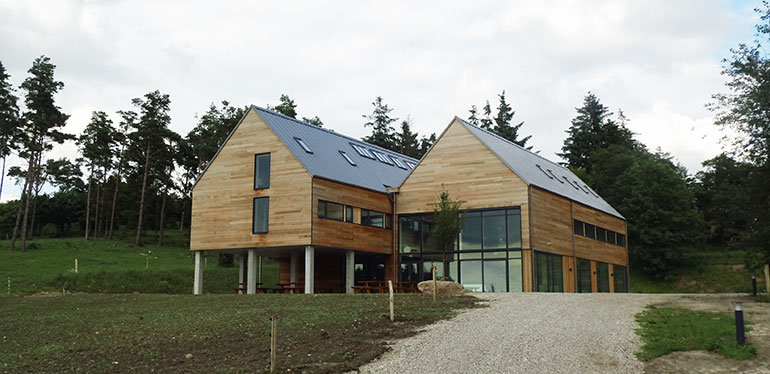
The course site is the Svanninge Bjerge Forsknings- og Feltstation (http://svanninge.sdu.dk/). There will be 16 twin bedrooms available. Participants might be required to share rooms. Bed linen and towels will be available.
Course costs
The course is included in the course program of the SDU PhD school and is free for PhD students. Researchers from SUND Odense and SUND Region of Southern Denmark have to pay 600 DKK and other researchers 5263 DKK.
You will receive an invoice which has to be paid no later than January 26, 2026.
Registration and preparations for the course:
a) Sign up at the PhD schools web-page https://www.sdu.dk/en/forskning/phd/phd_skoler/phdskolensundhedsvidenskab/phd_courses
b) Please send an e-mail to Ulrich Halekoh no later than January 26, 2026.The email should have the following content:
- Indicate your working place and position (PhD student or not).
- Choose up to two topics from the list you would like to be discussed at the course.
- Indicate whether you will stay at the venue overnight and whether you have special requests e.g. food allergies or vegetarian.
- Fill out the Project-description document with a brief one-page description of your project. The document will be used in the decision of the themes of the lectures and to present your project to the other participants. Please attach this document to your mail.
After the registration mail you will receive a confirmation mail.