
Newsletter October 2025: A Future with AI - 12 Perspectives on How AI Is Shaping Us as Humans
How is AI reshaping what it means to be human? This month’s newsletter highlights a new study from Elon University exploring how AI is influencing empathy, creativity, and critical thinking.
In our relatively small department, we have spent the past three years working more or less intensively with AI and this work just keeps evolving with new perspectives and continuous development.
We are still discussing how we can support teachers in integrating AI into their teaching while also ensuring the use of secure platforms. How it affects the validity of our exams, whether we should recommend one model over another as a recommendation to secure this, and whether we are facing a discursive or a structural transformation. And in this context, how we can support both teachers and students in navigating concerns about using AI in exam assignments. How we can create a common language at SDU for working with digital competencies across subjects and programmes.
Meanwhile, everyone in the department is getting ready for our annual conference, TAL2025- which this year focuses on AI and teaching - featuring a highly anticipated keynote. We are clearly not lacking things to address when it comes to AI—neither as a department nor as a university—and new opportunities are constantly emerging, along with important considerations.
Changes in The Age of AI
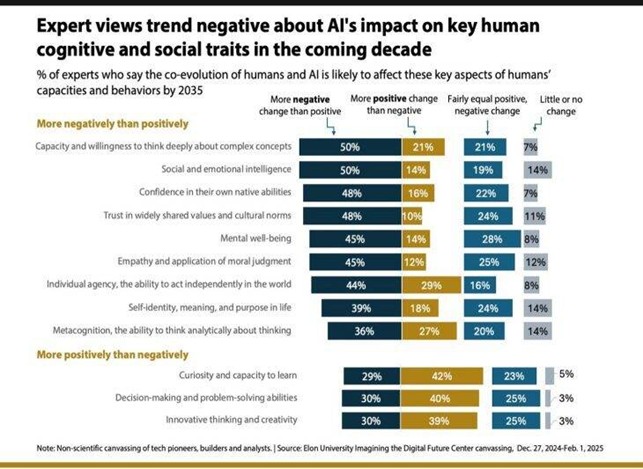
In this newsletter, I am addressing a number of important reflections, based on the report “Being Human in 2035 – How Are We Changing in the Age of AI?” (Anderson & Rainie, 2025), published by Elon University’s Imagining the Digital Future Center. The report is based on qualitative and quantitative research involving more than 300 experts from around the world – including technologists, researchers, ethicists, business leaders, and policymakers – who were asked to reflect on how AI might affect “the essence of being human” by 2035. This has resulted in a wide range of well-considered and often conflicting perspectives.
Overall, there is broad agreement among the participants that we are facing a “fundamental reshaping” of the human conditions as AI becomes an integrated part of everyday life – and that AI will not only transform our working and societal lives, but also influence core human traits such as empathy, social and emotional intelligence, critical thinking, agency, and our sense of meaning and purpose. At the same time, it is also emphasized that AI can enhance curiosity, creativity, and learning – provided the technology is used responsibly.
The report is structured around a summary of the quantitative findings, in which the experts assessed how AI may impact twelve key human characteristics, followed by a series of qualitative essays and quotes that elaborate on the participants’ views and concerns. Below, I have provided a brief summary of each of the twelve points, illustrated in the graphic below.
-
1. The ability and willingness to think deeply about complex issues
-
2. Social and emotional intelligence
-
3. Confidence in one’s own abilities
-
4. Trust in shared values and cultural norms
-
5. Mental well-being
-
6. Empathy and moral judgment
-
7. Personal agency and the ability to act independently
-
8. Identity, meaning, and purpose
-
9. Metacognition – thinking about one’s own thinking
-
10. Curiosity and the ability to learn
-
11. Decision-making and problem-solving
-
12. Innovative thinking and creativity
The reflections above highlight a dual challenge, the university is currently facing: On one hand we must embrace the learning opportunities AI offers. On the other hand, we must protect the human capacities, that define higher education—critical thinking, academic judgment, integrity, social and ethical responsibility, and student well-being.
That’s why it’s essential that we continue to prioritise digital competence across programmes at SDU—not just as a technical skillset, but as a critical, ethical, and transparent framework. One that enables students to navigate misinformation, understand data practices, and use AI responsibly.
As a starting point for this work, SDU CTL sees EU’s Digital Competence Framework for Citizens (DigComp 2.2) —adapted to a university context—a valuable foundation. We are also looking forward to the release of version 3.0 later this year, which will include an increased focus on AI.
In collaboration with Inger-Marie Falgren Christensen, we are hosting a workshop that explores how SDU can establish a common language around digital competence and integrate it into teaching within a university context.
Referencer
Imagining the Digital Future Center. (2025, March 31). Being Human in 2035: Experts predict significant change in the ways humans think, feel, act and relate to one another in the Age of AI - Imagining the Digital Future Center. https://imaginingthedigitalfuture.org/reports-and-publications/being-human-in-2035/
Vuorikari, R., Kluzer, S., & Punie, Y. (2022). DigComp 2.2: The Digital Competence Framework for Citizens - With new examples of knowledge, skills and attitudes, EUR 31006 EN. Publications Office of the European Union, Luxembourg, 2022. https://doi.org/10.2760/490274
Current developments on DigComp (2024-2025). (n.d.). The Joint Research Centre: EU Science Hub. https://joint-research-centre.ec.europa.eu/projects-and-activities/education-and-training/digital-transformation-education/digital-competence-framework-citizens-digcomp/current-developments-digcomp-2024-2025_en

TAL2025

Our annual conference TAL - Teaching for Active Learning is this year focusing on Teaching with AI.

