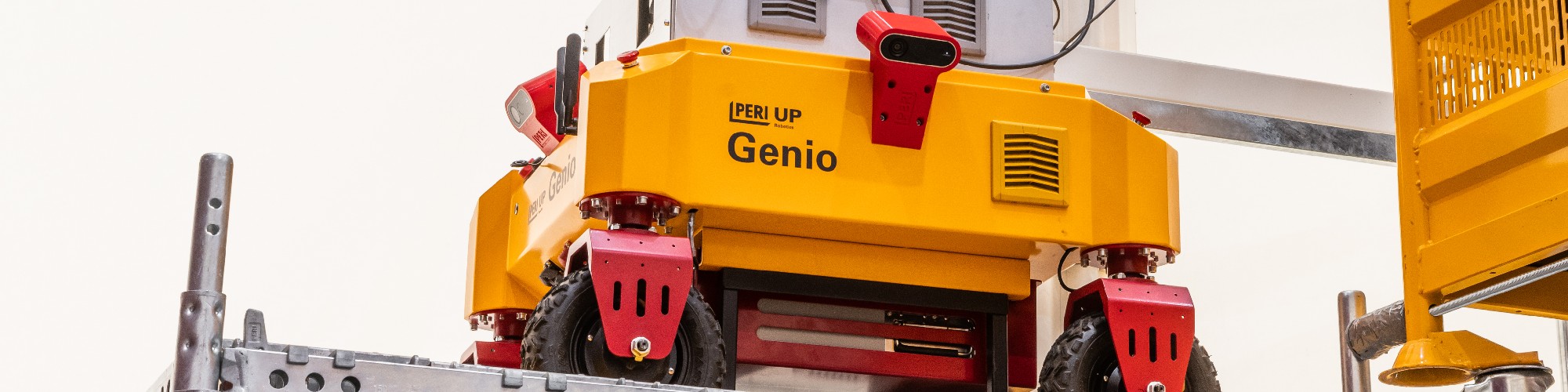
Research in safety shoes: Collaboration results in new scaffolding robot
With support from SDU and four other universities, the German scaffolding company PERI has developed a groundbreaking scaffolding robot. The project manager at PERI can only recommend other companies to collaborate with researchers, but there are also things to be aware of before getting started, he says.
The stereotype of the researcher is someone lost in books and theories, more or less disconnected from the real world outside of the lab.
At the University of Southern Denmark (SDU), however, this is far from the case. Here, research looks much more hands-on, says Peter Rübel, Senior Business Development Manager in the German scaffolding giant PERI.
He has been the project manager for the development of the scaffolding robot Genio, which PERI created with help from a consortium of European research groups, led by Professor Christian Schlette from the Centre for Large Structure Production (LSP) at SDU.
- We found everyone very solution-oriented and good to work with. It never became an academic exercise, says Peter Rübel.
”The researchers were practical people – wearing safety shoes, not just sitting behind desks – and they weren’t afraid of hands-on work.
Oliver Schilling, Scaffolding Automation Specialist at PERI, agrees. He felt they were working as one big team with a common goal. That became particularly clear when they had to present the prototype at the major construction fair Bauma in Munich in spring 2025.
- Of course, everything didn’t go as planned just before Bauma. For example, the Wi-Fi in the exhibition halls didn’t work properly which affected the wireless operation of the robot. But everyone stepped up and worked from early morning to late evening to make things succeed, he says.
Experts in their own field
PERI is one of the world’s largest players in the scaffolding and formwork sector, and they naturally use robots in the production of their components. But they do not have experience in developing entirely new robotic systems themselves.
- We are hopefully quite good at developing and producing scaffolding, but robotic technology is a completely different ballgame, says Peter Rübel.
That’s why it was crucial to work with the researchers at SDU, who are among Europe’s leading experts in robotics and were able to bring together a team of other top European researchers.
According to Christian Schlette, it was precisely the willingness to collaborate that made the project a success:
- Developing a robot that can assemble scaffolding is no easy task. It only succeeded because of the partners, all of whom are experts in their respective fields, and because of PERI, who were open-minded and ready to develop something entirely new, says Christian Schlette.

The prototype is only the beginning
At the Bauma fair 2025, PERI was able to showcase a functioning prototype, which received overwhelmingly positive feedback. However, the robot still needs development and testing before it is ready to be used on real construction sites, assisting scaffolders in their daily tasks.
- We now have proof that it can generally be done. But the exciting part is still ahead of us – turning it into a product that’s ready for the market, says Peter Rübel.
That is why PERI is investigating the possibilities for launching a new research project together with the university consortium.
- Of course it can be a challenge when you have not only one, but five universities in a project – especially on the legal and IP side – but that’s just how it is. It takes time to agree on these things, says Peter Rübel.
- The advantages far outweigh the potential challenges, so if you have the right case, I can only recommend that other companies collaborate with SDU.
Contact
Do you want to hear more about how your company can collaborate with the University of Southern Denmark?