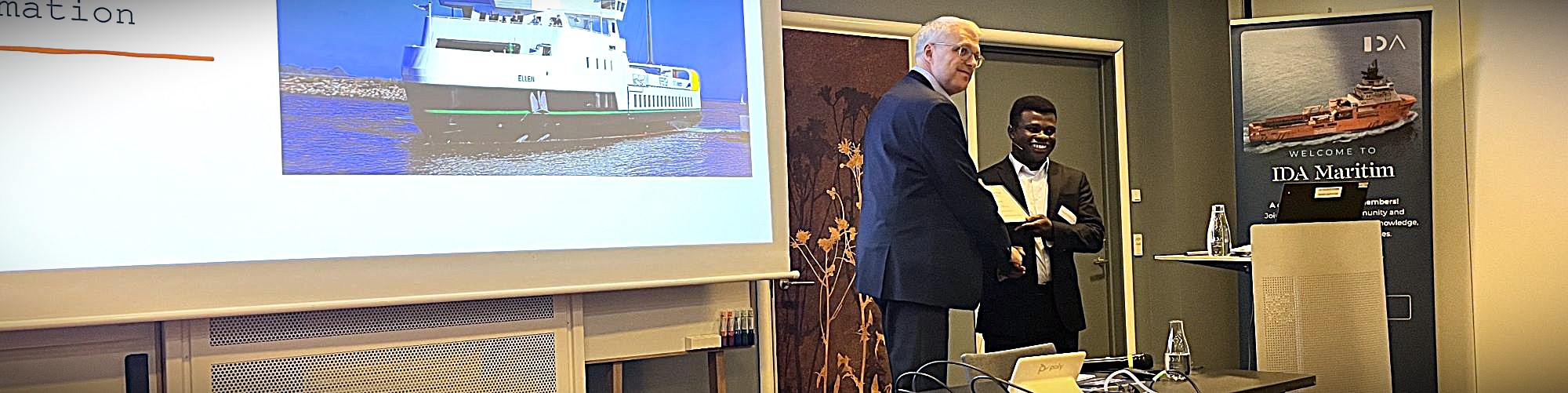
Thankgod Nnaji receives the DSNAME honarary award
Master’s student Thankgod Nnaji from SDU has been honoured by the Danish Society for Naval Architecture and Marine Engineering Foundation for his work on reusing batteries from the world’s first fully electric car ferry. The award means he can travel home to Nigeria for the first time in two years – and brings him closer to his dream of building a future in Denmark.
The DSNAME honarary award was awarded yesterday to Thankgod Nnaji, a master’s student at the Centre for Industrial Electronics at SDU in Sønderborg. The young Nigerian receives the prize for his research into how used ferry batteries can gain a long and efficient “second life.” It is work that can save ferry operators substantial amounts of money.
Along with the award, Nnaji receives 15,000 DKK, which now makes it possible for him to travel home over Christmas.
“It has been two years. I’m incredibly excited to see my family again,” he says. “It means the world.”
Nnaji works on the ferry’s most critical organ
Thankgod Nnaji works with the ferry Ellen, which sails daily between Ærø and Als. The electric ferry has been operating on pure electricity for more than five years, and the effects are now beginning to show on the enormous batteries housed in the vessel. As with our mobile phones, all batteries lose capacity over time.
The ferry’s battery system consists of so-called battery strings. A battery string is a long chain of many individual cells connected to deliver the high voltage and large amount of energy required to propel an electric ferry across the sea.
If just one of these cells becomes weak, it can affect the entire string – exactly like one faulty bulb can make a whole string of Christmas lights fail. This is why authorities require each string to be above 75 per cent “state of health” to remain in operation.
And this is where Thankgod Nnaji makes a difference.
Testing batteries 64 times faster than usual
Traditionally, a complete health test of a single battery cell takes about 16 hours. This becomes unmanageable when hundreds of cells must be checked.
Nnaji has developed a correlation protocol based on EIS diagnostics, which he now applies in the refurbishment efforts on Ellen. This approach allows him to estimate the state of health (SOH) of a battery cell in just 10–15 minutes instead of the usual 8 hours.
“We’ve been able to predict a cell’s condition almost perfectly,” he explains. “This means we can replace the weak cells and keep the rest – instead of scrapping an entire string.”
His supervisor, Associate Professor Henrik Andersen, is impressed:
“Thankgod is analytically strong and extremely dedicated. His method can extend the lifetime of the batteries by several months, which means a significant amount of money in ferry operations. That’s why we’ve applied for funding for a PhD position for him.”
In addition, Nnaji has developed a temperature-dependent model that can predict how worn battery cells behave in cold, normal, and warm conditions. This makes it possible to plan for how batteries can be safely reused in new contexts, such as stationary energy storage.
A new life for used batteries – and a greener future for maritime transport
Even when the batteries are no longer sufficient to power a ferry, they still retain a considerable amount of energy. They can have a “second life” as stationary storage units for solar or wind energy.
But only if we understand their precise condition.
“Nnaji’s models and measurement methods could become crucial when thousands of maritime batteries are to be reused in the future,” Andersen says. “This isn’t just a project for Sønderborg – the entire industry is watching.”
From Enugu to Denmark – and he hopes to stay
Thankgod Nnaji came to Denmark on a government scholarship because SDU hosts one of Europe’s strongest environments in power electronics.
“I have a huge interest in power electronics. It’s at the core of the green transition, so I studied it closely and discovered that CIE in Sønderborg was the best place to take my master’s degree. And I haven’t regretted it. Not even though it’s quite cold here and I was very seasick during my first trips with the Ellen,” he laughs.
Moving from a city of two million people to the quiet streets of Sønderborg has been a contrast, he admits.
“There are… fewer people,” he says with a grin. “But I’m happy to be here. I want to stay in Denmark and work in this field.”