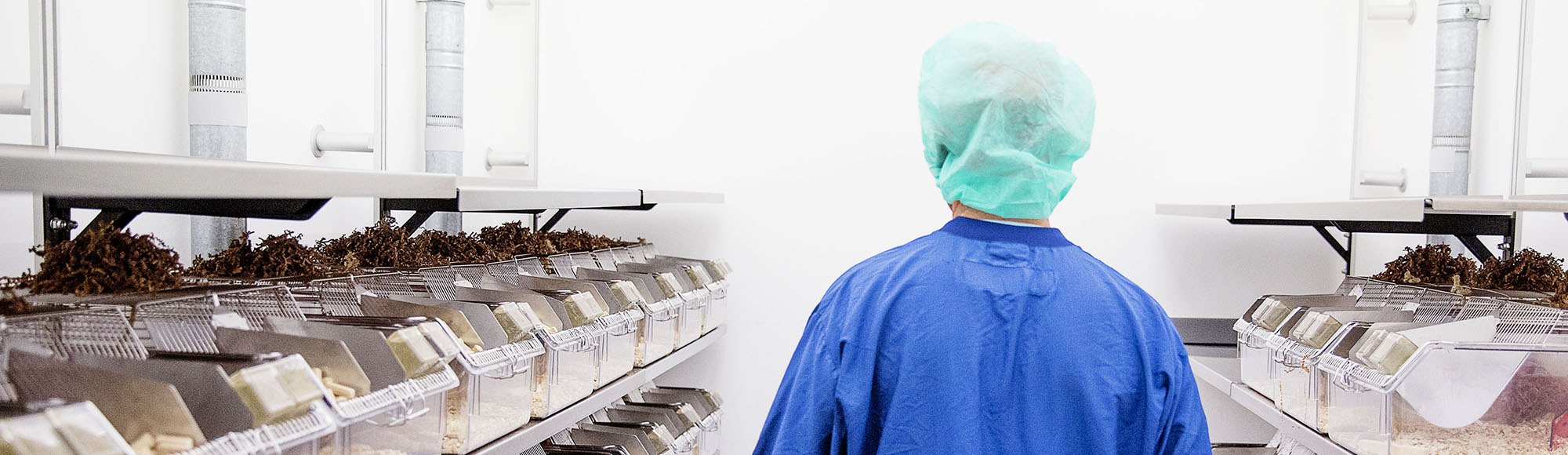
A new national centre to advance experimental disease research
An advanced centre for genetically modified mice, physiological measurements and surgical disease models is being established with funding of DKK 22 million from the Novo Nordisk Foundation – and will be open to all researchers.
A new research centre at the University of Southern Denmark (SDU) will enable researchers to work more precisely and effectively with experimental disease models. The centre will be named the Danish Center for Mouse Transgenics and Advanced Phenotyping – or DCM-TAP. It is being established with a DKK 22 million infrastructure grant from the Novo Nordisk Foundation.
The centre will support the development and use of genetically modified and experimental disease models, enabling precise measurement of how diseases affect the body – from blood pressure and metabolism to memory and behaviour.
Mice help us understand genes and disease
Mice play a key role in modern disease research because their genes and physiology resemble those of humans in many ways. By using various disease models – for example by modifying genes in mice – researchers can mimic a disease in the body and study how it develops and how it affects specific organs and functions.
Genetically modified mice are known as transgenic mice, and they can help us study how genes affect essential functions such as circulation, kidney function, brain activity and metabolism.
Glossary – what do the technical terms mean?
Transgenic mouse: A mouse whose genes have been modified, for example to mimic or study a disease.
Phenotyping: Measurement of how diseases or genetic changes affect bodily function and behaviour.
Telemetry: Wireless monitoring of e.g. blood pressure or activity in live animals.
Microsurgery: Very precise operations on small structures such as blood vessels or nerves.
Disease model: A method for mimicking a disease in an experimental animal in order to study it.
– We use transgenic mice to examine how individual genes influence bodily functions. This helps us understand diseases – and, in the long run, discover new treatment options. That’s why it’s so important to have both the infrastructure and expertise to develop these advanced models, says Professor Henrik Dimke from the Department of Molecular Medicine, who heads the project and the transgenic core facility.
Measuring signs of disease throughout the body
A key feature of DCM-TAP will be so-called phenotyping – detailed measurement of how body and behaviour are affected by disease. This might include blood pressure, heart rate, kidney function, metabolism, motor skills, memory and social behaviour.
– Our aim is to be able to measure advanced brain functions, energy expenditure, motor skills and disease-related signs – and to observe how these change when the body is diseased or genetically modified. This gives us a much more nuanced understanding of disease progression and treatment effects, says Professor Kate Lykke Lambertsen, who leads the phenotyping work and is co-responsible for the project.
These measurements are carried out using advanced equipment, including wireless monitoring (telemetry) and behavioural analysis.
Surgical disease models
The centre will also offer microsurgical models, in which diseases are mimicked through precise interventions in experimental models – for example in relation to brain, urinary tract or cardiovascular diseases. These models make it possible to study how the body reacts to disease and how new treatments work under controlled conditions.
The microsurgical part of the centre is led by Professor Peter Zvara.
A national resource
The centre will be the first of its kind to combine all these elements within experimental disease research. DCM-TAP will be located at the University of Southern Denmark in Odense, where the university and the hospital will soon be physically connected. The centre will serve as an open and shared platform for researchers from both academia and industry – nationally and internationally.
– Our goal is to make advanced techniques and models accessible to more people. It should be a resource that promotes collaboration, quality and innovation in Danish disease research, says Professor Henrik Dimke.
DCM-TAP – Danish Center for Mouse Transgenics and Advanced Phenotyping
Purpose: A national centre for research into genetically modified and surgically induced disease models in mice.
Three core areas:
- Transgenics: Modification of mouse genes using CRISPR, microinjection and viral methods.
- Phenotyping: Measurements of, for example, cardiac, renal and brain function, as well as behaviour.
- Microsurgery: Disease models based on surgical procedures, for example within the brain and the circulatory system.
Location: University of Southern Denmark, NytSUND, Odense – in collaboration with Odense University Hospital.
Project period: 2026–2031
Funding: DKK 22,496,787 from the Novo Nordisk Foundation.
Access: Open access – available to researchers from universities and industry, nationally and internationally.
Selected collaborators:
- Nicholas Ditzel and Arun Mariappan (IMM/BML) – transgenics
- Bettina Hjelm Clausen (IMM) – behavioural analysis
- Biomedical Laboratory – animal facilities
Meet the researcher
Kate Lykke Lambertsen is professor of neurobiology at the Department of Molecular Medicine
Meet the researcher
Henrik Dimke is professor of translational kidney physiology at Department of Molecular Medicine and Department of Clinical Research.
Contact:
Henrik Dimke – hdimke@health.sdu.dk
Kate Lykke Lambertsen – klambertsen@health.sdu.dk
Peter Zvara – pzvara@health.sdu.dk