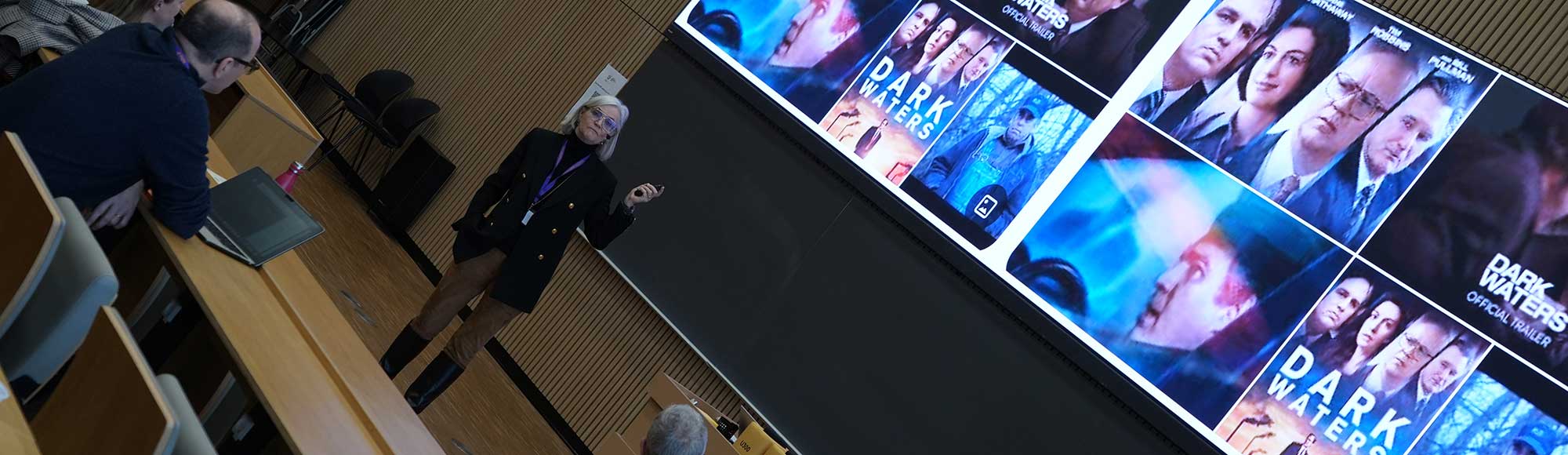
Health Innovation Day highlighted research with real-world impact
At Health Innovation Day 2026, researchers, foundations and health sector stakeholders gathered at the University of Southern Denmark (SDU) to explore how health research can create societal value. A newly announced national agreement on innovation provided a timely backdrop for the day's discussions.
How do we turn health research into solutions that work in practice? That was the question that brought together actors from academia, foundations, industry and public authorities at Health Innovation Day 2026 at SDU.
The event took place just days after the government launched a new agreement aimed at making it easier to translate research into innovation and entrepreneurship.
Dean Ole Skøtt referred to the agreement in his opening remarks:
– Universities must take on a greater role in shaping the framework for innovation and entrepreneurship. That’s exactly what we want to support with this event.
Relationships as the key to solutions
Diana Arsovic Nielsen, CEO of the Danish Life Science Cluster, opened the programme with a focus on Europe’s healthcare challenges – and the need for new forms of collaboration.
– Relationships are the key to solutions, she said in her presentation, which also looked ahead to the upcoming healthcare reform and a national life science strategy.
Regulation as a lever
Rita Hendricusdottir, CEO and co-founder of RegMetrics, shared how her startup helps researchers take ideas through to product development – and how regulatory frameworks can actively support innovation processes.
A standout message from her presentation was:
– Academic skills are business superpowers.
Municipal collaboration: From intent to action
Lone Krogsbøll, Investment Manager at Odense Municipality, described the municipality’s role as an investor in health innovation. Stine Sønderby Bonde, Head of Health at Odense Municipality, and Jens Troelsen, Professor and Head of Department at the Department of Sports Science and Clinical Biomechanics, shared their experiences of research collaboration in a municipal setting.
They both called for more commitment and closer collaboration:
– Think implementation from the start, said Bonde.
– We need data and evaluation – otherwise, we don’t know whether our efforts are making a difference, added Troelsen.
Research with direction – from PFAS to liver biomarkers
Three SDU researchers presented examples of research with the potential for societal impact:
Tina Kold Jensen, Professor at the Department of Public Health, spoke about PFAS and the need for regulation.
Grith L. Sørensen, Professor at the Department of Molecular Medicine, shared experiences from her spin-out and encouraged researchers to stay curious and proactive.
Maja Thiele, Professor at the Department of Clinical Research and winner of SDU’s Innovation Prize 2025, talked about biomarkers for early detection of liver disease. She described the barriers faced by translational research in a publishing system that prioritises novelty over robust documentation.
Impact requires collaboration and broader excellence
The panel debate featured Søren A. Mikkelsen, Chief Programme Officer at Innovation Fund Denmark; Jakob Grauslund, Head of Department at the Department of Regional Health Research; and Pernille Tanggaard Andersen, Head of Department at the Department of Public Health. The discussion focused on how impact can be measured and realised in practice
– A strong business case beats a clever algorithm, said Grauslund.
– We need to widen the reach of our research – including the way we communicate, added Tanggaard Andersen.
The panel’s message was clear: Societal impact doesn’t happen in the lab alone – it requires involving end-users and relevant partners from the very beginning.
SDU: Ready for the next step
Rikke Leth-Larsen, Head of Department at the Department of Clinical Research, and Uffe Holmskov, Vice Dean for Research and Innovation, closed the event by calling for openness, transparency and new cross-sector connections. Holmskov pointed to a shift in mindset:
– We shouldn’t only be recruiting based on H-index. We need to start talking about an innovation index.