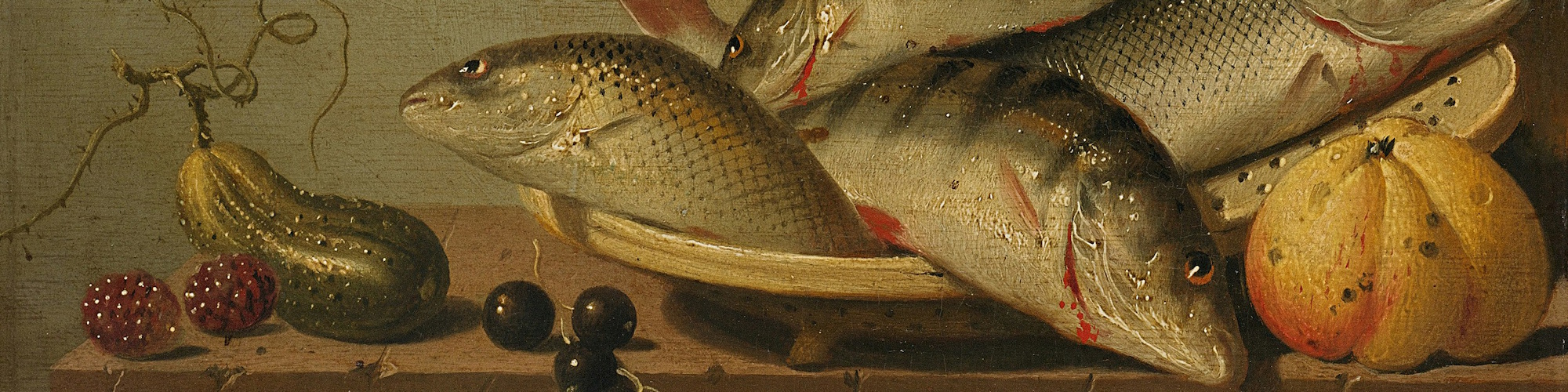
Archaeological trap: Fish can make skeletons appear hundreds of years too old
Radiocarbon dating of a skeleton can be seriously misleading if the person ate a lot of freshwater fish. A research team is now issuing a “word of warning” to archaeologists around the world.
The Danish town Svendborg was once home to a Franciscan monastery. As at other monasteries in Denmark, it was considered highly prestigious to be buried as close to the monastery church as possible, preferably inside the church itself, for instance near the chapter house or along the cloister.
One person who was given such a prestigious burial in medieval Svendborg was later excavated and is now known as skeleton III9B. The skeleton is attracting scientific attention once again because there is something very wrong with its age.
III9B was dated using radiocarbon dating, a method used worldwide and regarded for almost 75 years as a reliable scientific method for dating materials containing carbon.

Remains of 27 people re-examined
Now, however, a Danish-Dutch research team is drawing attention to a particular factor that can significantly distort radiocarbon dates:
“If someone ate a lot of freshwater fish during their lifetime, their bones can appear older than they really are. The difference can amount to several hundred years and can vary considerably,” says Professor Emeritus Kaare Lund Rasmussen from the Cultural Heritage and Archaeometric Research Team at SDU. He specialises in chemical analyses of cultural heritage finds.
Together with Johannes van der Plicht from the Center for Isotope Research in Groningen, the Netherlands, and Jesper Lie Boldsen from the Department of Forensic Medicine at University of Southern Denmark, he has re-examined the dating of 27 people buried at some of Denmark’s approximately 140 medieval monasteries, either in monastic cemeteries or even inside the churches themselves. This means that they must have been buried after the monasteries and their churches were built.
Freshwater fish on the menu
In medieval Catholic Europe, there were around 180 fasting days a year when meat was off the menu but freshwater fish was allowed. Freshwater fish was considered “cold” and “neutral”, unlike meat from warm-blooded animals and saltwater fish. In some places, freshwater fish was even regarded as a prestigious food. Tycho Brahe and his wife, for example, ate a great deal of it. We covered that here.
Skeleton III9B from Svendborg
One of them is III9B from Svendborg. Previous radiocarbon dating placed the person’s death sometime between AD 1100 and 1155. But Svendborg’s Franciscan monastery was not founded until 1236, almost a century later. The two dates clearly cannot both be right.
“We can say with certainty that another five of the 27 skeletons we re-examined have also been incorrectly dated. The results make it abundantly clear that this is a major problem. And not just in Denmark, but probably across the rest of Europe too,” says Kaare Lund Rasmussen.
The six incorrectly dated skeletons include one from the Monastery of Our Lady in Viborg, another Danish town. Previous radiocarbon dating put even the latest end of its estimated date range at AD 976, more than 200 years before the monastery was built. At the Cistercian monastery at Øm, also in Denmark, the same problem occurs in three burials.
So what is going on?
To draw attention to the problem, Kaare Lund Rasmussen and his colleagues have published a “word of warning” in the scientific journal npj Heritage Science. They hope archaeologists and others working with radiocarbon dating of fish-eating humans and animals will take heed.
The explanation for the misleading dates lies in something these people ate while they were alive: freshwater fish.
Fish from lakes and rivers can contain less carbon-14 than food from terrestrial sources. This is because old carbon can be released from sediments along the shores of lakes and the banks of rivers. When people consume this carbon in their food, some of it becomes incorporated into their bones. Centuries later, radiocarbon dating can therefore make those bones appear older than they really are.
“In extreme cases, a fish from the Rhine, for example, can appear up to 1,300 years older than a land-based organism that lived at exactly the same time. But that does not mean you can simply subtract 1,300 years from the date of a person who ate freshwater fish. Quite the opposite. The particular problem with freshwater is that the effect varies enormously. It can range from zero to 1,000 years,” explains Kaare Lund Rasmussen.
Richard III, the Rhine and the Danube tell a similar story
Radiocarbon dating of the bones of the English king Richard III placed his death sometime between 1412 and 1460. Yet we know from historical records that he was killed in battle in 1485. The same problem has been found in medieval human remains from Dorestad on the Rhine in the Netherlands, where the discrepancy was 250 years. Along the Danube, researchers examined the remains of people who had been struck by arrowheads made from animal bone, several of which were still embedded in vertebrae or pelvic bones. Yet radiocarbon dating made the human bones appear 300–500 years older than the animal-bone arrowheads. In all these cases, a diet rich in freshwater fish can explain the discrepancy.
Saltwater has a similar effect, but it is easier to correct for
This is why Kaare Lund Rasmussen and his colleagues are now urging others to be aware of the “freshwater trap” and make the necessary corrections when carrying out radiocarbon dating.
Saltwater fish can also make human bones appear older than they really are. Here, too, the effect varies geographically between different parts of the world’s oceans, but it is considerably more predictable than the freshwater effect.
In the North Sea, for example, the effect is well established at around 400 years, according to the researchers. So for an organism that obtained all its carbon from the marine food chain, the date can be corrected using a known reservoir effect.
Meet the researcher
Kaare Lund Rasmussen is Professor Emeritus and an expert in archaeometry. He has carried out chemical analyses of a wide range of archaeological and cultural heritage finds, shedding new light on the past. His research has taken him from the Dead Sea Scrolls to the shrine of King Canute the Holy, the remains of Tycho Brahe and a number of Catholic relics. He is also co-author of the book Arkæometri: Undersøgelser af kulturarv (Archaeometry: Investigating Cultural Heritage).