Where were the Dead Sea Scrolls written?
A European research team aims to uncover where the world’s oldest biblical manuscripts were written. The project is financed by the European Research Council and assisted by SDUs Faculty of Science expertise.
The Dead Sea Scrolls are the oldest known biblical manuscripts in the world. Since the first were discovered in 1947, they have played a pivotal role in shaping our understanding of the origins of Judaism and Christianity.
The manuscripts continue to attract significant scholarly interest. Now, a European research team led by Professor of Biblical Exegesis Mladen Popović from the University of Groningen has received approximately DKK 18.5 million from the European Research Council (ERC) to tackle a simple yet highly challenging question: Where were the Dead Sea Scrolls written?
The grant follows an earlier ERC-funded project led by Popović, which investigated whether artificial intelligence could be used to date the scrolls. That project was titled “The Hands That Wrote the Bible.” Read more in our article: First editions of the Bible discovered by artifical intelligence and chemistry.
Fragile parchments
Professor Emeritus Kaare Lund Rasmussen from the Department of Physics, Chemistry and Pharmacy at SDU participated in that work and is also involved in the new project. His role will again focus on conducting advanced chemical analyses of selected fragments of the Dead Sea Scrolls.
The new project, “Tracing Scribes and Scrolls,” brings together experts in natural sciences, artificial intelligence and the humanities. Together, they will examine up to 250 scrolls. Here is a press release from Groningen University.
"We will use non-destructive techniques such as XRF, µFTIR, µRaman and multispectral imaging. These methods make it possible to analyse the chemical composition of materials without damaging the fragile parchments,” says Kaare Lund Rasmussen. Over the course of his career, he has carried out similar analyses on a wide range of cultural heritage objects, including relics associated with the Apostles of Jesus and Francis of Assisi, as well as samples of Tycho Brahe’s hair and the shrine of King Canute the Holy.

Preserved biological traces
According to the research team, this is the first time such a large number of Dead Sea Scrolls will be analysed systematically using such a diverse set of methods. This opens up entirely new possibilities for understanding their origin. In addition to Rasmussen’s chemical analyses, the material will be examined using artificial intelligence and palaeography—the study of ancient handwriting.
At SDU, Professor Frank Kjeldsen, an expert in mass spectrometry from the Department of Biochemistry and Molecular Biology, is also ready to contribute protein-chemical analyses if it becomes relevant to add a biological or molecular layer to the material characterisation.
“Modern protein chemistry and mass spectrometry can be used to read preserved biological traces in historical material,” he explains.
This is not the first time Kjeldsen has applied his expertise in support of cultural heritage research. In 2025, he assisted Danish archaeologists in determining the sex of medieval child skeletons based on fragments of tooth enamel. We have covered that in this article: How science helped archaeologists determine the sex of medieval children.

Egyptian papyri will be included
With the new project, the researchers hope that the combined effort will make it possible to identify geographical patterns and perhaps even place individual scribes within specific environments. If it proves impossible to pinpoint exact locations, an important intermediate goal is to group the scrolls according to their origin.
“The overall aim is to find out where the Dead Sea Scrolls were written. If that turns out to be too difficult, we may still be able to group some of the scrolls and say that group A was written in a different place than group B. That would still be highly valuable,” says Kaare Lund Rasmussen.
A key element of the project is comparison with papyri from other regions. For the first time, Egyptian papyri from museums in Berlin, Turin and the Netherlands will be included in the analyses. By comparing materials from Egypt and Judea, the researchers hope to identify regional differences and thereby strengthen the chances of determining places of origin.
The Essenes and the Teacher of Righteousness
The Dead Sea Scrolls are among the most important sources for understanding the so-called Second Temple period (c. 500 BCE – 70 CE), during which Judaism took shape and Christianity emerged.
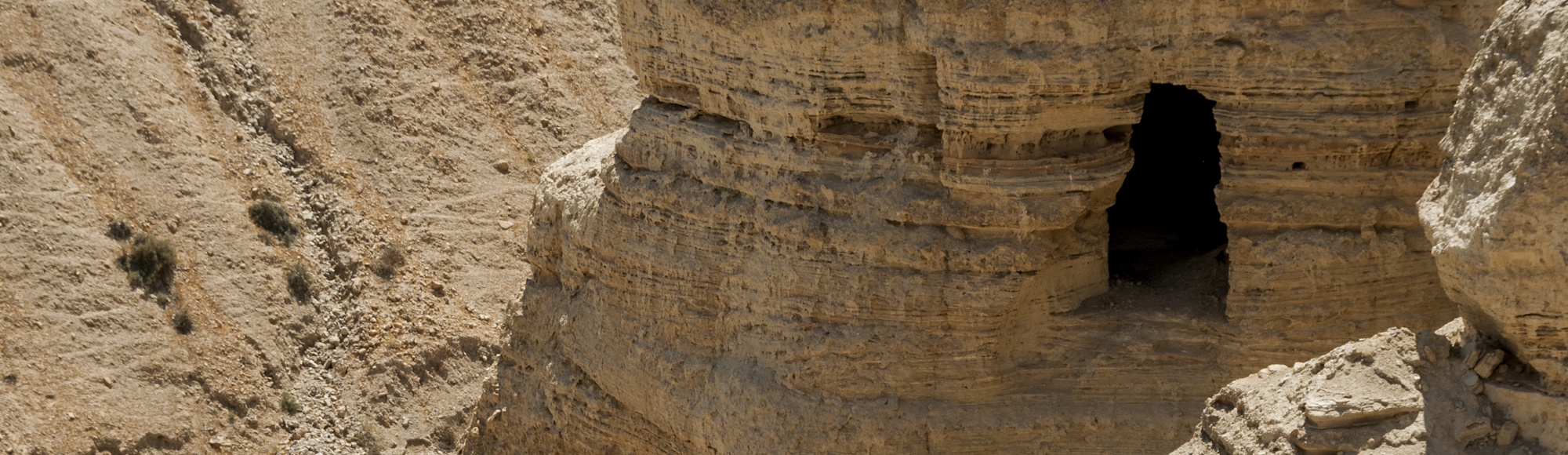
The scrolls were discovered near Qumran, a remote area by the Dead Sea where a Jewish group—possibly the Essenes—lived. The Essenes were an ascetic movement that, together with the Pharisees and Sadducees, represented key strands of Judaism at the time.
The texts refer, among other things, to a figure known as the “Teacher of Righteousness,” but researchers still do not know who this person was.
Meet the researcher
Kaare Lund Rasmussen is professor emeritus and an expert in archaeometry. Over the years, he has carried out chemical analyses of cultural heritage objects, shedding new light on the past. He is co-author of the book Archaeometry: Investigations of Cultural Heritage.