We develop advanced radar systems for remote sensing, combining software-defined radio, innovative antenna designs, and high-performance RF instrumentation.
Our research focuses on building flexible and reconfigurable radar platforms that can be adapted to emerging sensing applications, from tracking targets to exploring new radar architectures and signal-processing techniques.
Software-Defined Radios
Software-defined radios (SDRs) have revolutionized the way modern radio systems are designed by moving many traditionally hardware-based functions into programmable digital transceiver. By combining high-speed ADCs and DACs, FPGAs, and programmable RF front ends, SDRs provide a high degree of flexibility and reconfigurability.
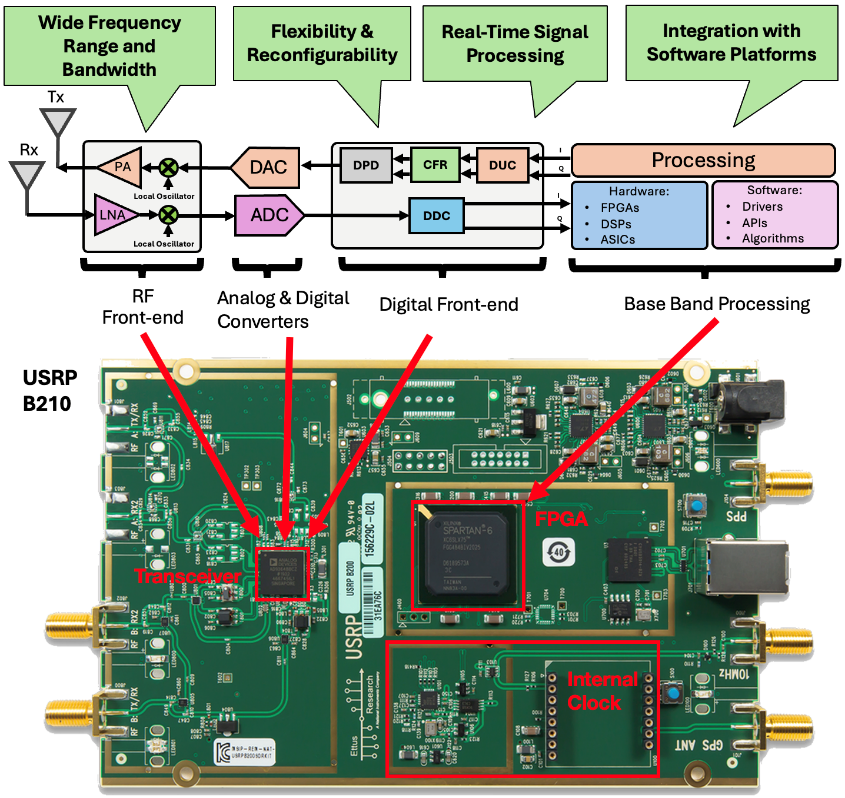
In our research, we use SDR platforms to design and test custom radar waveforms, signal-processing algorithms, RF architectures, and antennas. The same hardware can be reconfigured for different applications simply by changing the software, making SDRs a powerful tool for rapid prototyping and experimentation. Open-source software such as GNU Radio, Linux and Python further enable the development of custom platforms and signal-processing chains.
Antennas and Metamaterials
Antennas are a fundamental part of any radar system, defining how electromagnetic energy is transmitted, received, and focused in space. We investigate novel antenna architectures and electromagnetic structures to improve radar performance while addressing practical constraints such as size, bandwidth, gain, and efficiency. We use simulation tools like Ansys HFSS for modeling as well as open-source Python-based optimization tools. We count with facilities for the fabrication and prototyping of antennas such as PCB etching, milling machine and 3D printing using specialized RF filaments and substrates.
Our research includes the design and characterization of antenna arrays, compact antennas, frequency-selective surfaces, and metamaterial-inspired structures. These technologies allow us to explore new approaches to beamforming, spatial filtering, and efficient RF front ends for next-generation radar systems.

RF Instrumentation and Measurements
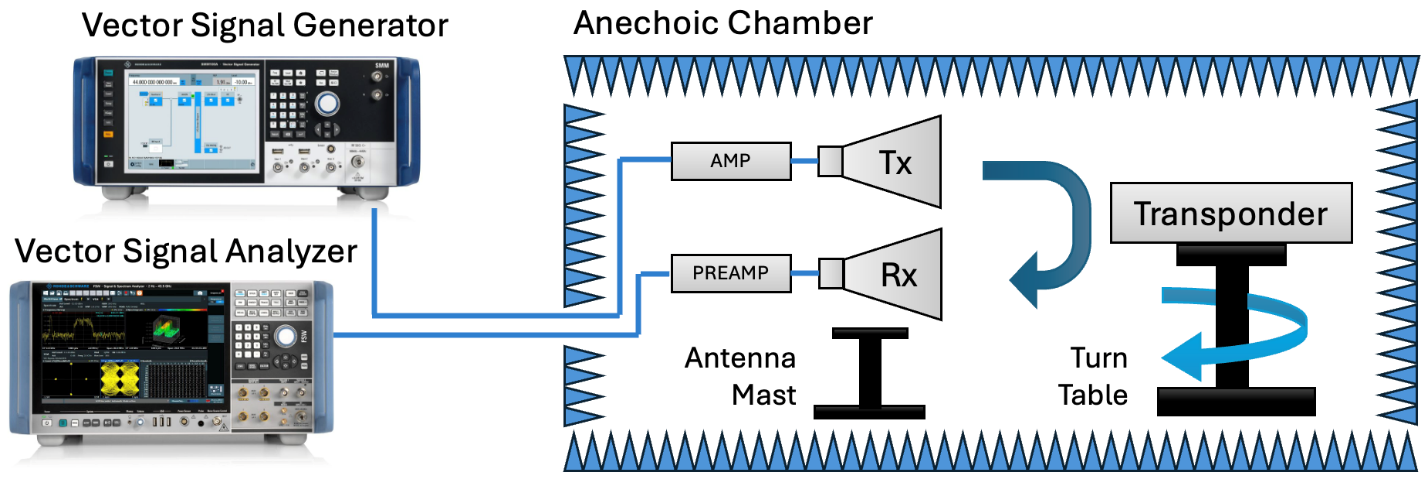
Reliable radar development requires accurate RF measurements and well-characterized instrumentation. We design and develop experimental measurement systems for evaluating antennas, RF components, transceivers, and complete radar architectures.
Our work combines vector network analyzers, spectrum analyzers, signal generators, power amplifiers, SDR platforms, and custom-built RF components. By integrating these instruments into flexible measurement platforms, we can characterize systems from the component level to complete radar prototypes and validate their performance under realistic operating conditions.
Publications
- D. Penaloza-Aponte, S. Brandt, and J. Urbina, "X-Band/K-Band Coherent RF Front-End for High-Power Pulse Software-Defined Harmonic Radar to Track Flying Insects," 2026 IEEE Radar Conference, May 2026.
- D. Penaloza-Aponte, J. Urbina, "Impedance Matching, Size Reduction, and Optimization Techniques Applied to Harmonic Transponder Antenna Using 3D Honeybee Dielectric Model," 47th Annual Antenna Application Symposium, University of Illinois, Urbana-Champaign, Illinois, September 2023.
- D. Penaloza-Aponte, J. Urbina and J. D. Fuentes, "Real-Time Transponder Detection Using Open-Source Software-Defined Radio Receiver Architecture for Harmonic Radar Systems," Radar Sensor Technology XXVI, Symposium SI22 SPIE Defense + Commercial Sensing, April 2022. https://doi.org/10.1117/12.2618927
- D. Penaloza-Aponte, J. Urbina and J. D. Fuentes, "Open-Source Software-Defined Radio Receiver Platform for Harmonic Radar Applications to Track Airborne Insects," 2021 XXXIVth General Assembly and Scientific Symposium of the International Union of Radio Science (URSI GASS), 2021, pp. 1-4, doi: 10.23919/URSIGASS51995.2021.9560407.
- D. Peñaloza-Aponte and M. Clemente-Arenas, "Directivity Enhancement to Antipodal Vivaldi Antenna with Slot Edges Using Zero-Index Metamaterials for S-band SAR Application," 12th European Conference on Antennas and Propagation (EuCAP 2018), 2018, pp. 1-5, doi: 10.1049/cp.2018.0541.