Research area
Bio-inspired Intelligent Systems
We investigate neural and non-neural biological systems as sources of principles for designing more efficient intelligent robots.
We study how biological organisms perceive, process information, interact with their environment, and generate movement, translating these principles into sensing, actuation, morphology, control, and computation.
Our research spans different biological models and robotic platforms: birds and other flying animals inspire agile and efficient aerial robots; plants and soft-bodied animals provide principles for embodied intelligence, adaptive morphology, and distributed control; while brain-centric biological systems inspire new approaches to low-power, event-driven computation and neuromorphic processing.
By combining embodied intelligence, event-driven sensing, bioinspired computing, and lightweight control strategies, we aim to reduce computational and energy requirements while enabling robots to respond efficiently, robustly and adaptively to unstructured, complex and dynamic environments.
Contact

Assistant Professor Emanuela Del Dottore

Professor Emad Samuel Malki Ebeid
Bio-inspired & Embodied Intelligence
We explore how principles observed in biological systems can be translated into robot morphology, sensing, control, and behavior. By distributing intelligence across the body, sensors, and control architecture, robots can exploit their physical dynamics and environmental interactions to achieve efficient perception, decision-making, and adaptation with reduced computational demands.
Bio-Inspired Aerial Robotics and Neuromorphic Processing
We make use of bio-inspired aerial platforms that mimic the flight mechanisms of birds and insects. Compared with conventional multirotor drones, these platforms can offer enhanced maneuverability, quieter operation, reduced risk from exposed high-speed rotors, and suitability for operation in complex and confined environments.
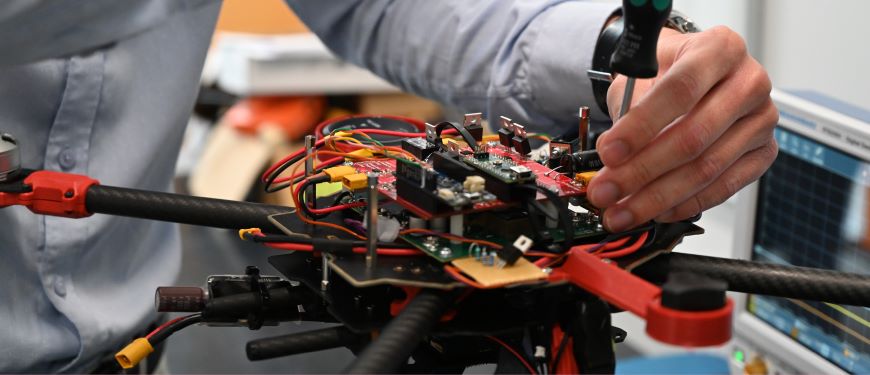
These platforms are outfitted with neuromorphic processors and event-based sensors for efficient onboard perception and control. Compared with conventional processors and frame-based sensors, neuromorphic technologies enable event-driven computation, lower power consumption, reduced computational overhead, and low-latency response. These characteristics are particularly valuable for lightweight aerial robots with strict constraints on power, payload, and onboard computational resources.
The long-term goal is to develop autonomous bio-inspired aerial platforms for indoor and outdoor infrastructure inspection, combining the unique capabilities of flapping-wing flight with energy-efficient neuromorphic perception, learning, and control.
Selected publications
- Baniya Kshatri, D., McRae, T., Ebeid, E. (2026). Spike-Driven Actuation in Robotics: A Survey of Spike-to-Motor Interfaces. In: Shin, H.-S., Howard, M., Lee, H.-I., Park, D. (eds) Robot Intelligence Technology and Applications 10. RiTA 2025. Lecture Notes in Networks and Systems, vol 1932. Springer, Cham.