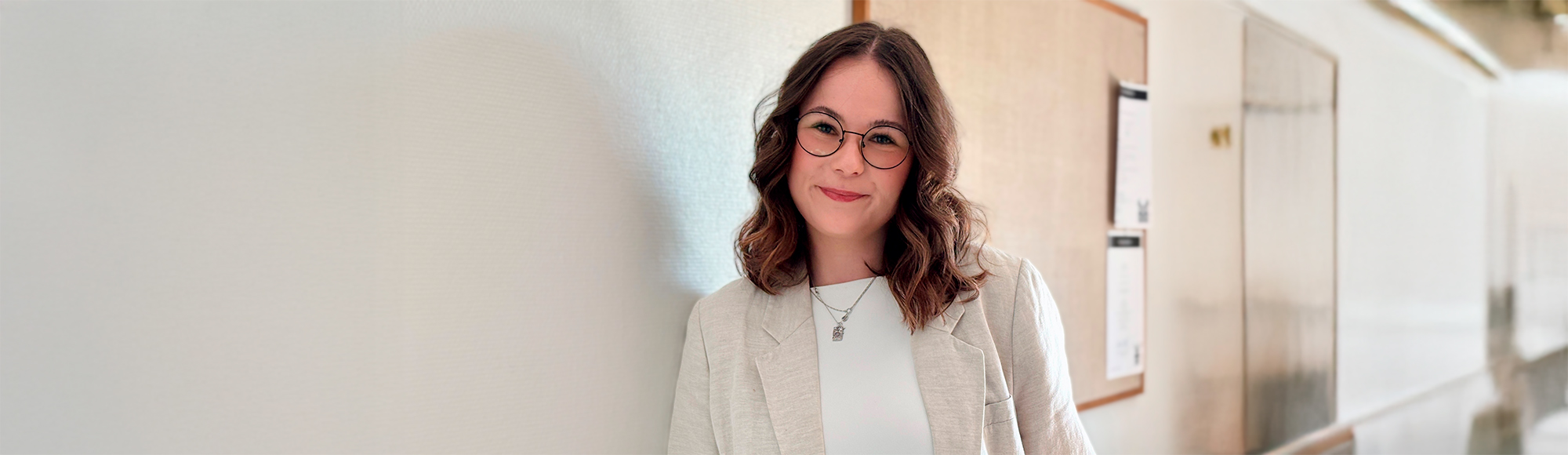
Digitalisation only works when organisation, people and technology work together
As a project manager in HR at the Region of Southern Denmark, Julie Thorning Rasmussen works to turn digital ambitions into solutions that function in practice. She creates structure in complex systems, bridges the gap between vendors and employees, and ensures that new solutions create value for the region’s staff — particularly within the hospitals. Julie collaborates with system providers, works with HR data, and makes sure digital solutions are embedded among the employees who use them in their daily work.
“I hold a bachelor’s degree in international business communication with IT and web communication and a master’s degree in web communication, both from Kolding. What has especially shaped me is the interdisciplinary approach. From the very beginning, we combined technical, communicative and organisational subjects, and that combination has had a major impact on the fact that I now work with digitalisation and project management.
In my current role, I work as a project manager in HR at the Region of Southern Denmark while also serving as system administrator for an IT system that I helped implement myself. As system administrator, I have the overall responsibility for the system. There are local administrators at the hospitals who manage their own areas, but when questions arise, clarification is needed, or new development requests come up, I am the person they turn to. I also work closely with the system vendor on budgets, estimates and solution descriptions, and I help prioritise what should be developed next.
”What has especially shaped me is the interdisciplinary approach. From the very beginning, we combined technical, communicative and organisational subjects, and that combination has had a major impact on the fact that I now work with digitalisation and project management.
A large part of my work focuses on developing and improving digital HR solutions and getting more value from the systems we already use. For example, I work with organisational data and hierarchies to ensure we have an accurate overview of the organisation — who works where, and who manages whom. This requires both technical understanding and the ability to create clear processes, because many people, systems and workflows are involved.
One concrete example is a project where I am investigating whether we can digitalise the registration of union representatives. Today, this information is maintained in Excel spreadsheets at individual hospitals, which quickly become outdated. In this project, I collaborate with internal working groups and with other regions using the same system to find a shared solution that both supports employees’ workflows and improves data quality.
I use my education every day, and especially the technical competences from my bachelor’s degree are important. I do not code myself, but I understand how systems are connected, how data moves between them, and where challenges may arise. That allows me to speak with system vendors on a professional level while also translating technical matters into something the organisation can work with. It is in that intersection between IT, organisation and people that I thrive — and that is what drives me in my work.”
Julie's path
Julie holds:
- a Bachelor’s degree in International Business Communication with English and Social Media (University of Southern Denmark)
- a Master's degree in Web Communication (Cand.it.) (University of Southern Denmark)
Julie’s career path has been shaped by both academic and personal interests, as well as the choices she made during his studies. What will your path be?