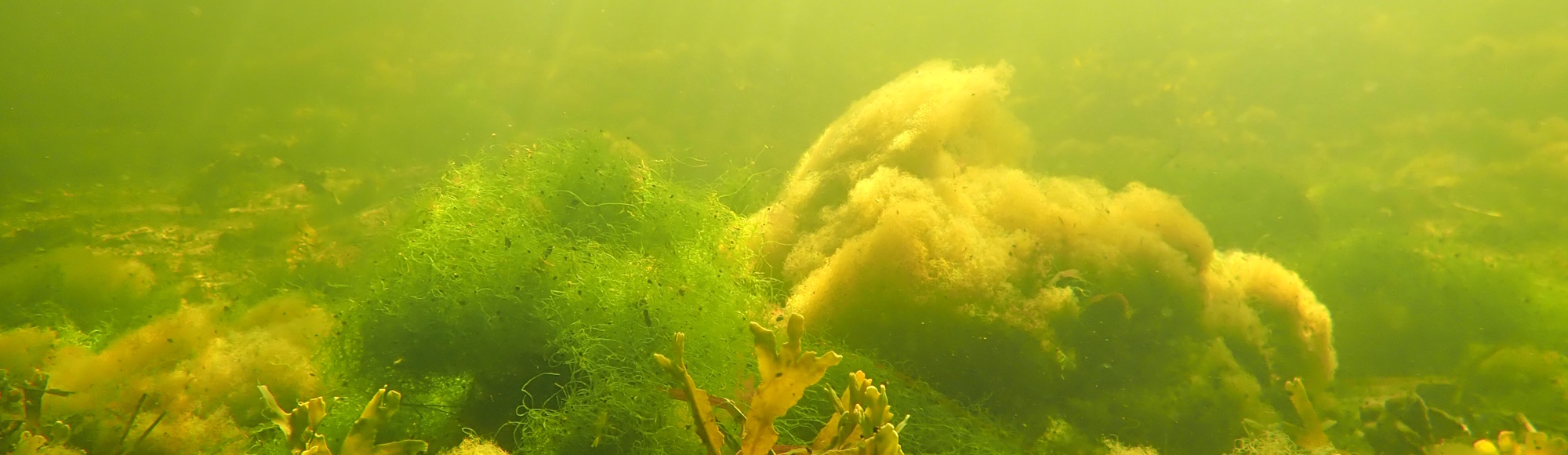
Warmer seas are undermining Denmark’s environmental efforts
Forty years ago, Denmark introduced a series of plans designed to restore marine ecosystems. Today, however, the situation is worse than ever. What went wrong? According to new research, rising temperatures may have changed everything.
A paradox: Discharges of nitrogen and phosphorus into Danish waters have fallen sharply since the 1980s, when oxygen depletion first emerged as a widespread environmental concern. Yet oxygen depletion has never been as extensive as it is today.
According to marine ecology professors Erik Kristensen and Mogens Flindt, the explanation is that temperature has been overlooked. Danish waters have warmed by 2.2°C since 1980—a shift with a major impact on the formation of oxygen depletion.
“Warmer seawater allows algae to grow faster and spread more widely. At the same time, decomposition at the seabed accelerates by around 25%, which amplifies oxygen depletion,” says Erik Kristensen, “Nutrients are also released more quickly and recycled back into the system. This means that the same amount of nutrients causes greater damage today than it did in the past.”
Nitrogen remains the lever we can still adjust
In a review article in Marine Pollution Bulletin, the researchers warn of a potential “death spiral,” where oxygen depletion could push Danish marine ecosystems beyond recovery unless action is intensified.
Since the first water environment plan in 1987, Denmark has cut phosphorus discharges by 80% and nitrogen by 45%. The goal was to curb the oxygen depletion that began plaguing coastal waters in the 1980s.
But climate change has shifted the baseline. While rising temperatures cannot be reversed in the short term, nutrient inputs can still be reduced. Phosphorus levels are already so low that further gains are limited. Nitrogen, however, remains a key lever. Annual nitrogen discharges have hovered around 60,000 tonnes since 2005.
How rising temperatures accelerates oxygen depletion
Heat affects all living organisms — especially ectothermic ones whose metabolism is regulated by temperature. Algae are ectothermic, and warmer seawater speeds up their metabolism, allowing them to grow faster. When the algae die and sink to the bottom, bacteria will break them down. These bacteria are also more active in warmer water. They consume oxygen while converting organic matter into nutrients such as ammonium, nitrate and phosphate—fuel for new algal growth. The result is a self-reinforcing cycle: more algae, more decay, and more oxygen consumption. Crucially, the oxygen used up at the seabed is not replenished, leading to oxygen depletion in bottom waters.
Current agreement is not enough
Under the current green tripartite agreement, Denmark aims to cut this by 14,000 tonnes per year.
“That is not enough,” says Kristensen. “It will help in many areas, but fjords will remain heavily impacted. In my view, we need cuts that are twice as large—and possibly three times as large as temperatures keep rising in the coming decades.”
So where should the cuts come from?
“Primarily agriculture, which accounts for about 70% of nitrogen load,” he says.
Wastewater treatment plants also contribute, but according to the researchers, their share is comparatively small—around 10%.
Fewer pigs may help Denmark’s seas
The issue is closely linked to agricultural policy. A recent government plan suggests that Denmark’s pig production should be scaled back to focus mainly on domestic consumption and value-added exports.
Such a shift could have significant environmental implications. Denmark currently produces about 30 million pigs annually, exporting roughly 17 million of them. Fewer pigs would mean less manure—and potentially less nitrogen runoff. But the impact is uncertain.
“If fewer pigs lead to less manure being spread and less intensive feed production, the effect could be significant. But if crop production continues unchanged, the gains may be limited,” Kristensen notes.

Climate change may also bring more frequent storms, which can temporarily oxygenate marine waters.
“Storms can provide short-term relief,” Kristensen says. “But they cannot solve the problem. To make a real difference, we would need a summer storm every week from July to October—and that is simply not going to happen.”
Meet the Researcher
Erik Kristensen is a professor of marine ecology at the Department of Biology. His work focuses on restoring coastal ecosystems and their ecological health, with particular attention to Odense Fjord and the Gyldensteen Coastal Lagoon on North Funen. His research is supported by the Aage V. Jensen Nature Foundation, the Municipality of Odense, and the Municipality of North Funen.