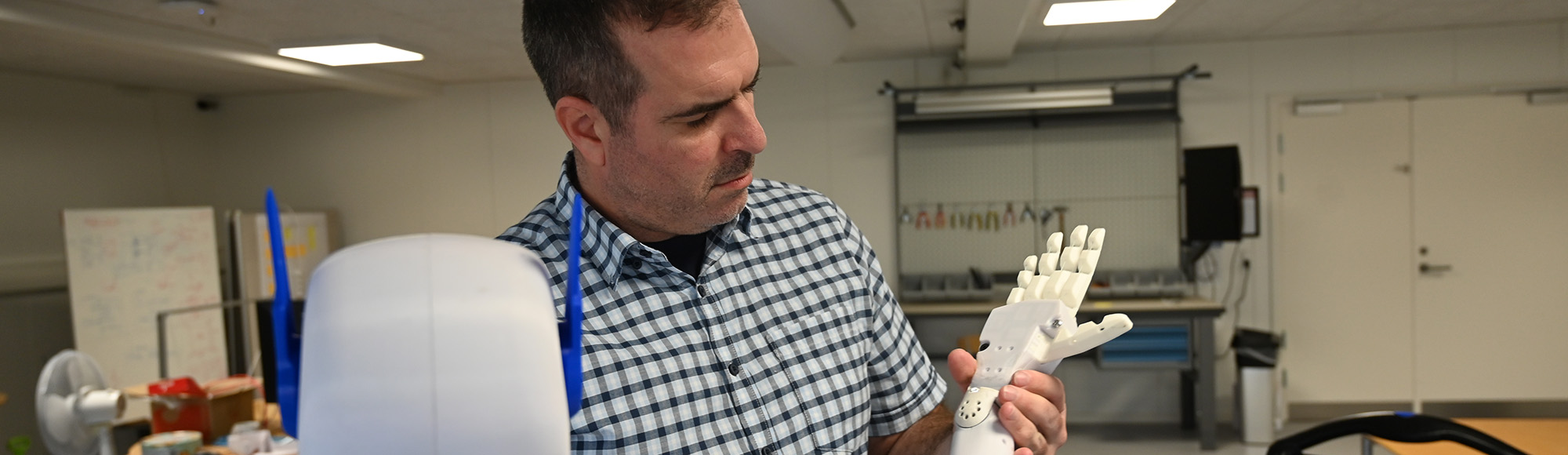
New research project to bring humanoid robots to Denmark
Researchers from the University of Southern Denmark (SDU), together with Novo Nordisk, Harting and several other partners, aim to develop a humanoid robot capable of taking over, for instance, repetitive and hazardous tasks in industry.
Denmark has a strong robotics sector and is globally leading in collaborative robots, the so-called cobots. But when it comes to humanoid robots, the story is rather different. Only small and sporadic attempts have been made with humanoid robots in Denmark.
A new research project at the University of Southern Denmark (SDU) called RobOdin aims to change that.
Together with Danish company Novo Nordisk and German firm Harting, researchers from SDU Robotics – alongside colleagues from Kiel University, University of Lübeck, University of Applied Sciences Flensburg and German Research Center for Artificial Intelligence – will, over the next three years, develop and test a humanoid robot that can carry out various tasks in industrial companies, such as assembly work or basic laboratory tasks.
It is precisely this versatility that is the major strength of humanoid robots, explains Oskar Palinko, associate professor at the University of Southern Denmark and head of the project.
- A humanoid robot is essentially a universal tool. You can move it from one task to another without rebuilding it. That makes it more flexible and also more sustainable. Building a specialised robot for every single task simply isn’t veru sustainable, Oskar Palinko says.
- If the robot has two arms and a head, people also find it more natural to interact with. People expect something with a human shape to be able to communicate like a human, and that’s important if employees are to feel comfortable working alongside it.
A torso with arms and head
The precise design of the robot in the RobOdin project has not yet been determined. But the researchers know that they will focus on building a humanoid torso with two arms and a head, while the legs will initially be replaced by wheels.
- Walking robots are technically possible, but beyond the scope of this project. We’ll be focusing on what the industry is asking for right now: strong, precise arms that can handle objects, says Oskar Palinko.
Building a humanoid robot is a technically complex task, but according to the researcher, there has been tremendous progress in areas such as artificial intelligence and actuator technology, which has made humanoid robots significantly better in just the past five years.
The researchers will build on existing technologies and on experiences from previous research projects – in particular, the Hospibot project, which focused on developing a series of assistive robots for the healthcare sector.
- We expect to have a functional prototype within one to two years, and then the robot will be tested in companies during the final phase of the project. The idea is that this could be a first step towards humanoid robots in Denmark, says Oskar Palinko.
Asked whether the humanoid robot developed by the Danish and German researchers will even be competitive with, for example, Tesla’s Optimus robot, the project leader replies:
- We can’t compete with the major companies in terms of resources, but we can differentiate ourselves through specialised functions. Our robot will have tactile sensing in the hands, strong interaction capabilities, and a friendlier, more human-like expression than many existing humanoids.
Meet the researcher
Oskar Palinko is an associate professor at SDU Robotics under the Maersk Mc-Kinney Moller Institute. Here, he particularly researches in human-robotic interactions and in mobile robots for, among other things, the health care sector.