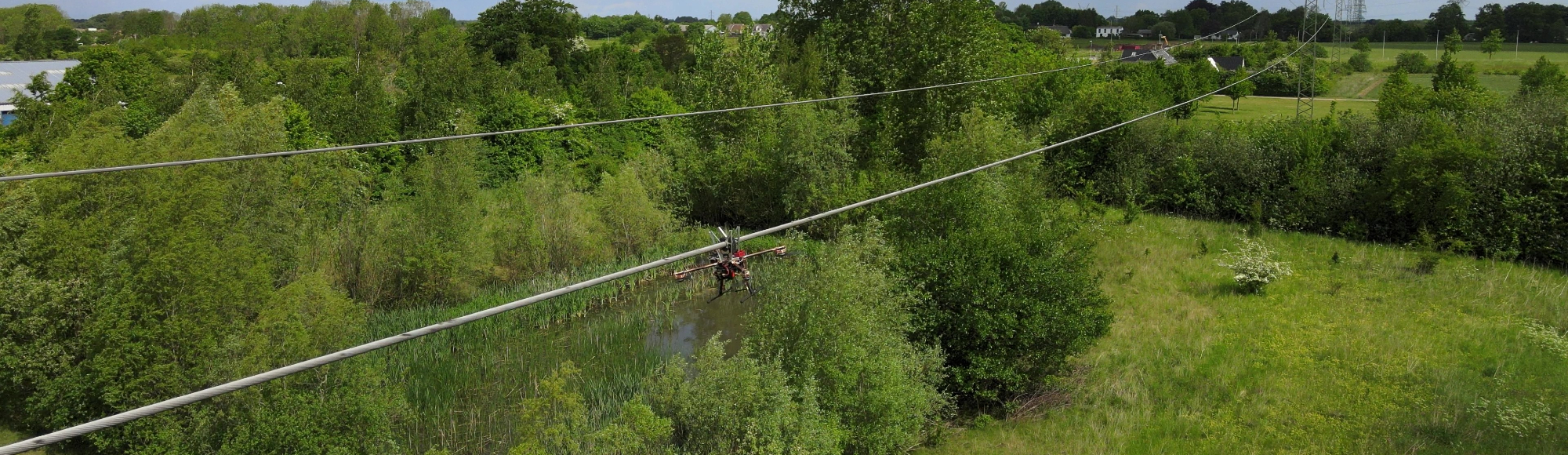
SDU charges drone on high voltage-line
Researchers from the Drone Center at SDU have for the first time in the world succeeded in connecting a drone directly to a high-voltage line with 150,000 volts in a test in central Odense, where it has taken new energy for its battery from the line.
Researchers from the Drone Center at SDU have for the first time in the world succeeded in connecting a drone directly to a high-voltage line with 150,000 volts in a test in central Odense, where it has taken new energy for its battery from the line.
The result opens for the use of drones for both inspection and other tasks directly on the 7000 km of high voltage lines. Thus, the national grid can be utilized to a greater extent than today, which can be of decisive importance for the green transition and the expansion of e.g. the wind turbine area in Denmark.
The result opens for the use of drones for both inspection and other tasks directly on the 7000 km of high voltage lines. Thus, the national grid can be utilized to a greater extent than today, which can be of decisive importance for the green transition and the expansion of e.g. the wind turbine area in Denmark.
Error while rendering view [GenericLinkList].
Meet the researcher
Emad Samuel Malki Ebeid has a PhD. from The University of Verona in Italy and is now an Associate Professor at the SDU UAS Centre at the Maersk Mc-Kinney Moller Institute. His area of research interests includes intelligent system design and heterogeneous embedded systems for aerial robotics. He is a Senior IEEE member and the project leader of the IFD Drones4Energy and EU H2020 Drones4Safety projects.