SDU research to help make global shipping greener
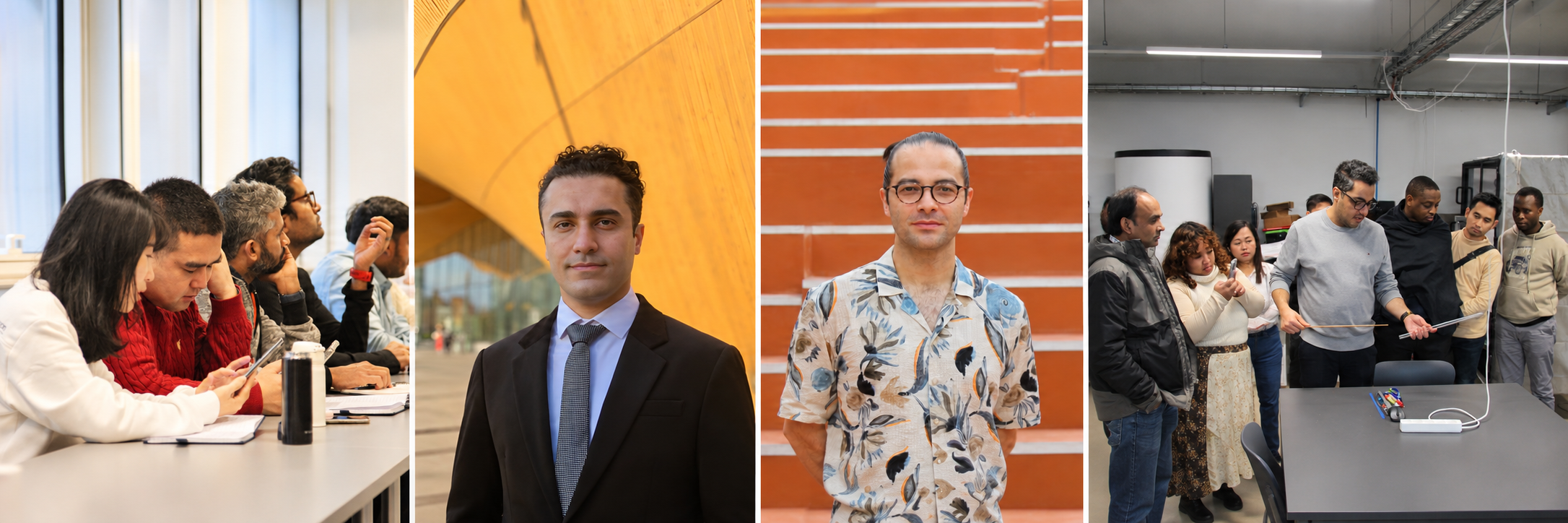
Maritime professionals from seven countries are visiting Denmark to learn how ships can use less energy and operate on greener fuels. Researchers at the University of Southern Denmark are sharing knowledge that participants can turn into practical solutions in their home countries.
The global shipping industry faces a major green transition. Around 80 per cent of world merchandise trade by volume is transported by sea, and reducing the sector's climate impact will require both alternative fuels and more efficient use of energy on board. But the solutions do not always have to be expensive or technologically complex.
That is one of the messages from researchers at the Faculty of Engineering at the University of Southern Denmark (SDU), who are sharing their expertise with maritime professionals from Ghana, Kenya, India, China, the Philippines, Indonesia and Ukraine.
The participants are visiting Denmark as part of a three-week learning programme under the Danida Fellowship Centre, bringing together universities, maritime educational institutions and industry partners to explore solutions to shipping's climate challenges.
At SDU, researchers associated with the Maritime Centre are contributing expertise in energy efficiency, energy systems and future green fuels.
Greener ships do not always require new technology
A modern ship is a complex energy system. Engines, electricity generation, heating, cooling and numerous auxiliary systems consume and exchange energy as the vessel operates under constantly changing conditions.
Improving the efficiency of a single engine or component does not necessarily make the entire ship more energy-efficient.
This is one of the challenges highlighted by Baris Burak Kanbur, a researcher in maritime energy systems at SDU, who has taught the international participants about energy efficiency and energy modelling.
"One of the biggest challenges is that ships are complex energy systems, where propulsion, electricity, heating, cooling, and auxiliary systems are strongly interconnected. Improving the efficiency of an individual component does not necessarily mean improving the efficiency of the entire ship," he explains.
The work can, in some respects, be compared to an energy assessment of a house, where specialists examine whether heat is escaping through draughty windows, poor insulation or inefficient installations.
On a ship, however, the task is considerably more complex. Using thermodynamic analyses, computer models and operational data, researchers investigate how energy flows through the vessel's systems, where losses occur and how energy can be used more effectively.
This knowledge can help identify opportunities to recover waste heat from engines and improve the integration of onboard systems.
According to Baris Burak Kanbur, the potential is significant.
"Improving energy efficiency does not always require developing new technologies or making major investments. Sometimes, significant opportunities can be identified simply by understanding existing energy flows, operational conditions, and interactions between systems," he says.
This is an approach that participants can take back to their home countries and apply to existing ships and maritime operations.
Making future fuels more affordable
Even if ships become considerably more energy-efficient, international shipping will still require large amounts of energy.
While batteries can provide a solution for shorter routes, direct electrification is much more challenging for long-distance shipping. This is why researchers are exploring alternative fuels such as green methanol and ammonia.
At SDU in Sønderborg, researchers are working with Power-to-X technologies, which use renewable electricity to produce fuels and other energy carriers that can replace fossil-based alternatives.
Ali Khosravi, a researcher in energy systems at SDU, sees considerable potential in these technologies, but also points to significant barriers.
"The main challenges are currently the high production costs, limited availability of green fuels, and difficulties in scaling up production and infrastructure," he explains.
At SDU, researchers are developing advanced modelling and optimisation methods to make green fuel production more efficient, flexible and economically viable.
Their work includes exploring how fuel production can be better integrated with renewable electricity, energy storage and other parts of the energy system.
From university research to the Power-to-X facility in Kassø
On Wednesday 18 November, the programme includes a session at SDU in Sønderborg, with Ali Khosravi and Fatemeh Mirsafi responsible for teaching about Power-to-X and alternative fuels.
The programme also includes a visit to European Energy's Power-to-X facility in Kassø, near Aabenraa. The facility is the world's first large-scale commercial e-methanol production plant, offering participants an opportunity to see how green fuel technologies are being deployed on an industrial scale.
According to Ali Khosravi, connecting academic research with practical applications is particularly important.
"Although our case studies focus primarily on Danish energy systems, the methodologies and findings are highly relevant internationally," he says.
"We hope participants will learn how integrating renewable electricity, fuel production, energy storage, and different energy sectors can improve the economic and environmental performance of Power-to-X systems."
The aim is to help participants adapt these approaches to the renewable energy resources, infrastructure, economic conditions and regulatory frameworks of their own countries.
Turning knowledge into action
The international learning programme runs from 9 to 27 November and includes lectures, workshops and visits to Danish companies, public authorities and research institutions.
Maritime Research Alliance is a key partner in delivering the programme under the Danida Fellowship Centre. The objective is not simply to provide participants with new knowledge. They are also expected to develop concrete action plans outlining how they intend to apply what they have learned when they return to their organisations. These plans will subsequently be followed up through online sessions.
For Baris Burak Kanbur, an important goal is to provide participants with methods they can apply under very different conditions.
"Different countries have different maritime needs and resources, but the fundamental principles of thermodynamics and systems thinking are applicable everywhere," he says.
"I would be happy if participants could take this perspective back to their home countries and apply it to their own maritime challenges, whether through research, education, ship operations, or collaboration with industry."
In this way, knowledge developed and shared at SDU could help support the green transition of shipping far beyond Denmark.