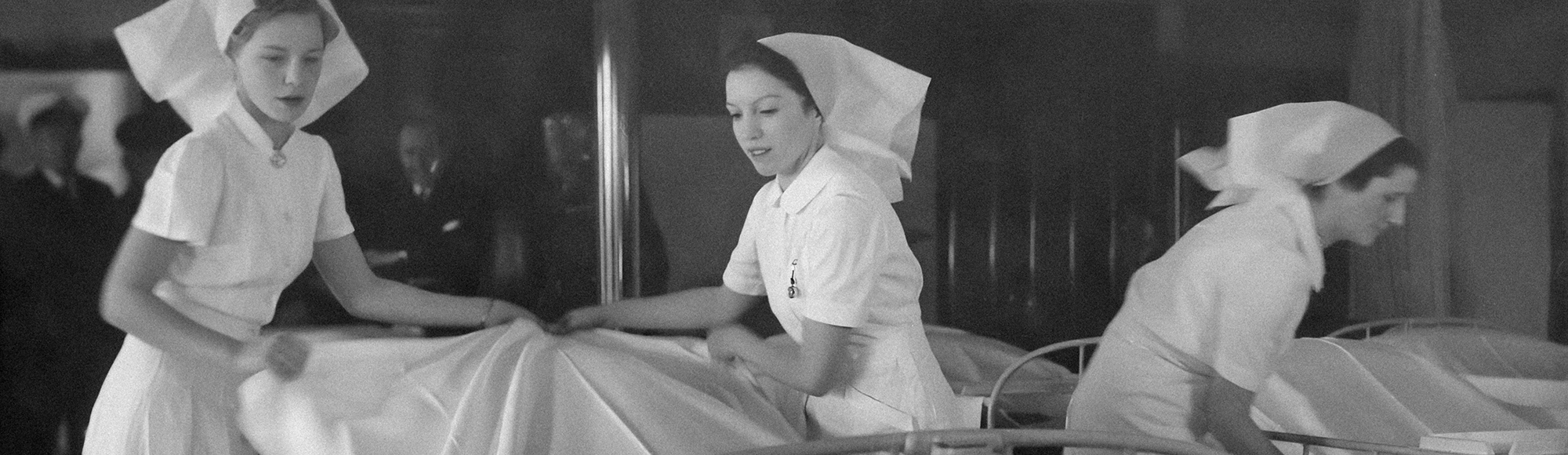
Newly qualified nurses and midwives have higher rates of long-term sickness absence
Hospital-based nurses and midwives have higher rates of long-term sickness absence and are more frequently diagnosed with back disorders than similarly aged graduates with the same level of education working in other sectors – even during their first years in employment. This is shown by a new study from the University of Southern Denmark and the National Research Centre for the Working Environment.
The early years of working life differ for newly qualified nurses and midwives working in hospitals and comparable graduates working in other sectors. Louise Schubert Paaske, PhD student in health economics at the Danish Centre for Health Economics (DaCHE) at the University of Southern Denmark, and her colleagues have used Danish national registers to follow the graduates' health trajectories over their first six years in employment.
The study shows that hospital-based nurses and midwives have higher rates of long-term sick leave and are more frequently diagnosed with back disorders during the first four years. Around 13 per cent leave hospital work within six years, and the analyses show increasing health problems in the period leading up to their departure and improvements in some health outcomes afterwards.
Differences emerge early
The study follows newly qualified graduates from their first job and for six years thereafter. This distinguishes it from much of the existing research in the field, which has examined employees later in their working lives.
This is an important distinction because employees experiencing strain or health problems may already have moved to another sector or left the labour market altogether by that point.
– We can see the differences as early as the first years in employment, long before we can talk about the effects of wear and tear over a long working life. Precisely because these newly qualified employees are at the beginning of their working lives, even a modest increase in long-term sickness absence and early departure from hospital work could have consequences over an entire career, says Louise Schubert Paaske.
Three questions for Louise Schubert Paaske about the study
What are you investigating in the study?
We investigate whether hospital-based nurses and midwives experience different health trajectories early in their careers compared with similar people of the same age working in other sectors.
What is the most important finding?
Hospital-based nurses and midwives have higher rates of long-term sickness absence and more diagnosed back disorders than people of the same age working in other sectors. Around 13 per cent leave hospital work within six years, with health problems increasing in the period leading up to their departure and some health outcomes improving afterwards.
What can the results be used for?
The results suggest that focusing on the first years after graduation may help hospitals retain more nurses and midwives.
The researchers compared newly qualified nurses and midwives who began their careers in hospitals with newly qualified graduates with the same level of education who started working in 36 other sectors.
The final analysis included 8,752 people. Among other factors, the groups were matched by age, gender, ethnicity, marital status, number of children, municipality of residence, timing of their first job and use of healthcare services before entering employment.
More sickness absence and more back disorders
During the first four years, hospital-based nurses and midwives had a higher annual likelihood of both long-term sick leave and diagnosed back disorders than the comparison group.
The difference was up to 2.8 percentage points per year for long-term sickness absence and up to 0.6 percentage points for diagnosed back disorders.
After around four years, the differences between the groups became smaller. However, this does not necessarily mean that the health of the hospital-based nurses and midwives improved.
To examine this development more closely, the researchers looked at the nurses and midwives who left hospital work during the follow-up period.
Some nurses and midwives with health problems leave hospital work
Around 13 per cent of the hospital-based nurses and midwives left hospital work during the six-year period.
A supplementary analysis shows that long-term sickness absence and recorded mental health problems increased in the period leading up to their departure from hospital work and declined again afterwards.
– When the differences become smaller after a few years, we cannot simply conclude that the health of those working in hospitals is improving. Part of the explanation may be that employees with health problems gradually leave hospital work, says Louise Schubert Paaske.
This also means that studies looking only at people who remain in hospital work may present an overly positive picture of how their health develops.
However, the analysis cannot show that leaving hospital work in itself leads to better health. It describes developments before and after leaving but cannot establish what causes the changes.
Less treatment does not necessarily indicate better mental well-being
In one respect, the results initially appear to point in the opposite direction. Hospital-based nurses and midwives were less likely than the comparison group to have recorded use of healthcare services and treatment related to mental health conditions. This included talking therapy with a general practitioner, medication, psychological treatment and psychiatric treatment.
According to the researchers, this finding should be interpreted with caution.
The study is based on register data, meaning that the researchers do not measure participants’ mental well-being directly. They can see whether a person has a recorded diagnosis or has received certain types of treatment, but they cannot identify psychological strain that has not resulted in contact with the healthcare system or a recorded diagnosis.
– The lower use of treatment and healthcare services should not be interpreted as evidence that hospital-based nurses and midwives have better mental health. The higher level of sickness absence may, among other things, reflect psychological strain that has not yet resulted in a recorded diagnosis or treatment, says Louise Schubert Paaske.
The result therefore primarily tells us about recorded use of healthcare services and treatment, rather than whether hospital-based nurses and midwives generally have better or poorer mental well-being.
The study follows newly qualified graduates from their first job
The study is based on nationwide Danish register data. The researchers identified people who completed a bachelor’s degree and entered employment no later than 180 days after graduation between 2010 and 2015.
Participants were followed for six years. The researchers compared developments in areas including long-term sick leave, diagnosed back disorders and recorded use of healthcare services and treatment related to mental health problems.
The study was designed to ensure that the groups were as comparable as possible, but the researchers cannot rule out all differences between people who choose different professions and workplaces. Register data also have the limitation that they can only provide information about health conditions that are actually recorded.
Furthermore, the results concern the first six years in employment for the groups included in the study and cannot automatically be generalised to all nurses and midwives working in hospitals.
The first years may be important for retention
The study was conducted in collaboration between the Danish Centre for Health Economics (DaCHE) at the University of Southern Denmark and the National Research Centre for the Working Environment (NFA).
By following employees from the very beginning of their working lives and continuing to follow them if they leave hospital work, the study provides a different perspective on the relationship between work and health compared with studies of employees later in their careers.
According to the researchers, the results suggest that the first years after graduation are an important period to focus on if hospitals are to retain more nurses and midwives.
– The results do not in themselves tell us which specific conditions in hospitals need to change. But they do suggest that it is important to focus on the first years after graduation if more nurses and midwives are to remain in hospital work, says Louise Schubert Paaske.
About the study
Method
The study is based on nationwide Danish register data and follows newly qualified graduates who entered the labour market between 2010 and 2015. Using a target trial emulation framework, hospital-based nurses and midwives were compared with newly qualified graduates with the same level of education who began their careers in 36 other sectors. The final analysis included 8,752 people, who were followed for six years.
The study was conducted by researchers from the Danish Centre for Health Economics (DaCHE) at the University of Southern Denmark and the National Research Centre for the Working Environment (NFA).
Funding
Helsefonden, Lån & Spar Fonden
Read the study
Health trajectories of early career hospital nurses and midwives compared to other graduates in Denmark by Louise Schubert Paaske, Nicolai Simonsen Damslund, Anne Helene Garde, Ann Dyreborg Larsen and Kim Rose Olsen is published in Communications Health: DOI: 10.1038/s44528-026-00023-4
Meet the researcher
Louise Schudert Paaske, PhD and academic staff at DaCHE - Danish Centre for Health Economics at Department of Public Health.