New project to restore polluted lakes and recycle phosphorus
With DKK 22.1 million in funding from Innovation Fund Denmark, Kasper Reitzel from the Department of Biology will lead the development of a new restoration technology designed for use in Danish lakes.
Lakes are among the most heavily impacted ecosystems in Denmark and across Europe. Although nutrient inputs to many lakes have been reduced, phosphorus-rich sediments continue to release nutrients into the water. The result is murky water, algal blooms, biodiversity loss, and greenhouse gas emissions.
A new project, RESTORE, will now demonstrate a sustainable and circular solution that can restore the ecological condition of lakes, reduce their greenhouse gas emissions, and recycle valuable resources for agriculture.
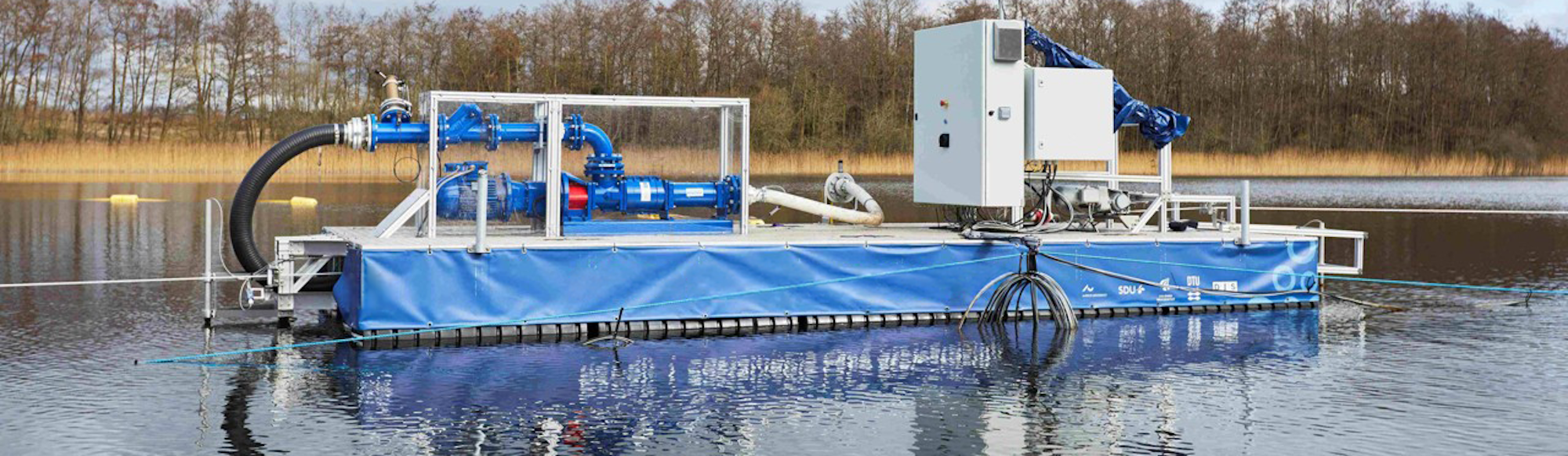
RESTORE will develop a sediment removal system known as the Lakebot (in Danish søbot), designed to remove nutrient-rich surface sediments more gently and efficiently than existing solutions.
Prototype was tested in Lake Ormstrup
The lakebot will build on a prototype tested in Lake Ormstrup in 2024 by Kasper Reitzel and colleagues.
Read more about that work in the SDU article:“Denmark’s Lakes Have Been Damaged by Phosphorus. Can Lake Robots and Hemp Help?”
The lakebot technology is designed to minimize sediment disturbance during operation, while also being adaptable to different lake types and local conditions. The goal is to reduce impacts on lake ecosystems and improve the collection of sediment for subsequent treatment and recycling.
Full scale in three lakes
“We are facing a major societal challenge, as many lakes are burdened by decades of accumulated nutrients. With RESTORE, we are developing a solution that not only restores the ecological balance of lakes but also makes it possible to recycle phosphorus as a valuable resource. This could create a new paradigm for lake restoration in Denmark and internationally,” says Kasper Reitzel.
As part of the project, sediment will be removed at full scale from three Danish lakes. Researchers will monitor the lakes before, during, and after the restoration work to document the effects on water quality, biodiversity, and greenhouse gas emissions.
At the same time, the project will investigate how the collected sediment can best be treated and reused as phosphorus fertiliser in agriculture. This includes testing whether industrial hemp can reduce levels of contaminants and heavy metals through phytoremediation. This was also covered in our SDU article “Denmark’s Lakes Have Been Damaged by Phosphorus. Can Lake Robots and Hemp Help?”
Potential for a new company and international roll-out
In the longer term, the ambition is to lay the foundation for a new company that can offer sustainable lake restoration as a complete service. The potential is considerable. Denmark alone has more than 100,000 lakes and ponds, while similar challenges affect millions of lakes across Europe.
The project brings together researchers and companies with expertise in environmental technology, lake ecology, sediment management, and commercialisation. Together, the partners will document the entire value chain, from sediment removal and improvements to aquatic environments to resource recycling and the development of new business models.
Project title: Sustainable Lake Restoration by Sediment Dredging and Nutrient Recycling
Partners: University of Southern Denmark (project lead), Aarhus University, WOLFF, Dansk Ingeniør Service (DIS), DALGAS, and AMINORD.
This article is based on a press release from Innovation Fund Denmark.
Meet the researcher
Kasper Reitzel is a biologist and professor at the Department of Biology. He is interested in interdisciplinary collaborations that can help deliver cleaner lakes in Denmark while safeguarding critical resources such as phosphorus. Supporters of his research include the Ministry of Environment and Food of Denmark, SEGES Innovation, the Green Tripartite Agreement, the Odense Fjord Partnership, the Poul Due Jensen Foundation, EU Horizon Europe, and Innovation Fund Denmark.