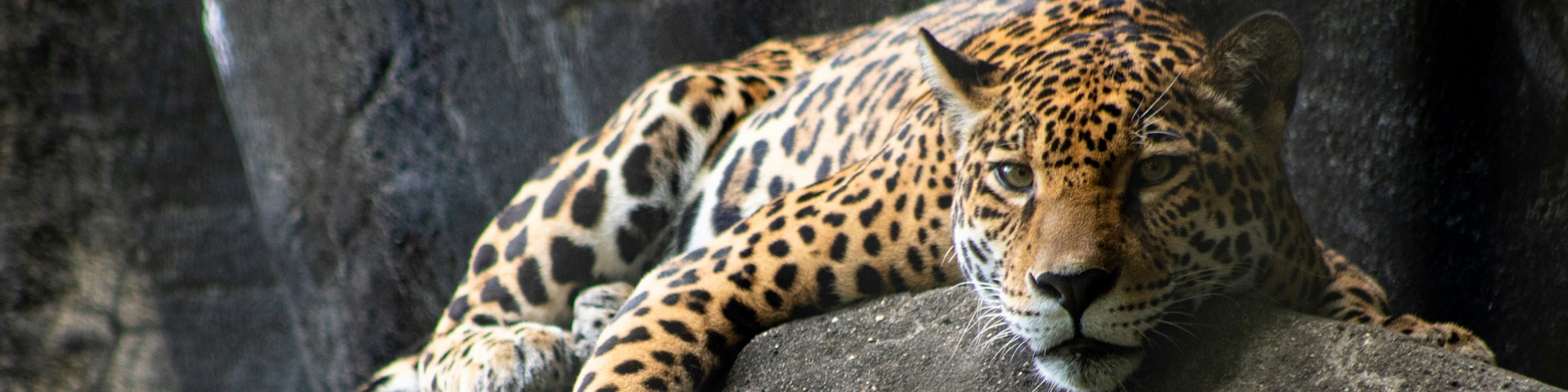
Where can jaguars still roam?
The largest study of its kind reveals where jaguars remain connected and where populations are becoming isolated.
Jaguars have lost about half of their historical range.
A new study shows where the species' remaining strongholds are and where the landscape corridors linking them are under threat.
According to the study, jaguars today can roam freely in a vast 6.5 million square kilometres connected landscape stretching across 11 countries and four of South America's most important ecological regions; the Amazon, Llanos, Pantanal and Chaco. It is one of the last places where a large cat still moves freely at continental scale.

Broken connections
Elsewhere the outlook is worse. Populations in Mexico and Central America are split by gaps in corridors and jaguars in Brazil's coastal Atlantic Forest appear almost entirely cut off.
The study is published in Global Change Biology. First author is Guilherme Costa Alvarenga, Oxford University and Mamirauá Institute for Sustainable Development. It was co-led by conservation biologists Samuel Cushman, Caroline C. Sartor and Żaneta Kaszta. When the work was done, Samuel Cushman and Caroline C. Sartor were at University of Oxford and Żaneta Kaszta was at Northern Arizona University. Cushman is now a Professor, Sartor a postdoc and Kaszta an Assistant Professor at Department of Biology, University of Southern Denmark. Together they guided an international team of more than 40 researchers.
The team used GPS data from 172 collared jaguars to model how the animals move from Mexico to Argentina. It is the first range-wide jaguar connectivity map built on real movement data, and it relies on connectivity modelling methods Cushman has developed over two decades.

Landscape corridors are crucial
The study identified 307 core living areas covering about 7.75 million square kilometres, roughly the size of Australia, and about half of that area is protected.
The team’s goal was to map where and how the jaguar habitats are connected by landscape corridors, as such corridors are crucial for the individual animals and populations to move and connect with each other.
The researchers ranked 176 corridors between core living areas and 507 potential landscape corridors among 905 protected areas and indigenous lands, highlighting locations where conservation action could strengthen future connectivity.

The money must go where it counts
“The purpose of this ranking is to allow limited conservation funding to go where it counts”, says Żaneta Kaszta.
Sam Cushman adds:
"The Amazon heartland gives jaguars a chance most big cats have already lost. But a stronghold is not enough. Without landscape corridors, isolated populations slowly disappear”.
Landscape connectivity models have become increasingly central to conservation planning. As modelling techniques evolve and empirical data become increasingly available, researchers can now incorporate species' distribution, abundance and dispersal capacity into movement rates, generating more biologically realistic measures of connectivity.
Such models have for example revealed critical connectivity challenges for tigers in Southeast Asia, bears in Iran and lions in Africa.
Meet the researcher
Sam Cushman is a professor at Department of Biology and Chair at Danish Centre for Advanced Study. He is co-leader of the Carlsberg Foundation-funded Danish Centre for Eco-Recovery.