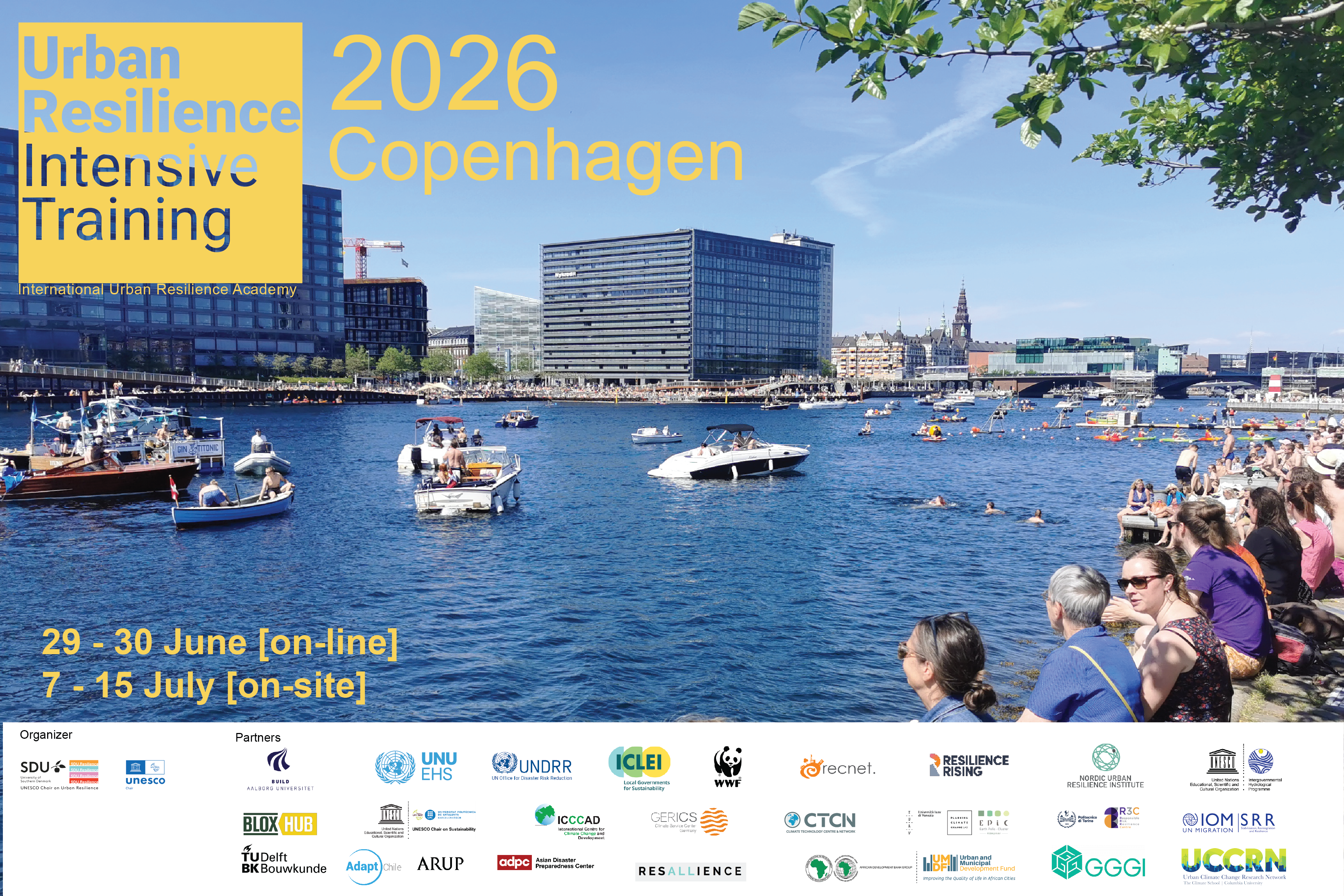
Urban Resilience Intensive Training 2026
29 – 30 June (Theoretical online training part: 3 hours per day)
7 – 15 July (Intensive Training - in person, at the venue in Copenhagen)
Copenhagen
Call for Participation!
The Urban Resilience Intensive Training (URIT) 2026 brings together policymakers, practitioners and researchers for online session between 29 – 30 June 2026 and in Copenhagen between 7 July and 15 July 2025. URIT aims to expand the participants' knowledge on policies, tools, strategic and action planning for resilient urban transition, integrating climate mitigation and adaptation, for a just and green transition.
URIT brings together transdisciplinary knowledge and perspectives on urban resilience from science, policy, and practice. URIT aims to build skills and competencies to tackle global challenges in the Global South and North. Through a system thinking approach, the program focuses specifically on core topics such as climate change and resilience analysis, future scenarios, strategic and action planning; as well as cross-cutting topics such as ecosystem services, multi-level governance, nature-based solutions, disaster risk reduction and participation. The highly interactive programme includes keynotes from international speakers, peer-to-peer sessions among participants, field visits to best practices in Copenhagen and group work on specific cities worldwide.
Download the call for participation here
Urban Resilience Intensive Training 2026
Today over 50% of the world population lives in urban areas, and cities account for 60-80% of global energy consumption and the same level of greenhouse gases emissions, producing 50% of global waste, consuming 75% of natural resources and producing 80% of global GDP.
Cities and their populations are vulnerable and increasingly exposed to rapid and slow on-setting climate and environmental disasters, which frequency and intensity are growing exponentially. Yet, cities are also major centres of economic activity, social life and culture, innovation and knowledge-creation.
Urban resilience aims to increase the ability of urban systems to respond systemically and dynamically to present and future shocks and stresses related to major global challenges as: unsustainable development patterns, rapid and unplanned urbanization, climate change mitigation and adaptation.
Urban resilience is instrumental in addressing both causes and effects of these major global challenges, re-thinking how cities are designed, planned and managed, and fostering innovation. The scientific research on urban resilience has been exponentially growing in the last decade, parallelly a growing number of cities worldwide started developing resilience-related plans and actions, following the recommendations and prescriptions national and international policies, as: Sustainable Development Goals, Paris Agreement, New Urban Agenda and Sendai Framework for Disaster Risk Reduction.
The key challenge for urban resilience is to co-develop and harmonize scientific and practice-led knowledge to support informed and science-based decision and policymaking, to enable our cities to evolve and innovate. Cities, both in the Global South and North, will need to re-think how they are designed, planned, managed, and lived. However, many lessons can already be distilled and can be used to strengthen the adaptive capacities of cities to face multiple and even concurrent global crises.
The training builds the core skills and competencies for urban resilient transition, including fundaments of urban resilience in research, climate science, international and national policies, and resilience in action. The participants will also acquire core competencies in system thinking, system dynamics, transition theory and transformative strategies/actions.
The training adopts a process design methodology, through which the participants will learn about system and stakeholder analysis methods, future scenarios (forecasting, visioning and backcasting), and strategic and action planning.
The training is funded on problem-based learning. The participants, divided into small groups, will respond to a specific challenge, applying specific tools and methods through a system thinking approach.
This year's challenge is focusing on just and green transition in the frame of climate change and how to enhance urban resilience through transformative strategies and actions.
The training will also focus on key cross-sectoral issues, such as multi-level governance, nature-based solutions, finance, appropriate technology, participatory processes and stakeholders' involvement, generation of co-benefits, urban metabolism, and circular economy.
The highly interactive programme includes keynotes from international speakers, peer-to-peer sessions among participants, field visits to best practices in Copenhagen and group work on specific cities worldwide.
- The basis of urban resilience and global challenges science, and research development in different disciplinary contexts.
- International policies (Sustainable Development Goals, Paris Agreement, New Urban Agenda and Sendai Framework for Disaster Risk Reduction).
- Urban resilience practices with specific case studies from cities worldwide, including strategic plans, action plans, and technological solutions.
- Cross-sectorial and thematic issues.
- System mapping & stakeholders’ analysis,
- Analysing current and future urban trends and drivers, at local and global level,
- Future scenarios methods: visioning and backcasting,
- Strategic and action planning.
Practitioners from the private and public sectors, including also non-profit organizations.
Policymakers from national and subnational governments and from international and intergovernmental organizations.
Scientists and Researchers from universities and research organizations, including PhD candidates, researchers and lecturers.
The course will be organised in two parts:
i) online (29-30 June, two days) and
ii) in person (7–15 July, seven working days) in Copenhagen.
Before starting the Urban Resilience Intensive Training, two days of online sessions of 23 hours (each day) will be organized to familiarize participants with the core fundamentals of urban resilience fundamentals, group formation and selection and discussion on case studies challenges that participants will be addressing during the training. Then, the seven days of intensive training are mainly organized with lectures, group work and field visits in Copenhagen. Upon the conclusion of the training, the participants will receive a Certificate of Participation, for which it is required to attend 80 % of the daily sessions, contribute to the group work and submit the required outputs.
The entire training, including lectures, group work and self-learning, is approximately 146 hours, equivalent to 5 ECTS.

LAUREN SORKIN
Executive Director, Resilient Cities Network
LinkedIn

ROBERTO ROCCO
Senior Associate Professor of Spatial Planning and Strategy, Delft University of Technology (TU-Delft)
LinkedIn
STELIOS GRAFAKOS
Principal Economist at the Climate Action and Inclusive Development Unit, Global Green Growth Institute (GGGI)

MARYKE VAN STADEN
Director of carbonn Climate Center - Local Governments for Sustainability (ICLEI)

SENAKA BASNAYAKE
Director of Climate Resilience, Asian Disaster Preparedness Center (ADPC)
LinkedIn

SANJAYA BHATIA
Head of the Global Education and Training Institute, United Nations Office for Disaster Risk Reduction (UNDRR)
LinkedIn

FRUZSINA STRAUSS
Head of the Disaster Risk Reduction Unit, United Nations Environment Programme (UNEP)
LinkedIn

MARTIN LEHMANN
Associate Professor and Lead of the Nordic Node of the Urban Climate Change Research Network (UCCRN), Aalborg University and UCCRN
LinkedIn

SIMONE SANDHOLZ
Head of FAST Division interim Head of WE Division United Nations University (UNU-EHS)
LinkedIn

CLARA CAMARASA
Senior Advisor UNEP Copenhagen Climate Center
LinkedIn

OMBRETTA CALDARICE
Politecnico di Torino
LinkedIn

ESTEBAN LEON
Head of City Resilience Global Programme (CRGP), UN-Habitat

MARÍA MÁÑEZ COSTA
Senior Research and Group Leader of the System Dynamics Group, Climate Service Center Germany – Helmholtz Centre Hereon
LinkedIn

BILL SOLECKI
Professor in Department of Geography and Environmental Sciences and Co-Chair of Urban Climate Change Research Network (UCCRN), Hunter College, City University of New York
LinkedIn

MARÍA ALEJANDRA MOLEIRO DALE
Research Associate, HafenCity University Hamburg

NICOLA TOLLIN
Professor wsr in Urban Resilience, Chairholder and Coordinator, United Nations Educational, Scientific and Cultural Organization (UNESCO) Chair on Urban Resilience (SDU.Resilience), University of Southern Denmark
LinkedIn
Course programme 7 – 15 July 2026 (in person).
Download In person programme
Download Online programme
REGISTRATION, FEE, AND PAYMENT
Urban Resilience Intensive Training 2026 welcomes middle and senior policymakers, practitioners, and scientists/researchers with different disciplinary backgrounds, including engineering, architecture, planning, environmental, economic and social sciences.
English language proficiency is required.
There is a limited number of places available. Inscription will be on first come first serve basis.
900 EUR - Regular fee*
600 EUR - Early bird fee**
300 EUR - Reduced fee***
Notes:
* apply before 25 June 23:59 CET
** limited seats available, apply before 30 April 23:59 CET
*** limited seats for participants from Least Developed Countries, apply before 5 May 23:59 CET. Applicants from nationals of and currently working in one of the Least Developed Countries (LDC) are eligible to apply under this category. Please refer to the United Nations' list of LDC countries. Upon registration, applicants must complete and sign an affidavit confirming the above-mentioned condition.
The registration fee includes:
- Participation in the course
- Site visits
- Coffee breaks
- Downloadable learning materials
- Participation diploma
- Welcome package
The registration fee does not include:
- Travel
- Subsistence (accommodation, meals, etc.)
- Visa expenses
Please go to this page for further information and registration
VISA
Applicants who require a visa to travel to Copenhagen should apply at least 2 months before the start of the in-person training. Therefore, applicants who need a visa must complete course registration before May 5 (23.59 CET).
Click here to check your eligibility for a visa.
For those applicants who don’t require a visa to travel to Copenhagen, the deadline for course registration will be June 25 (23.59 CET).
Registration for LDC applicants and regular fee applicants with visa requirement is open until May 5 (23.59 CET).
Once the registration is done, participants are responsible for visa application in their country; in case of visa denial the training fee will not be refunded.
Please follow the instructions in the registration procedure.
- For any question related to payment method and Course registration, please contact: Charlotte Kjær Bruun at cbp@iti.sdu.dk
- Upon completion of the registration process, if you have citizenship outside of EU, you should contact our International Staff Office at the University of Southern Denmark to determine if you need a short visa to enter Denmark. Kindly contact iso@sdu.dk as soon as possible, as the visa process can take up to two months from the beginning of the process till you get the visa issued.
- In terms of enquiries regarding course content, schedule, fee rate, etc. please contact IURA Organizing Committee Carl C. Anderson at ccy@iti.sdu.dk and Patrizia Gragnani at pgra@iti.sdu.dk
Partners
Organisers

 University of Southern Denmark (SDU)