AI-driven design of virtual microstructures
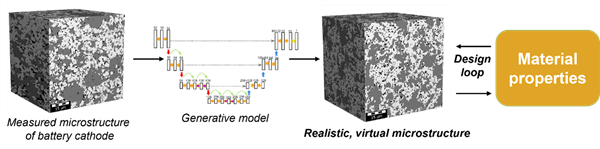
Thesis projects in this field explore the prospects of AI-driven microstructure design (e.g., in battery materials) by
- performing statistical image analysis on experimentally acquired microscopy data
- training generative adversarial networks (GANs) or interpretable generative models to create realistic virtual 3D materials
- designing structures with desirable properties (e.g., microstructures with improved electronic conductivity).
By combining structure modeling and AI, this project can help to create new materials more efficiently.
AI for 3D reconstruction from 2D images
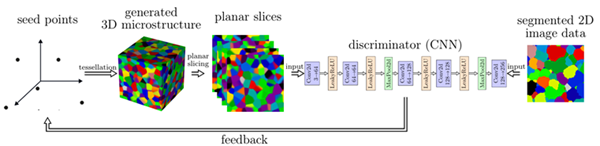
Thesis projects in this field deal with the adaptation of computational methods in Python that can reconstruct 3D structures from 2D projectional images. Models from generative AI will be trained to generate virtual 3D structures that exhibit realistic simulated 2D projections ⇒ reduction of experimental measurement efforts. Applications can range from remote sensing and microscopy to computer vision, where understanding of 3D structures is crucial.
Data-driven modeling of crystallographic orientations
- extracting crystallographic orientations from experimental diffraction-based image data and determining suitable embeddings of orientations that facilitate statistical
- applying machine-learning methods or probabilistic generative models to learn complex orientation distributions from image data
- correlating the orientations of grains with their size and shape
Probabilistic characterization of particle separation processes
Thesis projects in this field combine microscopy-based particle analysis with probabilistic modeling to understand how size, shape and composition of particles influence their behavior during mechanical separation processes such as sedimentation or filtration. The work involves developing probabilistic descriptions of how particle properties change throughout separation. By linking particle descriptors with separation outcomes, these projects help improve process design (e.g., recycling processes) and raw material utilization.