PAMSEN - Predictive Asset Management Smart Energy Network
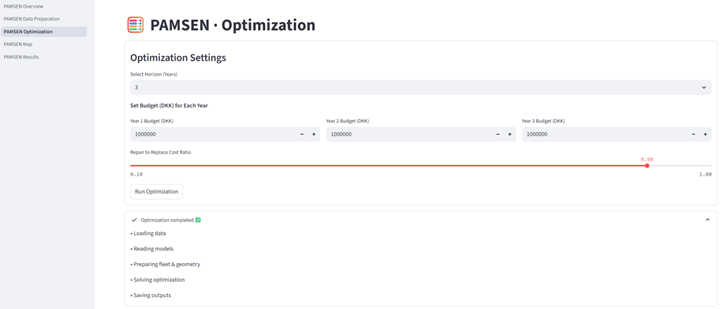
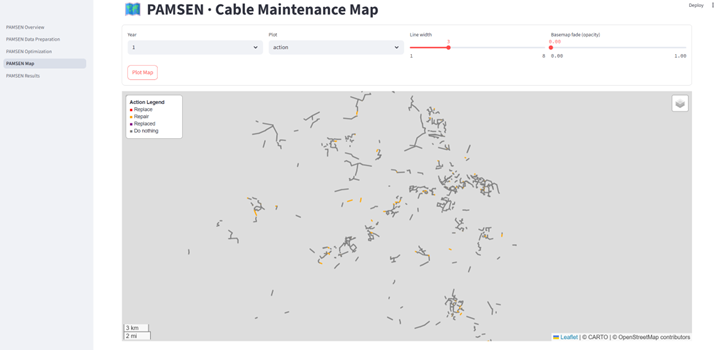
Developed as a case study in our lab, the Predictive Asset Management Smart Energy Network (PAMSEN) is a comprehensive decision-support application designed for multi-year, budget-constrained cable maintenance planning. By streamlining the ingestion and validation of GIS and asset register data, PAMSEN leverages a cutting-edge Neural Weibull Proportional Hazards (NWPH) model to accurately estimate per-cable failure risks. The application's core mixed-integer optimization engine uses these risk profiles to generate transparent, auditable renewal portfolios—recommending whether to repair, replace, or take no action—that minimize outage costs under strict annual budgets. Ultimately, PAMSEN balances financial constraints with key reliability indices (SAIDI, SAIFI, ASIDI), equipping users with interactive action maps, comprehensive performance KPIs, and exportable data to drive actionable, long-term grid resilience strategies.
Related publications:
Relative fault vulnerability prediction for energy distribution networks
SENOM - Smart Energy Network Operation & Maintenance
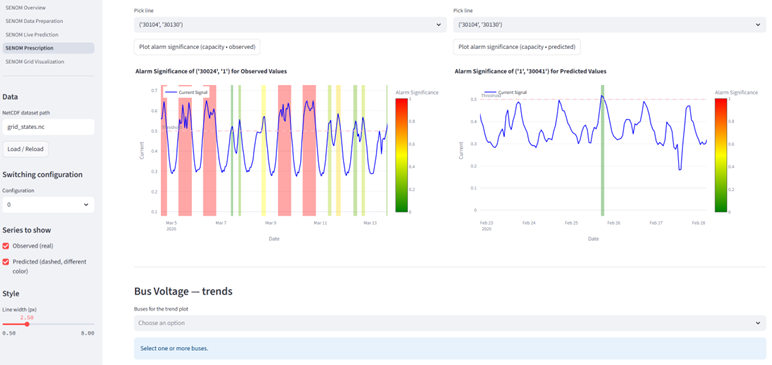
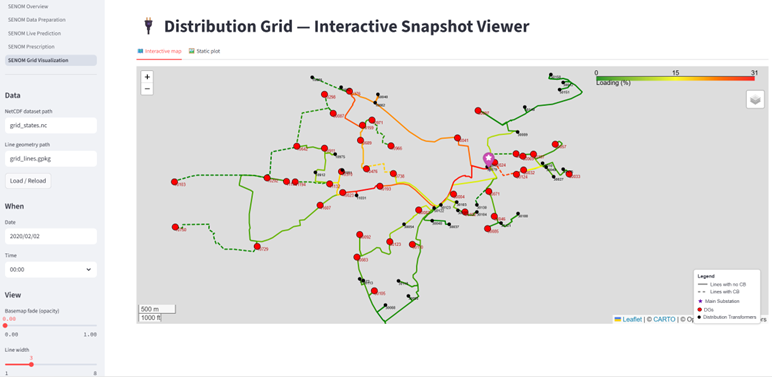
Another case study in our lab, SENOM is a browser-based operational toolset designed to translate short-term forecasts into concrete, consequence-aware actions for MV/LV distribution networks. The application provides a guided workflow to ingest and validate grid data, enabling operators to run asset-level load and distributed generation predictions via a powerful hybrid Transformer-KAN architecture. Consuming these one-hour-ahead forecasts, SENOM executes balanced power flows to identify network deviations, quantifying and ranking voltage or current alarm significance using a modified Chernoff-Bound scaled by the number of affected consumers. To mitigate these risks, a built-in prescription module leverages a Proximal Policy Optimization (PPO) algorithm—trained within a pandapower environment—to rapidly evaluate feasible radial topologies and recommend optimal switching actions. All insights, from live predictions to prescribed reconfigurations, are tied together in an interactive map interface, allowing users to visually explore line loadings, assess alarm significance, and make robust, data-driven operational decisions.
Related publications: