Interreg Deutschland-Danmark · 2023-2026
ARTEMIS
"We would like to, but …" Every company has a project that starts like that. For three years ARTEMIS handed exactly those projects to university students on both sides of the German-Danish border. More than 50 of them were finished. This page keeps what came out of it, and how to do it again.
DURATION: June 2023 - May 2026. INTERREG FUNDING: €1,551,963.
LEAD PARTNER: SDU, Sønderborg. PRIORITY: 1 Innovative region
DANSK VERSION - DEUTSCHE VERSION

The project
A bridge between classrooms and companies, across a border
The project ran from June 2023 to May 2026, funded by Interreg Deutschland-Danmark with co-financing from the European Union. It has now ended. The network it built between universities, business development agencies and companies has not.
“ARTEMIS aims to promote student innovation in small and medium-sized companies in the participating region, through tailored collaborations.” - Project mission, closing event 2026

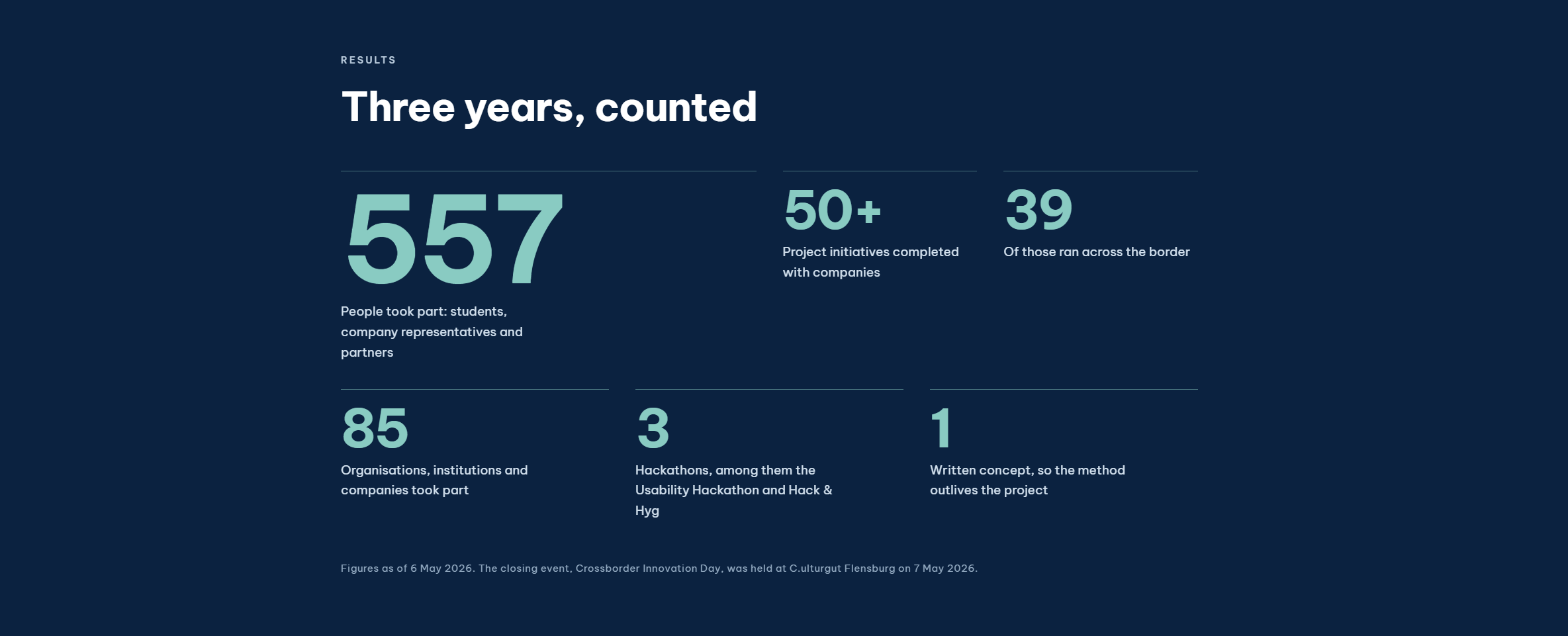
Results
Three years, counted
Figures as of 6 May 2026. The closing event, Crossborder Innovation Day, was held at C.ulturgut Flensburg on 7 May 2026.
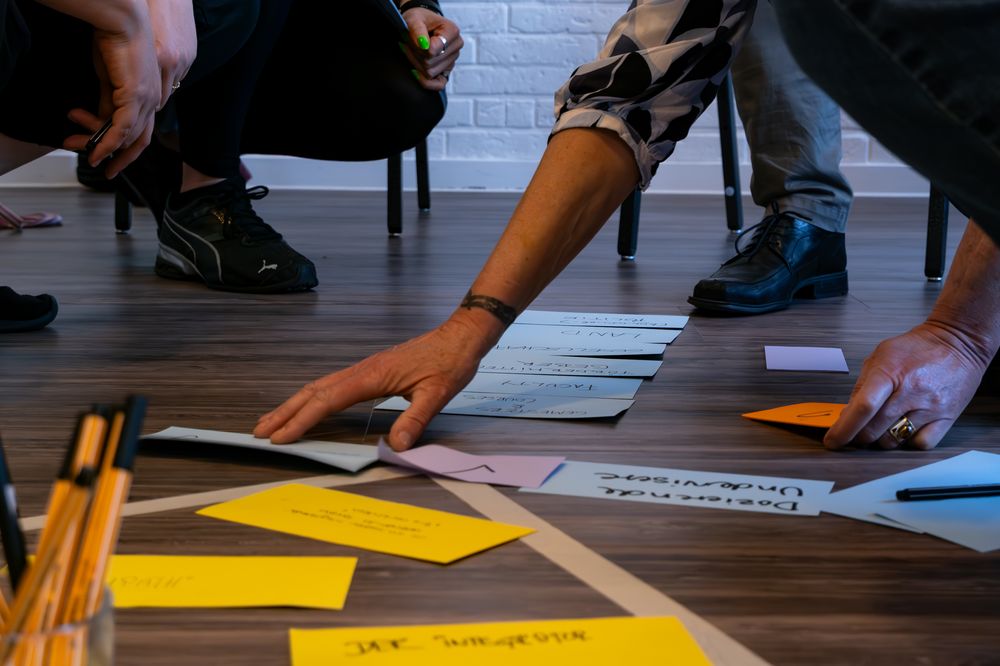
How it worked
Every collaboration followed the same nine steps
Nothing here is unique to ARTEMIS. This is the sequence any company and any university can follow.

Crossborder Innovation Day, Flensburg, 7. maj 2026
Before
Finding each other
– Matchmaking between company and university
– Preliminary screening of the idea
– Framing: turning the idea into a workable question
During
The work itself
– Kick-off and challenge definition
– Discover and define: the challenge space
– Develop and deliver: the solution space
– Delivery event, where the teams present
After
Closing the loop
– Feedback from company and students
– Evaluation of the initiative
Who is involved ?
Five roles: the business development agency that makes the introduction, the teacher who leads the course, the university that supervises, the students who do the work, and the company that brings the challenge and receives the results.

Formats
Four ways to work with students
Listed by how much time they take, from an afternoon to half a year. Start small if you have not done this before.
Workshop - A few hours to one day
Non-curricular programme
The simplest way in. In a few hours or a single day you work through one concrete question together with students and teaching staff. You get to know each other, test the collaboration and see whether it fits. Teachers can bring methods you may not have used yet: design thinking, future scenarios, structured ways of working through challenges.
What you obtain: New perspectives, first ideas, or a clear definition of the next step.
Hackathon - 12 to 48 hours
Non-curricular programme

You pitch your challenge and student teams work on it in parallel. Fast, intense, creative. There is exchange, feedback and pizza along the way, and every team presents at the end. It is the most creative way to start a collaboration.
What you obtain: Several competing angles on the same challenge, and first solution ideas to react to.
Semester project - 8 to 10 weeks
Curricular programme
Your challenge becomes part of a taught course. You agree the exact task with the teacher before the semester starts, then the university takes over supervision. You stay in contact as needed, or come by for interim presentations. At the end the teams present their work.
What you obtain: Several worked solution proposals from teams that have had two months on your challenge.
Bachelor or master thesis - 3 to 6 months
Curricular programme
Full focus on your topic. The student writes a two to three page proposal, which you review and confirm together with the supervising teacher. From there the student works independently, supervised by the university. You receive the results when the work is finished.
What you obtain: Deep, intensive treatment of a single question.

Is it worth it
What you put in, what comes back
The value can be large and so can the effort, depending on the format. Go in with clear expectations about which questions get worked on and what you expect to receive.
You invest
– Time for first contact, presentations and coordination meetings
– A look inside your operations
You obtain
– Outside perspectives and current subject knowledge
– Substantial input without hiring an agency
– A talent pool of people who already know your company
Students obtain
– A real look at how a company works
– Contacts in industry
– Cases and projects for their CV
Results vary: solution proposals, new perspectives, concrete impulses. A finished product is not the normal outcome, and expecting one is the most common way these collaborations disappoint.

Choosing a topic
The best question is probably already in your drawer
Anything filed under “we really should, but …” is a good candidate. Ask yourself:
Sensitive topics
Confidential subjects work too, for example new products or strategy. Abstract the question, or sign a non-disclosure agreement. State the challenge clearly and realistically. Your business development agency or the teaching staff can tell you what is feasible.
Think across the border
Working across the regional or national border pays off: more study programmes, more disciplines, more experience, more perspectives. Thirty-nine of the ARTEMIS initiatives were cross-border.

Top five takeaways
What three years taught us
Presented at the closing event in Sønderborg, 7 May 2026.
2. Collaboration does not run by itself. It needs resources, structure and active steering.
3. Innovation comes from genuine collaboration, and the result is often better than expected.
4. Cross-border collaboration creates real added value, but not without friction.
5. Collaboration needs more than networking. It needs active care of the relationship.

Case stories
Six of the companies
Six of more than fifty initiatives, covering all four formats above.
Fr. Petersen Maskinfabrik - Hochschule Flensburg · Bachelor thesis
The company's machine cleans mortar off used bricks so they can be laid again. A student mapped the German market for it and came back with two contacts: one wants to develop the machine further, the other signed up as a customer.
“It has been a great pleasure for us to participate in the ARTEMIS project. It has been good for us as an SME to get some good perspectives on a very relevant issue for us.”
- Fr. Petersen Maskinfabrik A/S
Messe Husum & Congress - SDU Sønderborg · Semester project
Students looked at why Danish holiday home owners rarely visit German trade fairs, compared fair culture on both sides of the border, and built virtual 3D models of the halls so visitors could walk the fair before travelling.
“The exchange with SDU Sønderborg was very enriching for us. We gained valuable input and fresh perspectives, not only for DOMIZIL but also for future event formats.”
- Business development, Messe Husum & Congress
Oxytabs - SDU Sønderborg · Semester project
The by-product of the company's descaling tablets was being incinerated at a cost. Students turned it into three tested product ideas: cleaning for brewery equipment, tablets for humidifiers, and own-label tablets for hot tubs.

Case stories
Herpel Gebäudereinigung - SDU Sønderborg · Workshop
In a single workshop, ten student groups redrew the company's dated ERP screens, covering shift planning, time tracking, payroll and internal messaging, and handed over sketches it can build from.
Matti Tæppekantning - Europa-Universität Flensburg · Semester project
Edging carpets leaves the company with large amounts of textile offcuts. Two rounds of student groups turned that waste into upcycled product concepts, including a line aimed at the pet and craft market, and worked out how to get them to buyers.

Waterkant Ingenieure - SDU Sønderborg · Semester project
The engineering firm wanted to know what entering the Danish market would take. Students interviewed Danish stakeholders, built a market entry strategy on the answers, and mapped circular economy openings in the firm's own services.
The full list
Every company and organisation that took part
Read out of the project's own result documentation. Companies, public bodies and research partners that ran at least one initiative with a university team.
Abfüllbar UG
Adapto Technologies ApS
Agramkow Fluid Systems
CAPTN
CCM Electronic Engineering ApS
Domicilet
ECCO Conference Center
E-SG.cloud ApS
F. Ehrich GmbH & Co. KG
First Camp Kruså
Fr. Petersen Maskinfabrik A/S
Friseure Gumbert & Partner
GTH Getränketechnik Honesz
Hamsø Engineering
Herpel Gebäudereinigung GmbH
High Lock Security ApS
Industri-Automatik
MARLIN
Matthies Druckguss GmbH & Co. KG
Matti Tæppekantning
MedicCare A/S
Messe Husum & Congress
ModuMach
Nissen Road Safety
NPZ Innovation
Oxytabs GmbH
Pack & Schnack
Puls Human Relations
Resense Denmark ApS
Schnoor Industrieelektronik GmbH
Schur Star Systems GmbH
Simon Moos A/S
Smarte Grenzregion
Softstack GmbH
Solar-Energie Andresen GmbH
SOOP
Soventec GmbH
Stadt Flensburg
Storyfischer
Sustaineration GmbH
Swienty A/S
Sønderborg Vækstråd
Sønderjyske Kvindehåndbold
The Guiding Light Art Company
Thitronik GmbH
Waterkant Ingenieure GmbH
Waterless.dk
Writer's End GbR

Get started
ARTEMIS has ended. The route it built is still open.
You do not need a project to work with students. Start with one email, or go through your regional agency.
Kari Kleine, Associate Professor, SDU, Department of Technology and Innovation, Sønderborg
Silke Tegtmeier, Associate Professor, SDU, Department of Technology and Innovation, Sønderborg
Main contact:
Su-Hyun Berg, SDU, Department of Technology and Innovation, Sønderborg. su-hyun@iti.sdu.dk
Write in English, German or Danish. Say what your company does and roughly where you are stuck. That is enough to start.
Your business development agency
They already have contacts at the universities and know which teachers work on what. This is the shortest route.
Business Aabenraa
Aabenraa, DK
Sønderborg Vækstråd
Sønderborg, DK
WFG Nordfriesland
Nordfriesland, DE
WFG Rendsburg-Eckernförde
Rendsburg-Eckernförde, DE
A university transfer office
Central contact points that route your question to the right department.
SDU, Technology and Innovation
Sønderborg, DK
Europa-Universität Flensburg, Wissenstransfer
Flensburg, DE
Hochschule Flensburg, Transfer
Flensburg, DE
Jackstädt-Zentrum Flensburg
Flensburg, DE
A teacher, directly
If you already know the field you need, go straight to the person who teaches it. Search LinkedIn for professors in your subject area. Browse institute, programme and seminar pages on the university websites. Ask for the study coordinator of a relevant programme.
Partners
Who ran ARTEMIS
Lead partner: University of Southern Denmark, Department of Technology and Innovation, Alsion 2, 6400 Sønderborg, Danmark

Lead partner
University of Southern Denmark, Department of Technology and Innovation, Alsion 2, 6400 Sønderborg, Danmark
Denmark
Syddansk Universitet
Sønderborg Vækstråd
Business Aabenraa
MIND FACTORY BY ECCO
Germany
Europa-Universität Flensburg
Hochschule Flensburg
Wirtschaftsförderungsgesellschaft Nordfriesland mbH
Wirtschaftsförderungsgesellschaft des Kreises Rendsburg-Eckernförde mbH & Co. KG
ARTEMIS was funded by Interreg Deutschland-Danmark with co-financing from the European Union, June 2023 to May 2026.