I just didn’t want to become a secondary school teacher
What do you do when you want to study Mathematics but really do not want to become a secondary school teacher afterwards? Nina’s secondary school teacher pointed her towards Applied Mathematics, and today she works as a data engineer at TV 2.
Nina Louise Pedersen had always liked the natural sciences at primary school and upper secondary school, and she was good at them too. Mathematics interested her in particular, and during Year 10, which she spent at a boarding school, it became increasingly clear to her that she wanted to go to a technical A-level college.
There, she became interested in studying Mathematics at university, and the decision had more or less been made when something happened: her mathematics teacher went on maternity leave, and a substitute teacher entered Nina’s world of mathematics and asked: ”Are you completely sure you want to study Mathematics?”
“Yes, I actually was completely sure, because that was what came up when I searched for mathematics degree programmes. But she made me realise that, with a master’s degree in Mathematics, I would almost certainly end up becoming an upper secondary school teacher. And if there was one thing I really did not want to be, it was an upper secondary school teacher! I’m not particularly pedagogical,” says Nina.
So it was thanks to her substitute mathematics teacher that she discovered Applied Mathematics. And that she chose that instead of Mathematics.
“I hadn’t thought that much about what job opportunities there would be. Today, I know, of course, that you can become something other than an upper secondary school teacher with a master’s degree in Mathematics, but that conversation opened my eyes to the fact that there were other degree programmes focused on mathematics,” she says.
”What they throw at me here, I can easily convert, because at university I learned how to learn something that is really difficult.
Today, Nina works as a data engineer at TV 2. She works in a department responsible for orchestrating internal data flows at TV 2. The team gathers data on, for example, which programmes are streamed and how often they are streamed – or what makes customers take out or cancel a subscription.
“I like developing new ways of doing things. It can always become smarter! And here at TV 2, I was hired to help build a new data platform. That appealed to me.”
Some might wonder how much mathematics there really is in a job like that, and the answer is that, in Nina’s own words, she uses the computer science part of her degree more than the mathematical part.
“Or actually, it is more accurate to say that I use my ability to understand difficult logic. What I am faced with here, I can easily convert, because at university I learned how to learn something that is really difficult.”
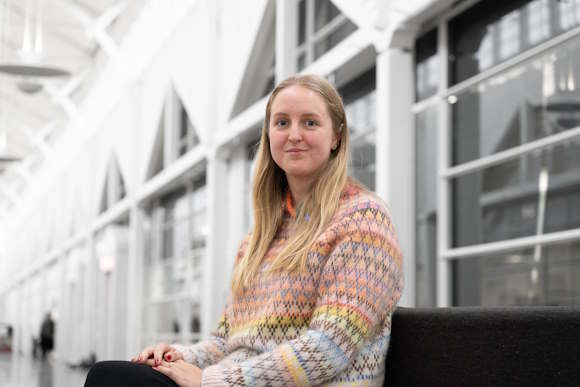
Nina got her first job in 2020, while she was still working on her thesis. It was as a software engineer at the robotics company MiR, where she worked on getting robots to communicate with each other so, for example, they would not run into one another in a warehouse.
After about a year there – it involved slightly too much programming for her interests – she moved on to the Danish IT and Development Agency in Copenhagen, but as neither she nor her partner enjoyed living in Copenhagen, they moved back to Odense. And while her partner still commutes to work in Copenhagen (and is perfectly happy with that, he says), Nina has found a job at TV 2 in Odense.
Not all her ideas about life as a university student and as a graduate in Applied Mathematics turned out to be true, but one of them has held true so far:
“When I was in upper secondary school, I had this idea that if I kept doing something I found interesting, someone would probably pay me to keep doing it once I had graduated. And that is exactly what happened. I am happy in my job!”