When teaching and research strengthen each other
Three robotics engineering students turned a bachelor’s project into a peer-reviewed journal article. Their subsequent work has generated further research on assistive and underwater robots. For Associate Professor Saravana Prashanth Murali Babu, the projects show how teaching and research can advance together.
SDU’s statutes call for research-based education and close interaction between research and teaching.
Associate Professor Saravana Prashanth Murali Babu puts this principle into practice by bringing research from SDU’s laboratories into student projects.
– I bring my research into my teaching, while the students help move the research forward. When this succeeds, both teaching and research gain more from our combined efforts, says Saravana Prashanth Murali Babu, Associate Professor at the Maersk Mc-Kinney Moller Institute and a member of SDU Biorobotics and SDU Soft Robotics.
The students work with open-ended problems, conduct systematic experiments and develop their own solutions – just like the university’s researchers.
– They go through the same research process as our PhD students. The scope is adapted to their level, but they learn how to design experiments, document results and work scientifically, he says.
The DAWN project shows what this approach can achieve.
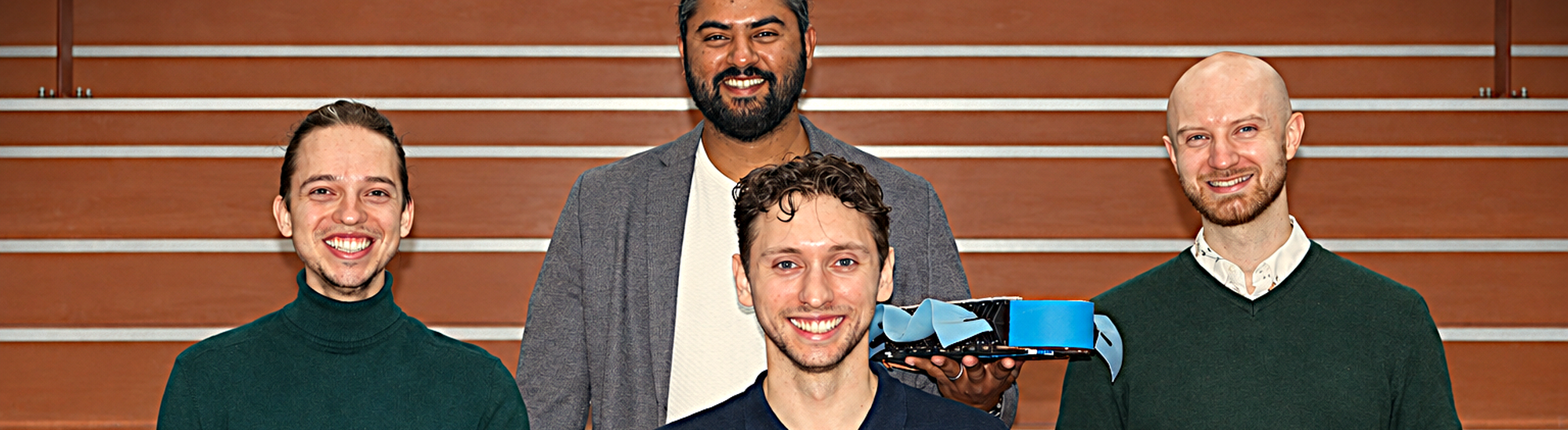
The three recent MSc graduates in Robot Systems Engineering – Mathias Jensen, Magnus Malthe Sigsgaard Nielsen and Nicklas Nikolaj Grønvall – developed their bachelor’s project into a scientific paper on their DAWN robot.
The paper was published in Advanced Intelligent Systems in 2025. It explores bioinspired travelling-wave locomotion and shows how inflating the robot’s soft outer layers improves movement on sand.
– This is a major achievement at bachelor’s level. They have delivered work of a quality that we would normally associate with PhD students, says Saravana Prashanth Murali Babu.
A robot inspired by a biology
For their bachelor’s project, the three students worked on a soft robot that uses wave-like movements inspired by a snail to traverse challenging terrain.
They built on an existing design and investigated how movements in the robot’s flexible surface could improve its ability to move through sand.
– By inflating and deflating the surface, we could change the dynamics of the movement. Among other things, this made the robot better at crossing the small piles of sand that it pushed ahead of itself, explains Nicklas Nikolaj Grønvall.
Following their bachelor’s examination, Saravana Prashanth Murali Babu concluded that the results had the potential to form the basis of a scientific paper. He therefore asked the three students whether they wanted to continue the work.
This led to a dedicated five-ECTS elective course during their master’s programme. Here, they conducted further experiments, processed the results and wrote the scientific paper.
For Saravana Prashanth Murali Babu, the model provides an opportunity to develop particularly promising student projects. The goal may be a journal paper, a conference paper or participation in a competition.
The students gain the opportunity to explore a current research problem in depth, while their results contribute to the research group’s ongoing work.
Close supervision creates independence
The model requires a considerable commitment from both the students and their supervisor.
Saravana Prashanth Murali Babu spends a significant amount of time with the project groups, particularly at the beginning of each project. He helps them define the research question, plan their experiments and ensure the quality of their methods.
This close supervision provides the students with a foundation that enables them to work more independently later in the process.
– Once they become familiar with the methods, the work progresses quickly. I show them what is required to work scientifically, and from there, they have the freedom to develop their own ideas. They often return with a different solution from the one I had imagined, he says.
The students’ own ideas are a central part of the model. They are encouraged to challenge the starting point and identify solutions that may also surprise their supervisor.
Magnus Malthe Sigsgaard Nielsen therefore experienced the collaboration as more equal than traditional teaching.
– Saravana is deeply involved in the project. He asks questions, contributes ideas and follows the work closely. He almost becomes an additional study partner accompanying you throughout the process, he says.
Learning to work as researchers
Working on the paper gave the three students first-hand experience of the standards required in scientific research.
Before the paper could be accepted, it was assessed by three independent peer reviewers with expertise in the field. They requested several additional experiments.
The students returned to the laboratory to investigate how much weight the robot could carry across sand. They also responded to the reviewers’ questions and documented how they had improved the paper.
– The experiments must be conducted in the same way again and again. Everything has to be documented with data, images, and video so that others can understand and reproduce the work. We learned how precise and structured the process needs to be, says Nicklas Nikolaj Grønvall.
The experience also influenced the rest of their studies.
– The way we learned to write and work raised the standard of our other assignments. We became better at structuring our work, documenting it and presenting the results clearly, says Magnus Malthe Sigsgaard Nielsen.
The project required many hours of work. The three students completed 35 ECTS during the first semester of their master’s programme while continuing to work on the paper.
In return, the additional elective course gave them more room later in their master’s programme. They had also gained experience in handling the practical challenges and unexpected results inherent in experimental research.
From a bachelor’s project to further research
The DAWN paper became the beginning of a longer research journey for the three students. All three subsequently chose Saravana Prashanth Murali Babu to supervise their master’s projects. Magnus and Nicklas co-authored two further studies:
1. SoFiE, a soft finger exoskeleton that senses movement and touch, and
2. SoftPINCH, which uses muscle signals to assist finger movement and grasping.
Both studies are available as preprints. SoFiE was accepted for an oral presentation at IEEE CBS 2026, and SoftPINCH for an oral presentation at SAB 2026.
Mathias authored OmniFish, a fish-inspired underwater robot whose article is undergoing peer review. Magnus Malthe Sigsgaard Nielsen and Mathias Jensen have also presented research at the APS March Meeting in the United States.
For Saravana Prashanth Murali Babu, the model is also a means of identifying and developing future research talent. Through these longer projects, he becomes familiar with the students’ academic strengths, while they have the opportunity to discover whether a career in research suits them.
This may eventually open the door to positions as research engineers or PhD students.
– Every student has talent. Our task is to create an environment that can unlock it. It requires considerable effort, but when students develop, produce high-quality research, and become motivated to continue, the effort is entirely worthwhile, says Saravana Prashanth Murali Babu.
For Mathias Jensen, the experience has strengthened an interest in research that he had already developed before beginning his degree.
– I have developed a real taste for academic work. I am now looking for projects and opportunities that could lead to a PhD, he says.