DA / EN

About the department

Key figures

The key figures are updated twice a year. Find the latest numbers here.

  • PhD students: 235
  • Postdoc/assistant professors: 70
  • Part-time lecturers: 21
  • Associate professors and clinical associate professors: 251
  • Professors and Clinical professors: 152
  • Research assistants: 27
  • Others*: 45

Total: 801

  • Adjunct associate professors: 6
  • Adjunct professors: 73

Total: 79


Employees and adjunct professors at Department of Clinical Research: 880

* Administrative staff, head of department, research assistants, lab assistants, and others


Bar chart showing the development in the number of employees and adjunct staff at KI from 2007 to 2026, illustrating a strong long-term increase with peak levels around 2023–2024. 

The key figures represent a snapshot, as there is a constant flow of people joining and leaving. The key figures is updated February 2026.


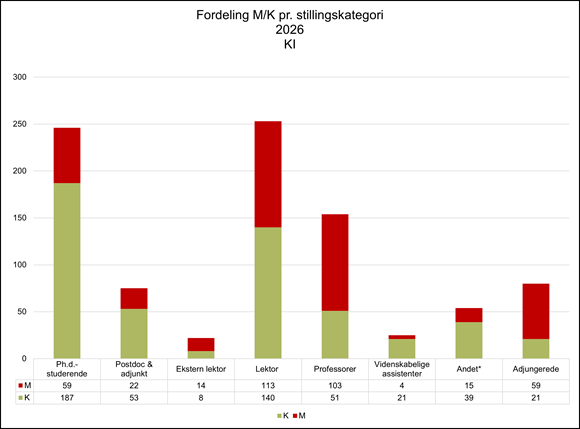
Bar chart showing gender distribution (male/female) by job category at KI in 2026. The chart displays the number of women and men across PhD students (175 women, 60 men), Postdoc & Assistant Professor (49 women, 21 men), Teaching Lecturer (7 women, 14 men), Associate Professor (137 women, 114 men), Professors (52 women, 100 men), Research Assistants (22 women, 5 men), Other positions (33 women, 12 men), and Adjunct positions (19 women, 60 men). The figure highlights a strong female majority among PhD students and lecturers, and a male majority among professors and adjunct roles.

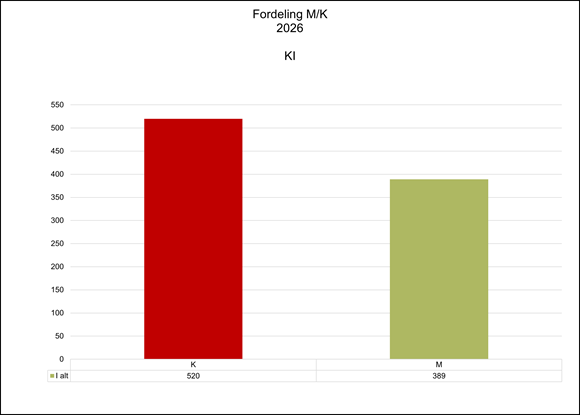
Bar chart showing the overall gender distribution (female/male) at KI in 2026. The chart displays a total of 494 women (K) and 386 men (M). The figure highlights an overall female majority across all job categories in 2026.

Updated February 2026.

Treemap chart showing the distribution of staff at KI in 2026, including clinical lecturers, PhD students, clinical professors, adjunct lecturers/professors, postdoctoral researchers and assistant professors, research assistants, coordinating lecturers, and other administrative and leadership roles.

The key figures represent a snapshot, as there is a constant flow of people joining and leaving. Updated February 2026.

Bar chart showing the development of PhD students at KI from 2010 to 2024. The chart presents the annual number of new enrollments, awarded PhD degrees, and withdrawals without degree. New enrollments increase from 46 in 2010 to 63 in 2024, with fluctuations throughout the period. Awarded PhD degrees range from 21 in 2010 to 63 in 2024, showing an overall upward trend. Withdrawals without degree remain low, varying between 1 and 7 per year. Overall, the figure highlights a positive trend in both PhD admissions and completed doctoral degrees at KI.

Updated February 2026.

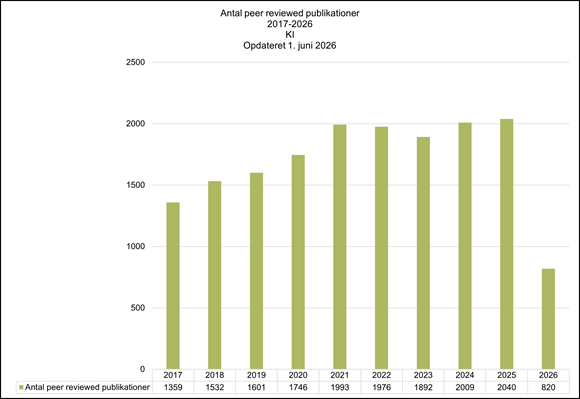
Bar chart showing the total number of peer-reviewed publications at KI from 2017 to 2025, updated January 1, 2026. The number increases from 1,359 publications in 2017 to a peak of 2,002 in 2024, with strong growth leading up to 2021 (1,993). After a slight decline in 2022 and 2023, the output rises again in 2024, followed by a small decrease to 1,898 in 2025. The figure illustrates an overall positive trend in research output at KI during this period.

Updated January 1, 2026.


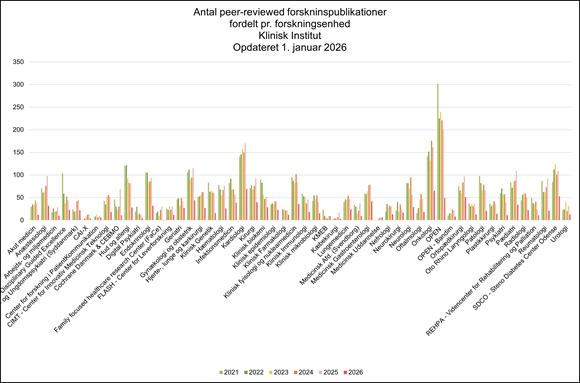
Bar chart showing the number of peer-reviewed research publications by research unit at the Department of Clinical Research, updated January 1, 2026. The chart compares the years 2021–2025 across a wide range of clinical and interdisciplinary units. OPEN and OPEN – Pediatrics have the highest publication numbers throughout the period, peaking at around 300 publications in 2025. Cardiology, Surgery, Oncology, Neurology, Endocrinology, and SDCO – Steno Diabetes Center Odense also demonstrate high and generally increasing publication output. The figure provides an overview of research activity and publication trends across the department’s units.

Updated January 1, 2026.


Last Updated 09.04.2025