Morten Nordhagen Ottosen
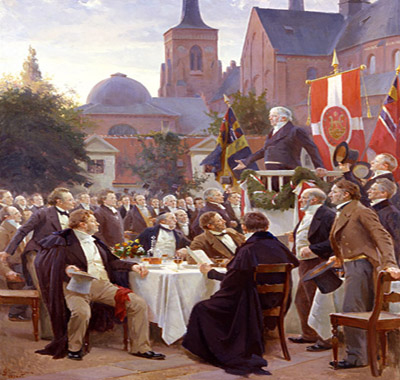 This project examines the Dano-Swedish national perceptions and reconciliation after 1814. It will focus on the mental and cultural dimensions of Dano-Swedish relations between the peace of Kiel and the 2nd Schleswig War in 1864 by way of political and cultural actors and spheres through which perceptions of “the other” were expressed and reconciliation thus accomplished.
”The different dialect that sounded so inimical in Danish ears in previous times”, the Danish poet Oehlenschläger wrote of the Swedish language in 1829, ”now ingratiated itself in all its euphony”. At this point unrestricted communications had opened across the Sound and Oehlenschläger was hailed in Sweden as “The King of Nordic Poetry”. In the Diet in Stockholm Danes were now referred to as ”primordial friends and sister people”. Such comments were different from the mutually derogatory stereotypes so widespread in previous centuries. In fact, at the outbreak of war in 1864, some Danish ministers expected military aid from Sweden and even suggested a Scandinavian federation.
To explain how Dano-Swedish relations improved so remarkably after 1814, historians have pointed out how international politics and the emergence of Scandinavism eliminated old hatreds. Yet, just how this happened has been given little attention. How was reconciliation rooted transnationally in terms of culture, mentalities and national identity? For reconciliation to last in an age of nationalism, national stereotypes would have to be neutralised and replaced by positive images and connotations, such as has happened in France and Germany after 1945. How, then, were mutual Dano-Swedish perceptions transformed in the context of Scandinavism and international politics? How did transnational Dano-Swedish relations play into Scandinavism? These questions link this project firmly to those of RG and LM.
Whereas French and German national antagonisms continued after 1814-15, Danish and Swedish ones did not. This discrepancy offers a comparative European perspective that helps shed light on national identity and reconciliation even on general levels. Furthermore, the project will assess patterns of change and continuity before and after 1814, i.e. how old prejudices might have been channelled into new ones (e.g. Russian, German), the views and influence of new generations after 1814, as well as the views of those who had experienced the conflicts and rivalries before 1814. There were some of the old guard in Sweden – such as the conservative Jacob August von Hartmansdorff – who as late as the 1840s could not forget old enmities. To what extent were new national perceptions and reconciliation brought forward by the new generations who entered the scene after 1814?
Another question is how political life in the two countries influenced mutual perceptions. How and why did the political systems inspire (or disgust) national and political movements? The significance of the different political systems in the two countries (at least until 1849) is important here, particularly how these might have been associated with national features. This, in turn, provides important areas of contact and comparison with the projects of MB, LM and RG.
The political and cultural public spheres are central to the project, as are private documents in order to circumvent censorship in Denmark. This, in turn, will allow for assessments of any discrepancies between public and private spheres. The source material will comprise a broad sample of texts and national symbols circulating in the public space, incl. a selection of newspapers, pamphlets, books and political proceedings, as well as memoirs, diaries and correspondence. This provides extensive empirical and methodological synergisms and ties to the other projects. Theoretically, the project will draw on Neue Politikgeschicte and New Historicism, examining the “spaces of communication” in which ideas and perceptions were formed, exchanged and transformed. Theories of nationalism will also be applied to frame Danish and Swedish national identities in the period.