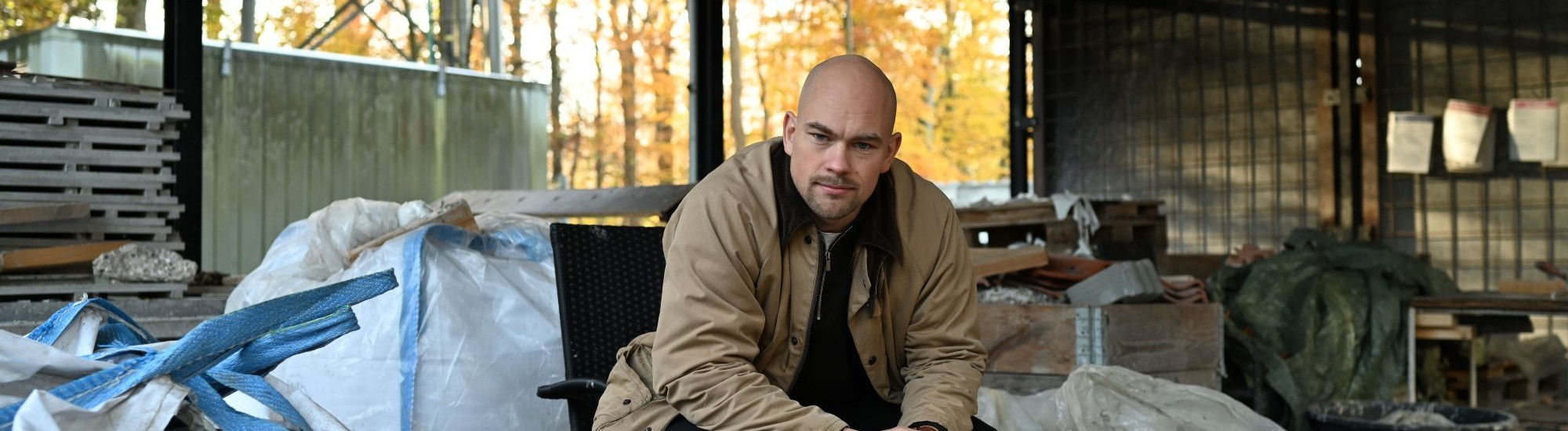
Companies want to recycle more waste, but the system is holding them back
Danish companies are keen to recycle more waste. Yet materials that could potentially be given a new lease of life still end up at incineration plants. New research from the University of Southern Denmark shows how economic interests, established practices and existing business relationships are slowing the green transition.
A company has a pile of waste that could be sent to a recycling facility in Jutland. But transporting it costs money, while a nearby incineration plant can take the waste at a much lower price. As a result, the material ends up being incinerated rather than recycled.
According to a new research study from the University of Southern Denmark (SDU), decisions like these help explain why the transition to a more circular economy is progressing more slowly than many would like.
“Companies genuinely want to recycle more. But when it comes to making actual decisions, they encounter a number of conflicting pressures. Recycling may be more expensive, their contracts may be designed around existing solutions, or their business partners may operate in ways that make it difficult to change anything,” explains Rasmus Paulsen Holm, a PhD student at the Department of Green Technology at SDU.
He is the lead author of the new study, conducted in collaboration with Associate Professor Ciprian Cimpan from SDU Life Cycle Engineering and Professor Kristin B. Munksgaard, who is also Pro-Rector at Roskilde University (RUC). The study has been accepted for publication in the international scientific journal Journal of Business & Industrial Marketing.
While Danish households have been provided with an increasing number of bins for sorting their waste in recent years, a substantial proportion of the country's waste comes from businesses. According to Rasmus Paulsen Holm, more than half of the waste delivered to the district heating company Fjernvarme Fyn originates from businesses (source: Fjernvarme Fyn, 2024).
“We have focused heavily on household waste because it is relatively easy to regulate. But commercial and industrial waste is far more complicated because so many economic interests and different stakeholders are involved,” he explains.
Everyone wants to go green, but no one can do it alone
The researchers examined a regional Danish waste management network through interviews with key stakeholders from the waste management sector and the wider network, supplemented by network meetings and company data.
One of the central findings is that companies are ambitious about making their operations more sustainable. At the same time, however, they are part of a larger system in which economic considerations, contracts and established partnerships determine what is possible.
The researchers identify three fundamental tensions. Green ambitions clash with economic realities, shared goals do not necessarily translate into collective action, and the desire for a circular economy encounters working practices developed for a traditional waste management system.
“The challenge is that these tensions cannot necessarily be resolved by individual companies. They arise from the interplay between companies' economic interests, activities and established partnerships. As a result, one company may successfully develop a new recycling solution without necessarily bringing about a wider transformation of the entire waste management network,” explains Rasmus Paulsen Holm.
Green solutions become a competitive advantage
One example of this challenge arises when companies develop new ways of recycling waste. The study describes a partnership focused on recycling insulation materials. In this case, a waste management company has established a collaboration that makes it possible to return materials to the circular economy.
On the face of it, this is a success. But the solution is not necessarily adopted by other companies. When a company has invested time and money in developing a new solution, it may also have a financial interest in keeping the partnership exclusive as a competitive advantage.
“What is interesting is that competition can both drive the development of new recycling solutions and limit their wider adoption. This shows why we need to understand not only the actions of individual companies, but also the relationships between them,” explains Rasmus Paulsen Holm.
The construction industry must play its part
The challenges do not end with the companies that collect the waste. Even when materials can be successfully sorted and recycled, there must also be someone willing to buy and use them. Here, the research highlights the construction industry, where contractors and consultants may impose requirements concerning material properties, documentation and availability that make it difficult for recycled materials to compete with virgin materials.
For example, a contractor needs to be confident that a material meets specific quality standards and can be delivered in the required quantities at the right time. If these conditions cannot be guaranteed, choosing new materials is often the easier option.
“We may be able to find a company that can recycle a particular material. But if no one is willing to use it afterwards, we cannot move forward. That is why we need to look at the entire value chain. There is little point in changing waste collection practices if the rest of the system continues to operate as before,” says Rasmus Paulsen Holm.
The green transition requires more than new regulations
According to the researchers, one of the most important lessons is that the green transition cannot be achieved simply by imposing new requirements on individual companies. Although legislation can help steer developments in a greener direction, companies still need to ensure that their operations remain financially viable.
For recycling to become more widespread, changes are therefore also needed to the contracts, partnerships and economic incentives that shape the waste management sector.
“We need to look beyond what individual companies are doing. We need to understand how the entire network operates and how companies assess the value of their activities. Otherwise, we risk a situation where green ambitions remain just that, while everyday business decisions continue as before,” says Rasmus Paulsen Holm.
The researchers are now developing an agent-based model to investigate how companies' decisions, their relationships with one another, and changes in economic and regulatory conditions influence waste flows and the development of more circular solutions.
The aim is to provide companies and policymakers with a better basis for assessing which changes could actually divert more materials away from incineration plants and back into circulation.
“We have identified some of the mechanisms that keep the system locked into its existing practices. Now we are working to understand how we can change them, so that the green transition takes place not just within individual companies, but across the entire network,” concludes Rasmus Paulsen Holm.