Microalgae could pave the way for a new type of biofactory
Researchers at the University of Southern Denmark aim to produce a sought-after pigment using microalgae. This requires relocating metabolic processes to new compartments within the cell, and if successful, the potential is vast.
Carotenoids are a group of yellow and red pigments naturally found in everything from carrots to autumn leaves. Not only are they vibrant pigments, but they are also highly beneficial to health, making them desirable, for instance as dietary supplements.
The challenge, however, is that they are currently expensive and energy-intensive to produce. For example, they can be extracted from flower petals or synthesised in a laboratory, but both methods are slow and costly.
Now, researchers at SDU’s Department of Green Technology may be on the path to a better solution.
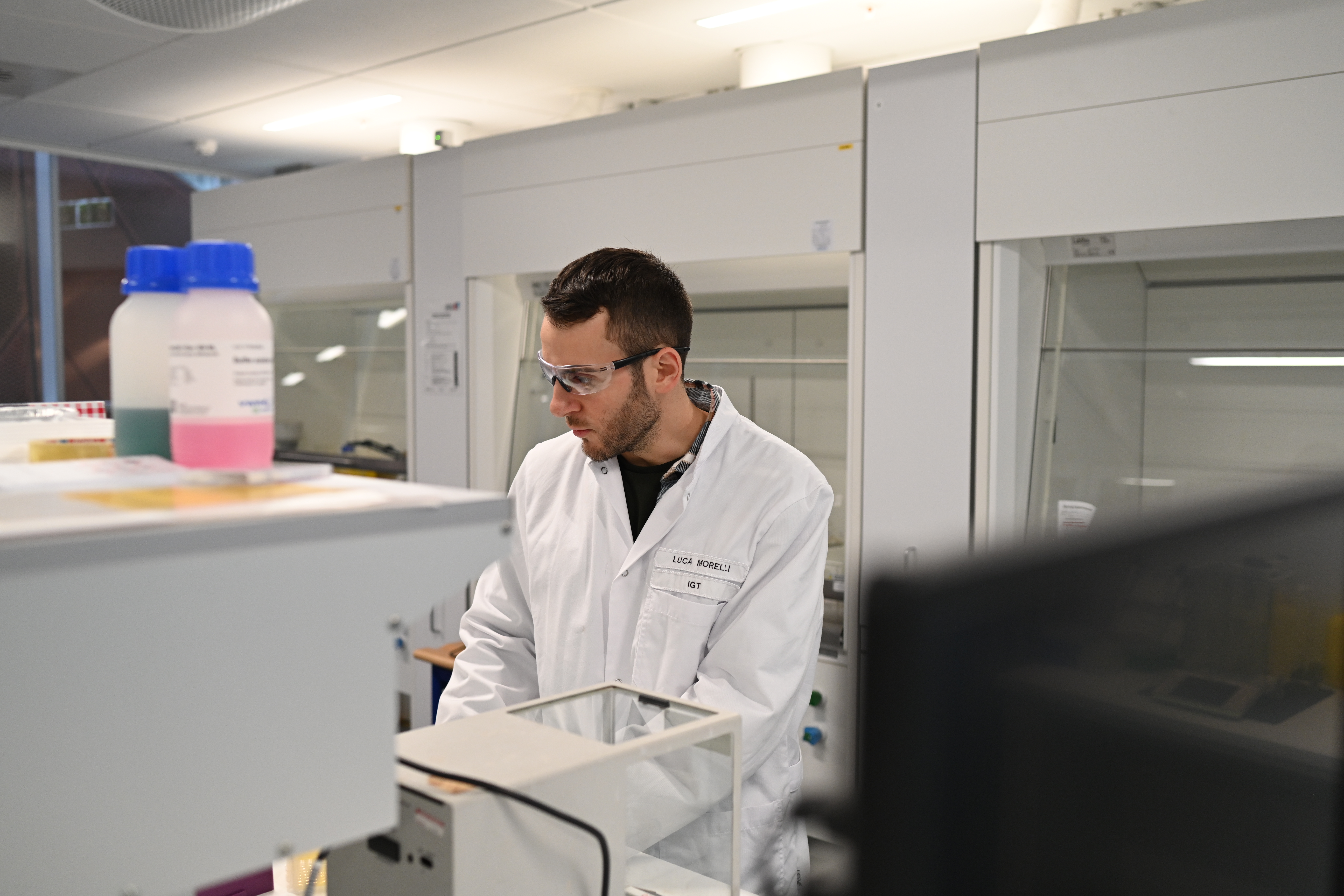
Postdoctoral researcher Luca Morelli, together with Associate Professor Michele Fabris from SDU Biotechnology, will attempt to modify a specific type of microalga to produce carotenoids cost-efficiently, sustainably, and quickly.
- The alga we’re working with is a single-celled microalga, a diatom called Phaeodactylum tricornutum, known for being relatively easy to modify, explains Luca Morelli.
- The algae naturally produce carotenoids, but we aim to relocate production from the part of the cell known as the chloroplast, where photosynthesis and carotenoid production normally occur. This would not only increase carotenoid yield but also make extraction easier, enabling a sustainable and scalable production method.
Ground research in algae
The research project, named SORTED, is funded by the EU’s prestigious Marie Curie Programme. While prospects for more efficient carotenoid production could lead to improvements in, for instance, global public health, the implications go beyond this.
- The project serves as a proof of concept. It would be a significant advancement if we can demonstrate that entire metabolic processes can indeed be transferred to other cell areas in algae, says Luca Morelli.
- This would mean, for instance, that genes from different organisms could be combined and transferred to locations in the algae where they remain unaltered by the alga itself. It’s a modular and much more flexible approach to synthetic biology, which could be highly valuable, for example, in the pharmaceutical industry.
The advantage of using algae in biofactories is that they only need saltwater and light – often just daylight – making them far more efficient than plants, for example.
However, the researcher highlights that extensive lab work lies ahead. And as algae are living organisms that do not always behave as expected, there’s no certainty that everything will proceed as planned.
- In theory, this should work, but it’s hard to predict the exact outcome. Nonetheless, this type of research is rewarding, as even if it doesn’t succeed, it advances our understanding of algae biology.