SDU researcher honoured for making supermarket waste heat more valuable
Milad Morid Zadeh has received an international award for research that could help supermarkets use heat from their refrigeration systems more efficiently – even as the equipment deteriorates.
Supermarkets need to keep their refrigerated and frozen displays cold around the clock. In the process, their refrigeration systems produce considerable amounts of heat, which can either be used to heat the supermarket itself or supplied to a local district heating network.
However, this requires the system to continuously determine where the heat will be most valuable: Should it be used immediately, stored in a hot-water tank for later use or exported to the district heating network?
This question is at the heart of research conducted by Milad Morid Zadeh, a PhD student at SDU Mechatronics.
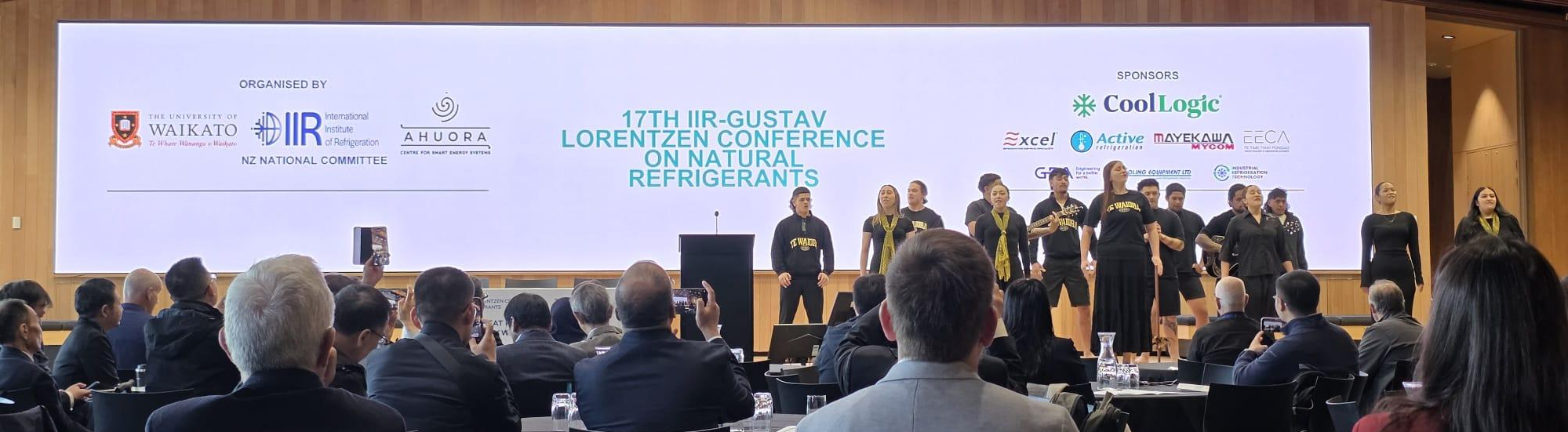
His scientific paper received the Elsevier–IIR Best Communication Paper Award at the 17th IIR–Gustav Lorentzen Conference on Natural Refrigerants, GL2026, held in Hamilton, New Zealand.
– Receiving the award is one of the most meaningful milestones of my PhD. The work was evaluated within an international community of leading researchers and industry experts in refrigeration and natural refrigerants. I am proud that both the scientific quality and the practical relevance of the method were recognised, says Milad Morid Zadeh.
Accounting for equipment degradation
Heating demand, energy prices and the amount of stored heat all change over time. At the same time, components in the refrigeration system gradually deteriorate or become fouled. This can, for example, reduce the amount of heat that the heat exchanger is able to recover.
Milad Morid Zadeh has therefore developed a supervisory scheduling method for a CO₂ refrigeration system. The method considers the actual condition of the equipment when determining how the recovered heat should be used.
The model underlying the method was validated using measurements from a Danish supermarket. The researchers also mapped the physical and operational limitations of both the refrigeration system and its heat-recovery unit.
This gives the control system a realistic picture of how much heat the equipment can actually deliver.
Preventing unrealistic decisions
Without this information, a control system might select an option that initially appears economically attractive but which deteriorated equipment is no longer capable of delivering.
The researchers evaluated the method under scenarios including reduced compressor performance and heat-exchanger fouling. Their results show that the method can prevent the system from scheduling heat recovery that the equipment cannot deliver in practice. This could help supermarkets avoid the additional costs associated with an unrealistic operating plan.
The study also indicates that detecting faults and deterioration at an early stage can have economic value. The control system can adapt its decisions before the deterioration causes significant operational and financial consequences, while operators gain a better basis for deciding when maintenance is economically justified.
Supermarkets as local energy hubs
In the longer term, the method could help supermarkets reduce their dependence on separately purchased heat and make better use of their existing refrigeration equipment and thermal storage.
At the same time, supermarkets could develop from buildings that primarily consume electricity and reject heat into flexible local energy hubs.
By recovering, storing and potentially supplying heat to a district heating network, the same infrastructure could keep food cold, heat the supermarket and contribute to the local heat supply. This could reduce wasted energy and the need to produce heat elsewhere.
The paper was written by Milad Morid Zadeh together with Roozbeh Izadi-Zamanabadi from Danfoss Climate Solutions, Mirco Rampazzo from the University of Padua and Paride Gullo from the University of Southern Denmark.