
Communication tool can improve treatment outcomes for patients with high blood pressure and cholesterol
A new study from the University of Southern Denmark shows that when people are given a clear and concrete understanding of their heart health alongside their usual treatment, they can achieve significant improvements in blood pressure and cholesterol levels.
For many people with high blood pressure or high cholesterol, the condition does not feel like an illness. The body rarely gives clear warning signs, even though the heart is gradually placed under greater strain than normal. This is precisely why it can be difficult to see the importance of lifestyle changes and adherence to treatment.
Three questions for Kathrine Stjernholm Nielsen about the study
What does the study investigate?
We investigate whether the Your Heart Forecast tool and monthly lifestyle emails can improve blood pressure and cholesterol levels in people with high blood pressure.
What is the most important finding?
Blood pressure and cholesterol levels improved in people with moderately to severely elevated levels when they used the tool, compared with usual care.
What can the results be used for?
The results show that the tool can be used as a non-pharmacological supplement in preventive consultations in general practice.
A new Danish study now suggests that the way in which a GP communicates a patient’s risk of heart disease can make a significant difference. Providing people with a clear, personalised overview of their heart health – combined with simple, ongoing lifestyle guidance in addition to standard treatment – can lead to better choices and measurable improvements in both blood pressure and cholesterol levels.
What makes the study particularly noteworthy is that patients achieved improvements in their heart health through a relatively simple intervention consisting of user-friendly visual communication that explains how risk factors affect the heart.
– Our results show that clear and accessible communication support, alongside standard treatment, can lead to measurable improvements in both blood pressure and cholesterol levels in people with elevated levels, says Kathrine Stjernholm Nielsen, medical doctor and PhD student at the Research Unit for General Practice, Department of Public Health, University of Southern Denmark.
From abstract numbers to a concrete overview
The study examined a digital tool, Your Heart Forecast, designed for use in general practice. The tool enables the GP to show patients how factors such as blood pressure, cholesterol and smoking influence their risk of developing heart disease in the years ahead.
Instead of focusing solely on numbers and clinical thresholds, the projected development is illustrated using graphs and colours. Patients can see what their situation looks like now, how it could look under more favourable conditions – and what might happen if they change specific risk factors.
After discussing Your Heart Forecast with their GP, participants received monthly emails containing general advice on diet, physical activity and other everyday habits that are important for heart health.
– Many people do not feel that their blood pressure or cholesterol is elevated. It can therefore be difficult to stay motivated to make healthy lifestyle choices or continue medical treatment. When the link between everyday life and heart health is made visible, it becomes easier to understand why even small changes can make a difference, explains Kathrine Stjernholm Nielsen.
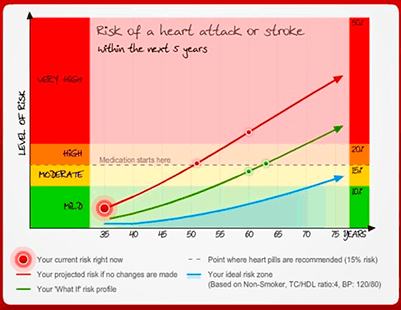
Screenshot from the digital tool Your Heart Forecast, which can help general practitioners advise patients on heart health.
Better results with a simple intervention
In the study, researchers compared people who had access to the tool and the ongoing lifestyle advice with a group receiving usual care from their GP.
The results were most pronounced among those with the highest levels at baseline. In this group, both systolic and diastolic blood pressure decreased more in the group that received the visual overview and emails than in the comparison group. Cholesterol levels also improved – an effect that was not observed to the same extent among those who received usual care only.
– Previous research has shown that this type of tool can improve patients’ understanding of the need for treatment and lifestyle changes. What is new here is that we also see this improved understanding translating into actual reductions in blood pressure and cholesterol, she says.
When communication becomes part of prevention
According to the researchers, the results indicate that prevention is not only about prescriptions and recommendations, but also about how easy it is to understand one’s own health situation.
The study shows that even a relatively simple intervention can help people who otherwise struggle to reduce their blood pressure and cholesterol to healthier levels.
– This can be seen as a supplement to existing treatment and can be used in preventive consultations with people who have elevated levels, says Kathrine Stjernholm Nielsen.
She emphasises that the tool does not replace the GP’s clinical assessment or treatment, but can strengthen the dialogue and provide a shared starting point for decisions made during the consultation.
How to lower your blood pressure and cholesterol
- Be physically active on a regular basis – even 20–30 minutes of daily activity can make a difference.
- Eat more vegetables and wholegrains – and cut back on salt, sugar and processed foods.
- Choose healthy fats – for example from fish, nuts and seeds, rather than saturated fats found in butter, meat and dairy products.
- Avoid tobacco – both active and passive smoking affect blood pressure and damage the blood vessel walls.
- Limit your alcohol intake – the Danish Health Authority recommends no more than 10 units per week and no more than 4 units on a single day for both men and women.
- Talk to your GP – remember that your body can change over time. Are you keeping up with your regular check-ups?
- Good medication habits – if you are on medication, it can be helpful to establish fixed routines so you remember to take your tablets every day.
About the study:
Method
The study was conducted in 17 general practices in the Region of Southern Denmark and included 255 men and women aged 35–75 with high blood pressure. Participants were followed for up to 18 months. All patients received their usual treatment, but half were also given access to Your Heart Forecast and monthly lifestyle advice emails in addition to standard care.
Funding
The study was supported by the University of Southern Denmark, the Region of Southern Denmark, Lilly and Herbert Hansen’s Foundation, the Foundation for General Practice, and the A.P. Møller and Wife Chastine Mc-Kinney Møller Foundation.
Publication
Stjernholm K. et al. Danish evaluation of Your Heart Forecast: a cluster randomised controlled trial aimed at improving modifiable risk factors of cardiovascular disease. Open Heart, 2026. https://doi.org/10.1136/openhrt-2025-003812
Meet the researcher
Kathrine Stjernholm Nielsen is a PhD student at the Research Unit of General Practice, Department of Public Health.