New ground station gives SDU direct access to space
A Danish research collaboration has established a ground station that will support both climate research and the search for exoplanets.
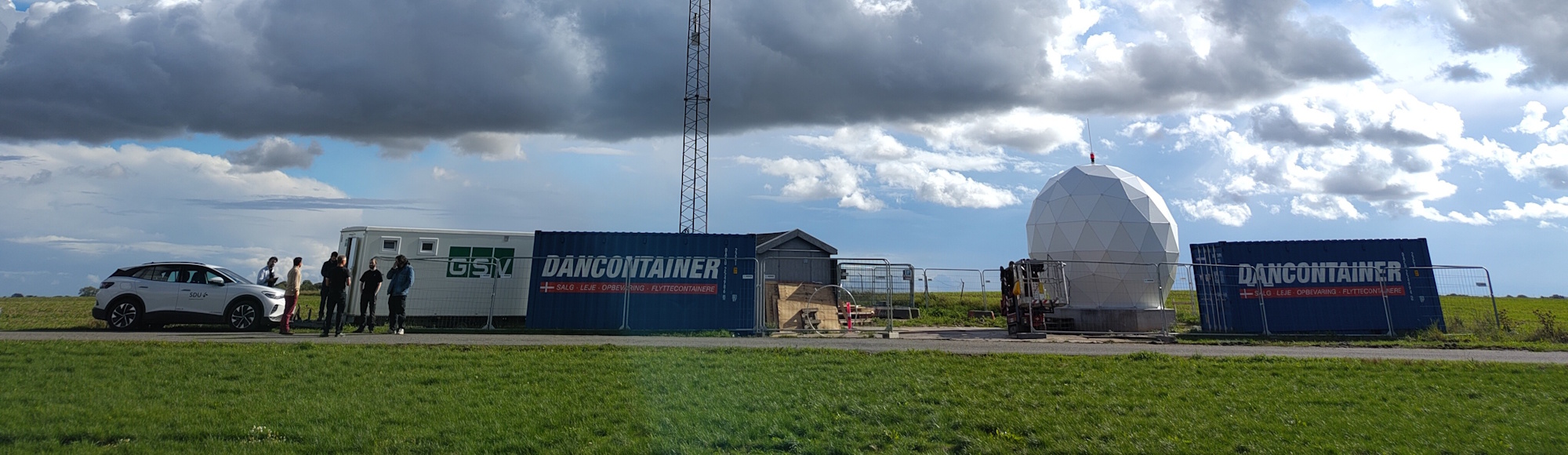
A new satellite ground station has been erected at H.C. Andersen Airport near Odense. Once the final radio components have been installed, the facility will enable researchers and students at the University of Southern Denmark (SDU), the Technical University of Denmark (DTU), the Danish Meteorological Institute (DMI), the University of Copenhagen (KU), Aarhus University (AU) and Aalborg University (AAU) to communicate directly with Danish satellites in Earth orbit.
Initially, the ground station will support the national satellite missions DISCO-2 and STEP (STars and ExoPlanets).
The first mission, DISCO-2, is a Danish student-developed satellite designed to collect images and measurements from Greenland in support of climate change research, including the monitoring of glaciers, snow, ice and coastal areas. The satellite is equipped with optical and infrared cameras.
Are there other habitable planets in the Universe?
The second mission, STEP, has a different scientific objective. It will place a space telescope in orbit to study stars and exoplanets, that is, planets beyond our own Solar System. The satellite will help researchers answer key questions about stellar evolution and potentially habitable planets elsewhere in the Universe.
SDU Climate Cluster is providing financial support for the ground station, which is also funded by the Danish Ministry of Higher Education and Science and the Novo Nordisk Foundation.
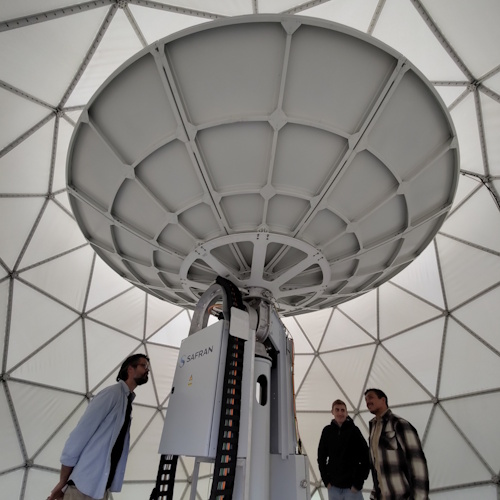
The facility at H.C. Andersen Airport has been constructed by staff and students from the Department of Physics, Chemistry and Pharmacy (FKF) in collaboration with engineers from the French company Safran, as well as colleagues from Aarhus University and the IT University of Copenhagen.