Expert on Species Distribution: “The Caterpillar from Hell” Must Be Controlled Through a Collective Effort
The key tools in the fight against the oak processionary moth are effective reporting and swift action. This is the assessment of Professor Sam Cushman at the University of Southern Denmark.
In recent weeks, the oak processionary moth caterpillar - also known as “the caterpillar from hell” - has dominated headlines, attracted political attention and, not least, concerned residents in the parts of Odense where the species is particularly widespread.
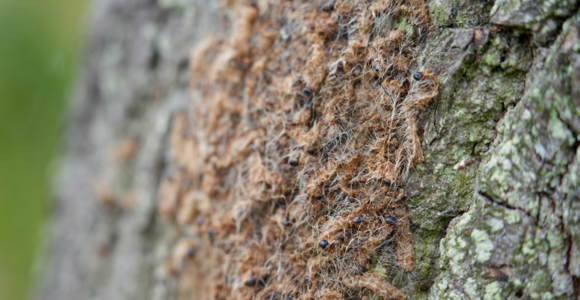
Within just a few days, an unprecedented number of children and adults came into contact with the caterpillar’s urticating hairs, experiencing symptoms such as skin rashes, irritation and respiratory problems.
- However, it is not certain that we will experience the problem in the same way next year, says Professor Sam Cushman, who researches species distribution at the Department of Biology at the University of Southern Denmark in Odense.
The unusually warm weather encouraged more people to put on summer clothes and swimwear and spend more time in their gardens and recreational areas precisely when the caterpillars were at their most numerous and active. At the same time, windy conditions helped spread the caterpillar’s toxic hairs.
- In other words, it was the perfect storm, says Professor Cushman.
Introduced by Humans
While many countries in Central and Southern Europe have lived with the caterpillar for thousands of years without major health concerns, conditions in Odense have been particularly favourable, resulting in significant disruption over a short period.
The caterpillar did not arrive in Odense naturally. It is believed to have been introduced through the importation of oak trees in connection with the city’s light rail project.
- As a result, healthy and thriving caterpillars have arrived here without their natural enemies, such as viruses, bacteria, fungi and parasites, which in other countries help limit the species’ spread, explains Professor Cushman.
These organisms are collectively known as pathogens - a general term for disease-causing organisms, in this case organisms that cause disease in the oak processionary moth.
- For thousands of years, the caterpillar was confined to its natural habitats, where birds and insects fed on it and, together with pathogens, kept populations under control. It has now suddenly arrived in Odense, where it is thriving in absence of natural enemies, says Professor Cushman.
He also points to the large clusters of oak trees connected by oak-lined avenues as part of the explanation for the species’ rapid spread in Odense.
- Unfortunately, it is spreading along the same routes and in the same areas where the city’s residents travel and spend their time, he says.
This may lead some to conclude that the solution is simply to cut oak trees along roads and streets. Professor Cushman strongly advises against this.
- Similar measures have been attempted to combat other unwanted species in many parts of the world, but they almost always prove ineffective, he says.
Another seemingly obvious solution would be to introduce the caterpillar’s natural enemies to the area, a form of biological control. However, this is not a straightforward option either, as it carries significant risks.
- Far too often, this approach has resulted in natural enemies turning their attention to other native species. In this case, that could particularly affect other caterpillars, but potentially also entirely different species that could decline or disappear from the area because they have no natural defence against the organisms introduced to control the oak processionary moth, explains Professor Cushman.

So What Is the Solution?
Instead, the species should be kept under control through a coordinated effort involving easy-to-use reporting systems and effective management measures.
- Fortunately, it is easy to recognise, and we know where to look because it prefers oak trees above all else, says Professor Cushman.
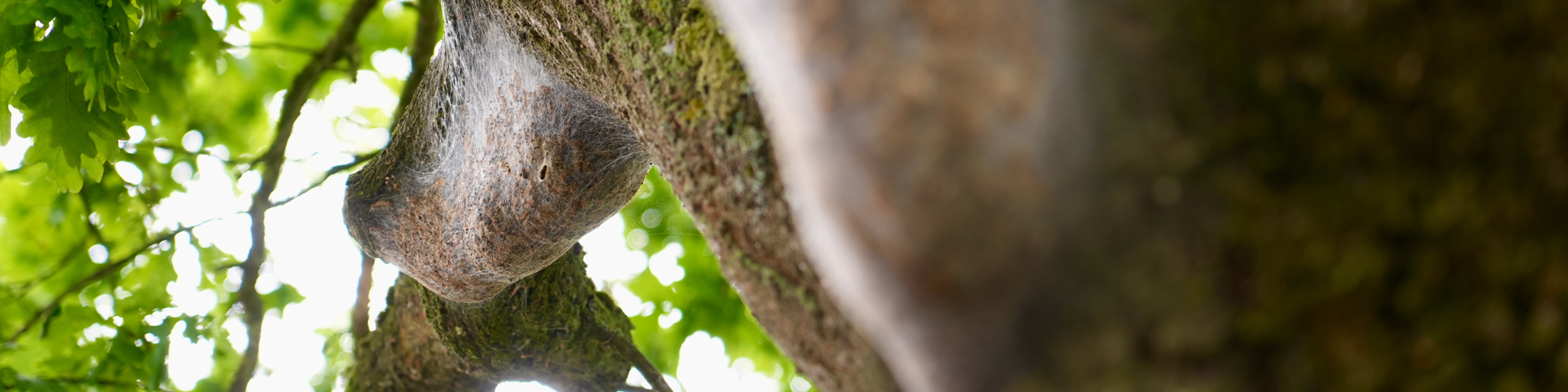
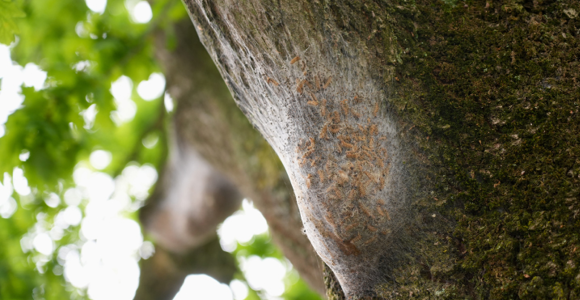
The caterpillars gather in distinctive nests, often containing thousands of individuals.
For that reason, Professor Cushman proposes developing a dedicated reporting app, enabling local residents to identify and locate nests accurately and easily. Municipal authorities could then remove and destroy the nests quickly, before the caterpillars have a chance to reproduce.
- Citizen reporting is not just a way to remove individual nests, it is also a source of real-time monitoring data. Every tip logged through such an app builds a live picture of where the population is growing, shrinking or moving. Coupled with spatial models of how the population is likely to spread and how effective different control measures are at reducing it, that citizen-science data lets us target eradication efforts where they will have the greatest impact, rather than spreading resources thinly across the whole city, says Professor Cushman.
In his opinion, Odense Municipality is already heading in the right direction and has chosen a sensible strategy.
- The municipality has also taken the situation seriously from the outset and acted quickly. We must remember that this is a challenge that emerged suddenly, and it takes time to build the necessary experience and routines required to control the species effectively, he says.
With the right system in place, everyone can contribute to managing the caterpillar population.
For that reason, he remains optimistic and believes that, over time, the population will stabilise at a level that makes coexistence possible, as is the case in other countries.
Nature itself may also become part of the solution if Odense Municipality act thoughtfully, remain patient and have a little luck on their side.
- If we support a high level of biodiversity in Odense, we may eventually find that native species begin to recognise the oak processionary moth and contribute to its natural regulation. However, this is not a strategy in itself, because there is no guarantee that it will happen. And even if it does, it would take a long time before we saw such a development, explains Professor Cushman.
Therefor active vigilance and rapid response are the key.
What About the Rest of the Country?
In the meantime, Professor Cushman is not overly concerned about seeing the species become as widespread in oak trees elsewhere in Denmark, partly because oak woodland accounts for only around 1 per cent of the country’s land area.
- And because Denmark’s climate is not ideal for the species, which prefers warm conditions and low humidity. Denmark instead experiences long cold periods and high humidity. It is always difficult to predict exactly how and to what extent species will spread, but although temperatures are rising in Denmark, it is not a foregone conclusion that the caterpillar will naturally spread to the rest of the country, says Professor Cushman, noting that the species in Denmark is already far outside its natural geographical range.
- We have already seen isolated finds beyond Odense, in Kerteminde and Nyborg municipalities, so the species is clearly capable of turning up elsewhere. But that does not mean it can establish anywhere. The fundamental constraint is the host tree: the caterpillar can only reproduce on oak, so wherever oak is sparse, isolated, or absent, the population simply cannot take hold, regardless of how favourable the weather is. The real risk is concentrated in the dense, connected oak plantings in and around towns, not the countryside at large, says Professor Cushman.
- We must, of course, remain vigilant to ensure that humans do not introduce it into new parts of the country, he says.
Meet the researcher
Sam Cushman is a Professor and researcher at the Department of Biology