New innovation project aims to give the food industry a better understanding of plant-based ingredients
Interest in plant-based foods continues to grow. Yet plant-derived ingredients are not always easy to understand, and expertise from university researchers can be a valuable resource for the food industry.
Anyone who has made their own redcurrant jelly knows that boiled redcurrant juice will naturally set into a jelly, provided the berries are not overly ripe. This is because the berries contain naturally high levels of pectin. The food industry has long taken advantage of this property, routinely using pectin to provide structure and stability in products ranging from jams and drinking yoghurts to desserts.
As demand for plant-based foods increases, so does interest in finding new plant-derived ingredients that can be used in food production. However, identifying the most suitable ingredients remains challenging. Research into plant-based ingredients is not yet as advanced as research into more traditional food systems, such as dairy products.
“Plant-based ingredients are a complex world. We still lack a more fundamental understanding of how different plant-derived ingredients interact, for example within a gel,” says Adam Cohen Simonsen, biophysicist and associate professor in the Physics Section at the Department of Physics, Chemistry and Pharmacy.
.jpg?h=400&iar=0&w=600&hash=C1BB207EC7AE64048C1150B97DF80D42)
He leads the new innovation project Molecular Food: Sustainable Food through Molecular Imaging of Plant-Based Ingredients, which has received DKK 800,000 from the Faculty of Science Innovation Fund. The project is also supported by International Flavors & Fragrances (IFF), making it a collaborative effort between academia and industry.
The project team also includes postdoctoral researcher Ellen Juel Pørtner from the Physics Section at the Department of Physics, Chemistry and Pharmacy, and Flemming Møller, Fellow Sr. Lead Scientist, R&D – Physical Food Science at IFF.
The project builds on previous research conducted by Adam Cohen Simonsen, Flemming Møller and their colleagues.
How Do You Make a Good Gel?
“Developing new foods today is about systematically understanding the relationship between the molecular structure of ingredients and their effects on properties such as texture, stability and, ultimately, the sensory experience,” says Flemming Møller.
For many years, Simonsen has worked on understanding food ingredients at a fundamental level: what principles determine whether a gel, for example, develops particular structures and properties? Much of this work has been carried out in collaboration with industry partners and the Danish Dairy Research Foundation.
According to Flemming Møller, the research team’s expertise in mapping plant proteins and carbohydrates down to the molecular scale is highly valuable for the food industry because it provides a new level of insight into the ingredients companies work with.
The required equipment is not standard
Companies do not always have access to the advanced microscopy needed for this kind of research. Nor do they necessarily possess the expertise required to develop the highly specialised analytical methods needed to interpret the images produced by such instruments.
This is where collaborations between industry and university researchers become important.
The main objective of this project is to develop a method capable of mapping the molecular structure of ingredient molecules by spreading them across a surface. Each molecule leaves its own distinctive signature, appearing as tiny elevations, much like differences in terrain appear on a topographical map.
“The equipment required to create these molecular maps is not standard technology, so very few companies have access to it. We do, however, have it at the university, which is why we are able to collaborate with industry on this challenge,” says Adam Cohen Simonsen.
A deeper mechanistic understanding
Flemming Møller of IFF says:
“Our collaboration with SDU is valuable because we hope to gain new insights and a deeper mechanistic understanding of how different ingredients interact with proteins, sugars and water, which are the building blocks of most foods. By being able to visualise and measure these interactions at the molecular level, we may eventually become better at rationally selecting or designing ingredients for specific food products instead of relying mainly on trial and error.”
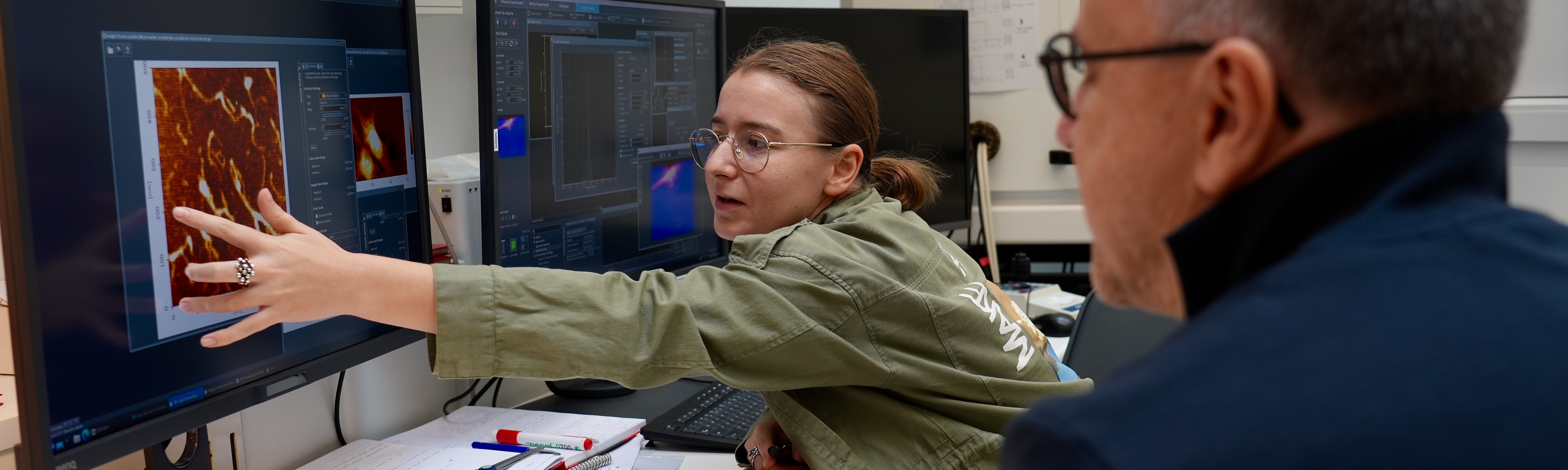
The biophysicists’ contribution to the project is to adapt a specialised microscopy technique known as Atomic Force Microscopy (AFM), enabling it to produce the molecular maps needed for the research.
Working at the nanoscale
“AFM produces high-resolution images that cannot be obtained using conventional optical techniques. At this scale, every detail matters. The surface on which the molecules are measured must be perfectly smooth, with no irregularities whatsoever. We are working at the nanometre and even ångström scale,” explains Ellen Juel Pørtner.
The innovation aspect of the project is not the invention or patenting of a new instrument or technique. Instead, the focus is on applying existing equipment and technologies to a very specific task: developing refined, customised workflows and methods for visualising the molecular structure of plant-based ingredients.
“We have the expertise that the industry needs, and that naturally brings universities and companies together. Projects like this help create the conditions for productive collaborations between academia and industry,” says Adam Cohen Simonsen.
Natural Science for societal needs
Innovation is one of the many ways in which research can create value for society. At the Faculty of Science, fundamental research forms the foundation of our work and accounts for the vast majority of the research we conduct. However, in some research environments, fundamental research and societal value creation go hand in hand and reinforce one another.
This is why we actively support innovation wherever new knowledge has the potential to generate solutions, partnerships, companies or other forms of societal impact.
Meet the researcher
Adam Cohen Simonsen is a biophysicist and Associate Professor at the Department of Physics, Chemistry and Pharmacy. He is part of SDU’s interdisciplinary research network, PhyLife, which investigates the biophysics of living systems. The network also includes the Danish Molecular Biomedical Imaging Center, which provides access to a range of advanced microscopy techniques.