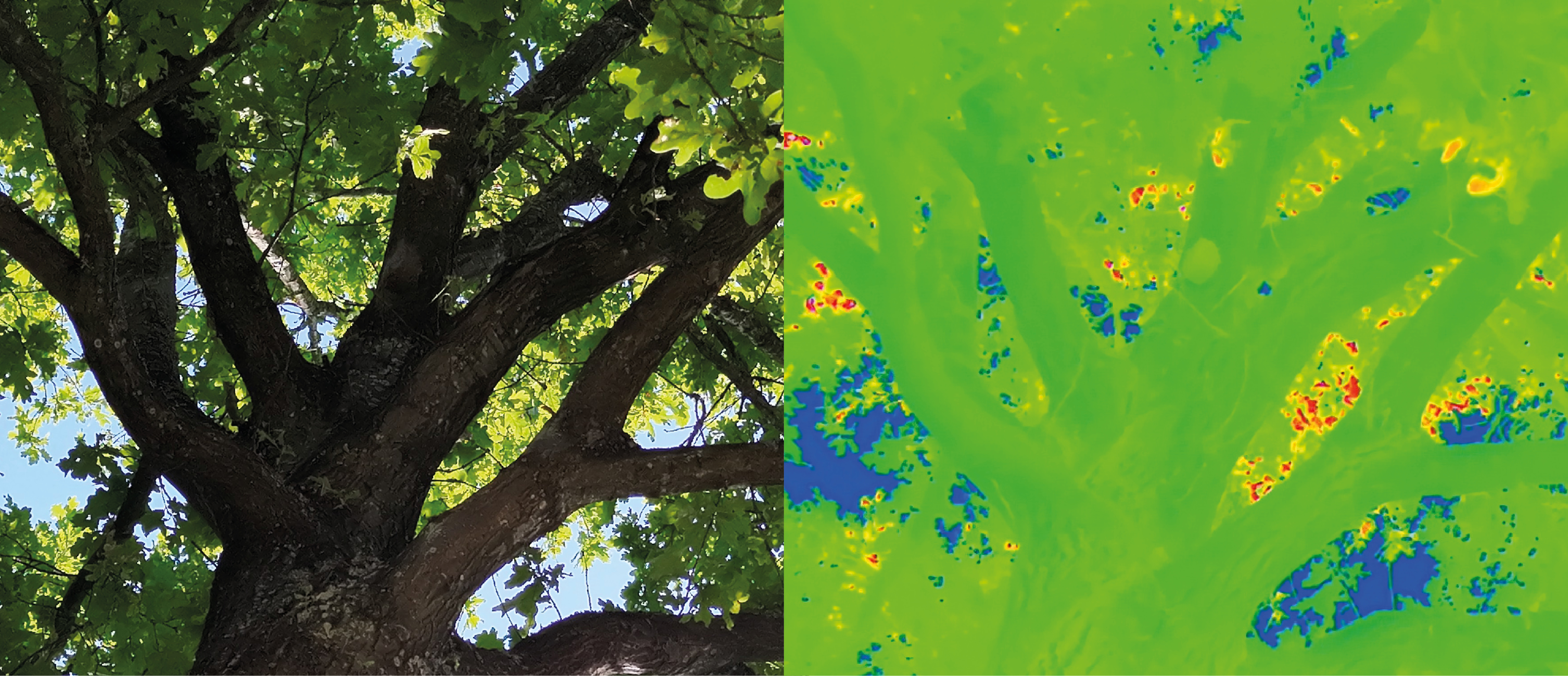
Researchers at the University of Southern Denmark are investigating how drones, thermal cameras and artificial intelligence can support the detection and management of the oak processionary moth. Through collaboration with municipalities and industry partners, the project aims to develop more efficient, safer and scalable methods for future pest control efforts.
Background
 The oak processionary moth has emerged as a growing challenge in Denmark and across Europe. The caterpillars pose a significant threat to public health due to their microscopic urticating hairs, which can cause severe skin irritation, allergic reactions and respiratory problems. At the same time, municipalities spend considerable resources locating and removing nests from affected areas.
Current control methods are labour-intensive and often require personnel to work in close proximity to infested trees. There is therefore a need for new technological solutions that can improve the efficiency, safety and effectiveness of monitoring and control activities. Leveraging SDU's expertise in drones, robotics and intelligent systems, this project explores how advanced sensing technologies can support future management of the oak processionary moth.
Project objectives
- Scope the potential of drone-based approaches for detecting and managing oak processionary moth infestations, to establish whether and how this warrants further investigation
- Conduct an initial feasibility assessment of thermal imaging for nest identification in complex outdoor environments, testing basic detectability under a limited set of conditions
- Survey and pilot-test existing AI and digital tools for automated detection, to identify promising approaches and gaps that a larger project could address.
- Identify the key bottlenecks and requirements for improving the efficiency and safety of pest control operations, as input for a future, larger-scale intervention study.
- Generate a small pilot dataset to test data collection protocols and demonstrate the value of an open dataset, laying groundwork for larger-scale data generation later.
Project details and method
The project combines field studies, drone-based data collection and analysis of sensor data. Researchers work closely with municipal pest control teams to observe current workflows, identify operational challenges and evaluate where technology can create the greatest impact.
A key part of the project involves collecting images, videos and measurements using drones equipped with advanced sensing technologies. Early field investigations indicate that thermal cameras may significantly improve nest detection, as nests can appear warmer than their surroundings under suitable environmental conditions. This makes them easier to identify compared to conventional visual imagery.
The collected data will be analysed to understand when thermal sensing provides the greatest benefit and how drones, artificial intelligence and digital technologies can be integrated into future operational workflows. All datasets generated through the project will be released under an open-source licence to support further development by researchers, municipalities and companies.
Expected outcome of the project and future perspectives
The project is expected to generate new knowledge about technology-enabled monitoring and control of the oak processionary moth. In the longer term, the results may contribute to the development of tools that enable faster nest detection, improved planning of control activities and reduced exposure of personnel to health hazards.
By making data openly available, the project also seeks to stimulate innovation across the Danish robotics, drone and public-sector ecosystems. The solutions and methodologies developed may have relevance beyond Denmark and could support the management of invasive species in other regions of Europe.
Partners
- University of Southern Denmark (SDU)
- Odense Municipality
- Odense Robotics
- SkyLevel
Funded by
The project is supported by Odense Robotics, which has provided funding of DKK 100,000 for the initiative.
Project Period
2026-2027 (to be adjusted when official project dates are available)
Contact
 |
Elzbieta Pastucha |
 |
Henrik Skov Midtiby |
 |
Robert Ladig |