Seed Funding
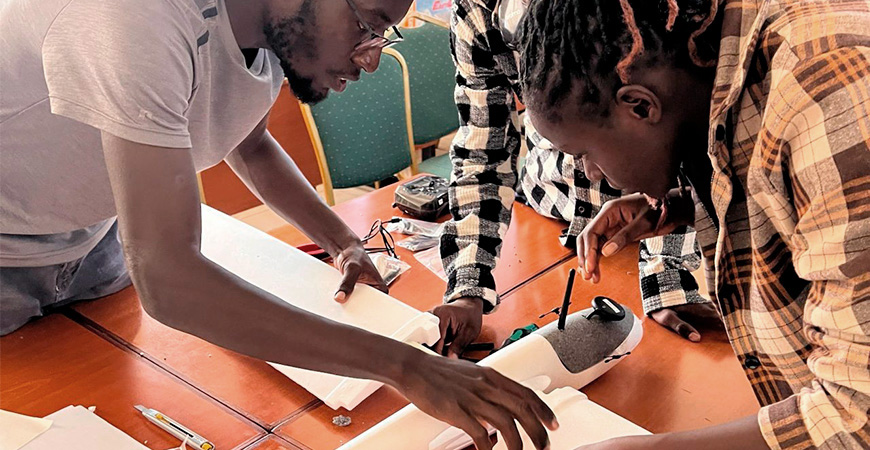
The seed funding for the CO-KENDAI project laid the foundation for a Kenya-Denmark partnership. The initiative will create an ecosystem supporting educational collaboration between Kenyan and Danish universities, promote innovation in drones, robotics, and AI, and connect companies and technology stakeholders from both countries.
Collaboration and partners
To make this vision a reality, Professor Ulrik Pagh Schultz Lundquist of the SDU Drone Center teamed up with Yvonne Brandle-Amolo of 4APioneer, an organisation dedicated to supporting sustainable partnerships between the Global South and the Global North.
Based on this collaboration, a consortium of Kenyatta University (KU) and the University of Southern Denmark (SDU) applied for seed funding for the project.
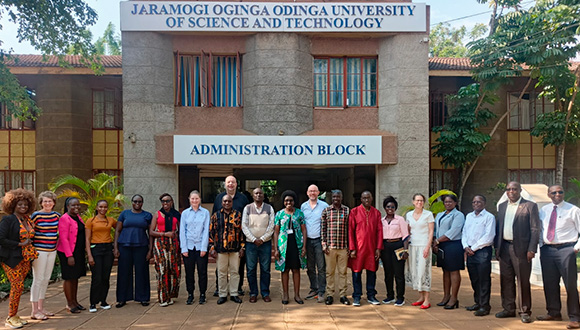
The seed funding enabled the submission of a proposal for a full partnership involving a consortium of four primary partners: Kenyatta University (KU), Open University of Kenya (OUK), Jaramogi Oginga Odinga University of Science and Technology (JOOUST), and the University of Southern Denmark (SDU).
Full partnership
Proposal submitted
Purpose
Kenya and Denmark share urgent sustainability challenges, including food production under climate pressure, water quality concerns, biodiversity loss, strained health systems, risks to cultural heritage, and security issues.
 CO-KENDAI addresses these challenges by establishing a locally rooted, institutionally sustainable education and innovation ecosystem in East Africa focused on drones, artificial intelligence (AI), and robotics. The initiative aims to build technical capacity and develop a skilled workforce to tackle these issues across seven application areas related to environmental and social sustainability.
CO-KENDAI also emphasises the integration of engineering, law, art, and innovation management, highlighting that technological development must align with regulation, user acceptance, and business development. This approach ensures that solutions generate value for society and industry, creating viable pathways from technological concepts to societal implementation.
Complementarity
Through knowledge sharing and collaboration, the four universities achieve greater progress in education, regulation, innovation, and research than would be possible individually. Similar to the advancement of Kenyan mobile money, drones offer an opportunity for growth and industrial development in Kenya. CO-KENDAI supports this by building skills, regulatory frameworks, and innovation infrastructure.
Outcomes
If funded, CO-KENDAI aims to:
- Establish a jointly governed and sustainable Kenyan–Danish partnership that co-develops and accredits MSc-level education in Kenya, strengthens teaching capacity, and fosters durable collaborations in regulation, innovation, business development, research, and practitioner education.
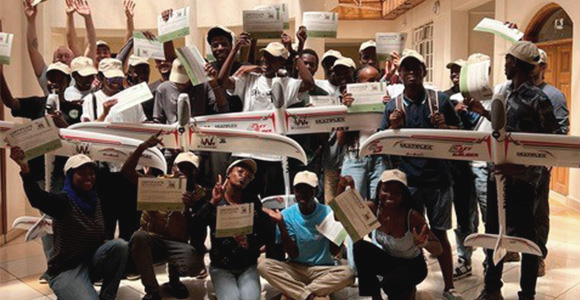
- Provide inclusive and reciprocal international learning opportunities for 500 Kenyan students: 170 will study, intern, and reside in Denmark through exchange semester courses and summer schools at SDU; 330 will participate in local and online Kenyan programs bridging Danish-Kenyan learning; and approximately 50 self-funded Danish students will study in Kenya in return.
Beneficiaries
Direct beneficiaries include students and staff at the four universities, while broader beneficiaries encompass regulators, industry, healthcare, conservation, cultural heritage, agriculture, security sectors, and local communities.
Long-term impact
By 2035, CO-KENDAI is expected to contribute to sustainable institutional collaboration, the development of locally led start-ups and market pathways, and the graduation of bicultural professionals capable of designing, regulating, and commercializing drone, AI, and robotics solutions. These graduates will be employable across Kenyan institutions and companies, Danish enterprises entering East Africa, and their own start-ups.
CO-KENDAI aims to have at least 60% of graduates to secure relevant employment, pursue further study, or engage in entrepreneurial ventures.
Partners
Open University of Kenya, Jaramogi Oginga Odinga University of Science and Technology (JOOUST), and 4APioneer as secondary partner.
Links to information on CO-KENDAI activities
- https://dfcentre.com/stories/co-designing-kenyan-danish-ai-and-robotics-for-sustainability-and-impact/
- https://www.ku.ac.ke/advancing-sustainable-innovation-through-global-partnerships/
- https://www.linkedin.com/feed/update/urn:li:activity:7480257323945373697/
- https://www.linkedin.com/posts/openunikenya_yourfutureisopen-studywithouk-ai-activity-7484153253962649601-IhRn?utm_source=share&utm_medium=member_android&rcm=ACoAAF78f9oBJ4eE2txQmnigEMVKQdoEueIFtyMhttps://www.facebook.com/share/p/1Coyd1PJZx/?mibextid=wwXIfr
- https://www.facebook.com/100093425682055/posts/pfbid0Xhbozvnf8D1hh58MVZBFuVuHGbDVf1cUeGUvwR3bScuMdnzczLXsh1gEkLQKwGQ8l/
- https://www.instagram.com/p/Da7SyCfDCTk/?igsh=enU4bjZ4aGp2YjF0
Contact
 |
Ulrik Pagh Schultz |