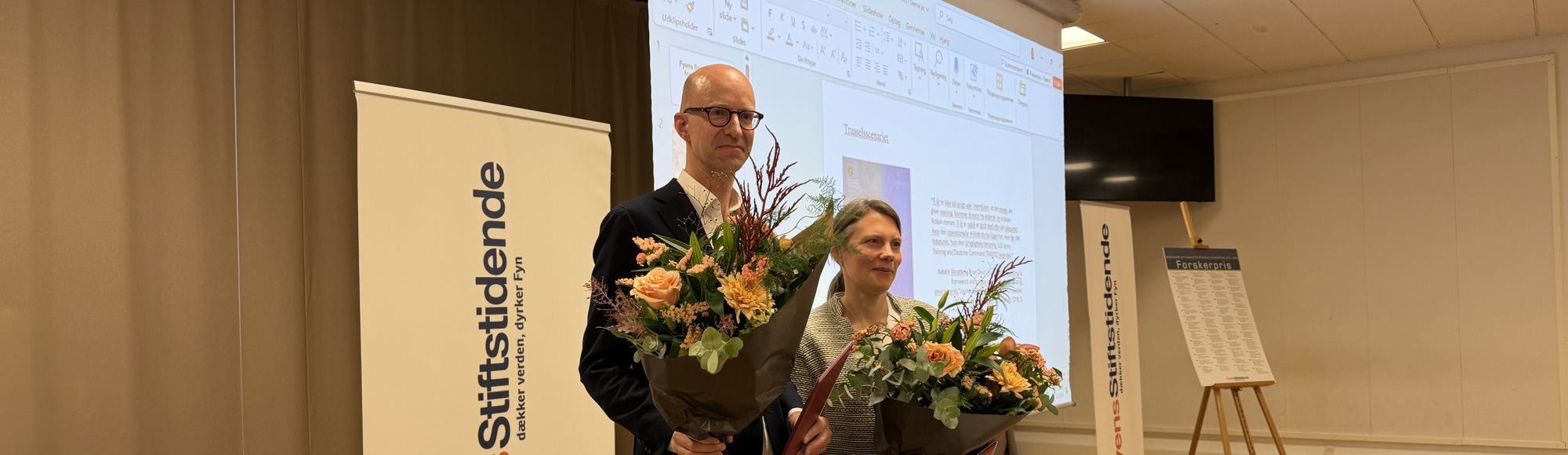
Two SDU researchers receive Fyens Stiftstidende’s Research Award 2026
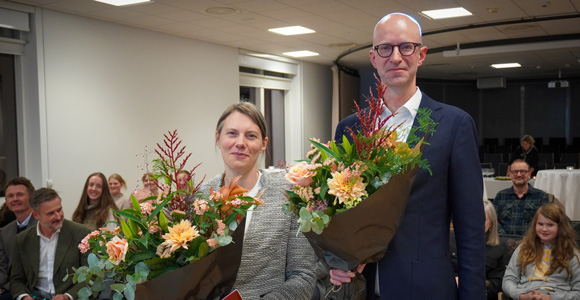
Anne Loft and Anders Engberg-Pedersen received Fyens Stiftstidende’s Research Award 2026 on 4 November for their research into fat cells and future wars. They join a distinguished group of researchers who have been honoured since 1972 with the award informally known as the ‘Funen Nobel Prize’
– Today is a particularly lovely Wednesday: we have blue skies in November, a new blue Democratic majority in the US, and here on Funen we are honouring people who know what they are talking about. All of this gives us hope. It is therefore a particular pleasure to gather here today to celebrate two researchers who insist on deepening our understanding, examining things thoroughly before drawing conclusions, and questioning everything we take for granted.
With these words, Poul Kjærgaard, editor-in-chief of Fyens Stiftstidende, opened this year’s presentation of the long-established research award at the newspaper’s offices in Odense.
At first glance, it may not be obvious how research into fat cells and future wars can offer hope. But the connection became clear as the ceremony unfolded.
Attention to detail can push boundaries
The first insights came in the speeches explaining the reasons for the awards, delivered by Jakob Møller-Jensen, head of the Department of Biochemistry and Molecular Biology, and Per Krogh Hansen, head of the Department of Culture and Language.
– Anne Loft has an exceptional eye for detail. Her research demonstrates how important it is for someone to take a closer look at something most of us try to get rid of: fat tissue. Through persistence and the courage to try new approaches, Anne Loft and her team have achieved significant results and pushed the boundaries of our understanding of fat tissue. Her work has attracted the attention of the international research community, said Jakob Møller-Jensen.
Explaining the decision to honour Anders Engberg-Pedersen, Per Krogh Hansen said:
– Anders Engberg-Pedersen’s research explores the relationship between literature, aesthetics, knowledge, war and society. He has established himself as a key voice in research into the cultural and aesthetic forms of war. His work shows how historical insight, conceptual precision and critical reflection can help us better understand today’s political, technological and democratic challenges.
The secrets of fat tissue
The sense of hope was particularly evident in the engaging lectures delivered by Associate Professor Anne Loft and Professor Anders Engberg-Pedersen that brought the ceremony to a close.
Anne Loft explained how she and her team are using new methods and single-cell analyses to uncover the secrets of fat tissue and its role in health and disease. She concluded:
– Fat tissue is therefore much more than something we simply want to get rid of. By looking closely at fat tissue and what happens when we lose weight, we open up new possibilities for developing medicines that can target the fat cells that make us ill.
Dual-use literature gains ground
Anders Engberg-Pedersen explained how the rapidly growing techno-thriller genre is influencing our security and now features on reading lists in the US military.
– The genre really took off with Singer and Cole’s Ghost Fleet, which, quite frankly, is an exceptionally bad novel. The book’s strength is that it combines storytelling with research-based analysis, allowing it to entertain, educate and help us imagine the near future, said Anders Engberg-Pedersen.
He continued:
– Dual-use literature, including Ghost Fleet and a host of other titles, is undoubtedly a symptom of the pre-war period we are living through. But that should not stop us from asking critical questions about it. There is, after all, no guarantee that the future will be a bestseller, and perhaps our imagination is constrained when literature can envisage only two or three futures in which the usual great powers are at war.
Den Fynske Bladfond, which owns Fyens Stiftstidende, has presented Fyens Stiftstidende’s Research Award since 1972. Playfully referred to as the ‘Funen Nobel Prize’, the award comes with DKK 25,000 for each researcher.