The lab develops and evaluates agentic AI, LLM-supported diagnostics, and advanced machine-learning workflows through applied case studies in energy informatics, smart buildings, and industrial energy systems.
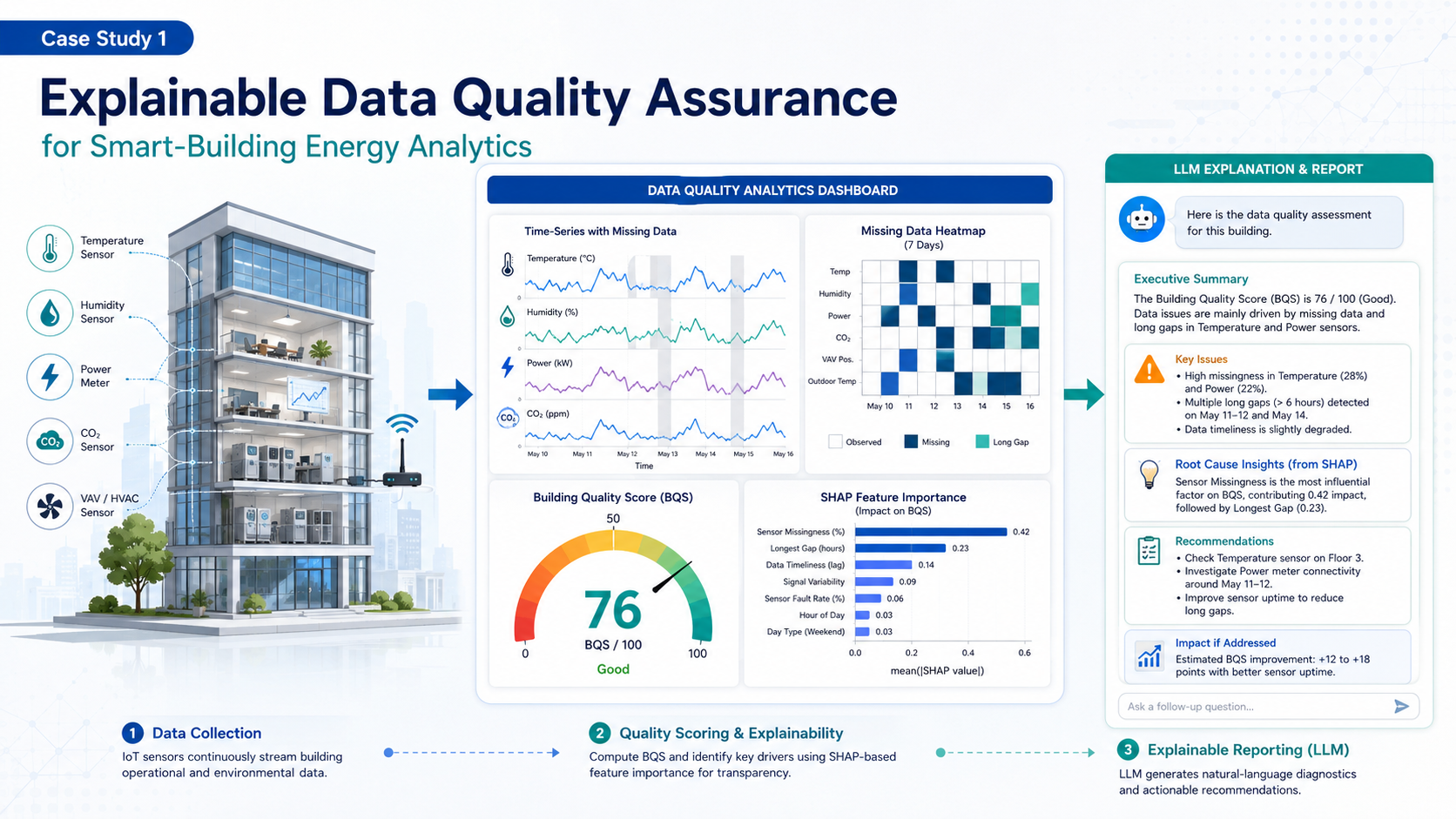
Explainable Data Quality Assurance for Smart-Building Energy Analytics
This case study demonstrates how automated data-quality assessment, explainable AI, and lightweight LLM-based reporting can support reliable energy analytics in smart buildings. Using the ADRENALIN smart-building dataset, the study developed a modular pipeline for profiling time-series data, detecting missing values, timestamp irregularities, and statistical anomalies, and aggregating these indicators into a Building Quality Score. SHAP analysis was used to identify which data-quality factors most strongly influenced non-intrusive load monitoring performance, while an LLM module translated diagnostic charts and quality metrics into concise, human-readable explanations. The case study shows how LLM-supported diagnostics can improve transparency, dataset selection, and preprocessing decisions for AI-based energy analytics.
Publication:
Tolnai, B. A., Ma, Z., Jørgensen, B. N., & Ma, Z. G. (2025). An automated domain-agnostic and explainable data quality assurance framework for energy analytics and beyond. Information, 16(10), 836. https://doi.org/10.3390/info16100836
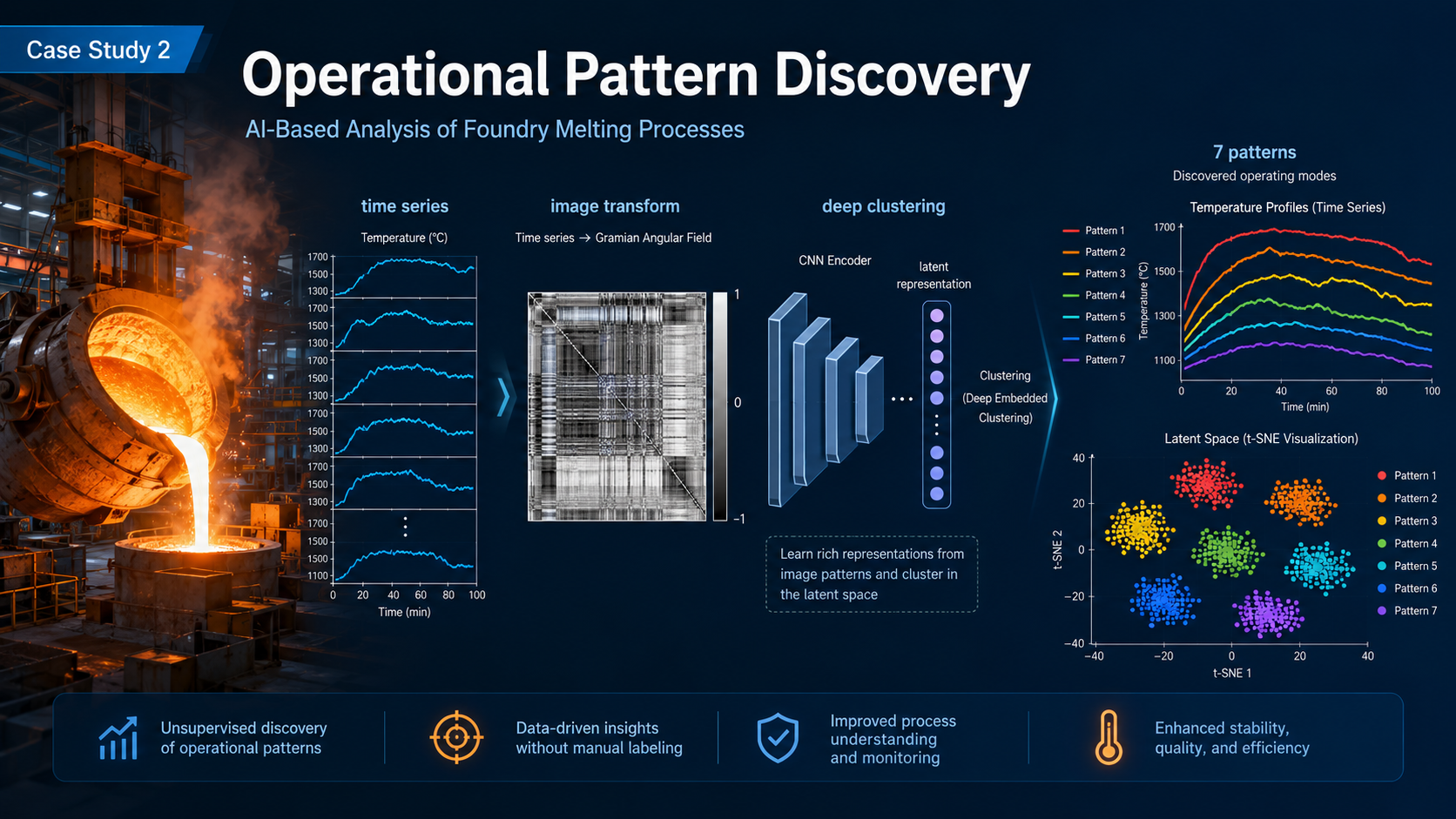
AI-Based Operational Pattern Discovery in Foundry Melting Processes
This case study applies deep unsupervised learning to discover operational patterns in energy-intensive industrial furnace processes. The study developed TS-IDEC, an image-based convolutional clustering framework that transforms furnace temperature time series into grayscale matrix representations, learns latent features through a deep convolutional autoencoder, and combines soft and hard clustering with a composite internal evaluation metric. Applied to more than 3900 melting operations from a Nordic foundry, the method identified explainable operational modes with different energy consumption, thermal dynamics, and production durations. The case study illustrates how AI can support industrial process diagnostics, energy-efficiency benchmarking, and data-driven operational improvement without requiring labeled process data.
Publication:
Ma, Z., Jørgensen, B. N., & Ma, Z. G. (2025). Discovering operational patterns using image-based convolutional clustering and composite evaluation: A case study in foundry melting processes. Information, 16(9), 816. https://doi.org/10.3390/info16090816
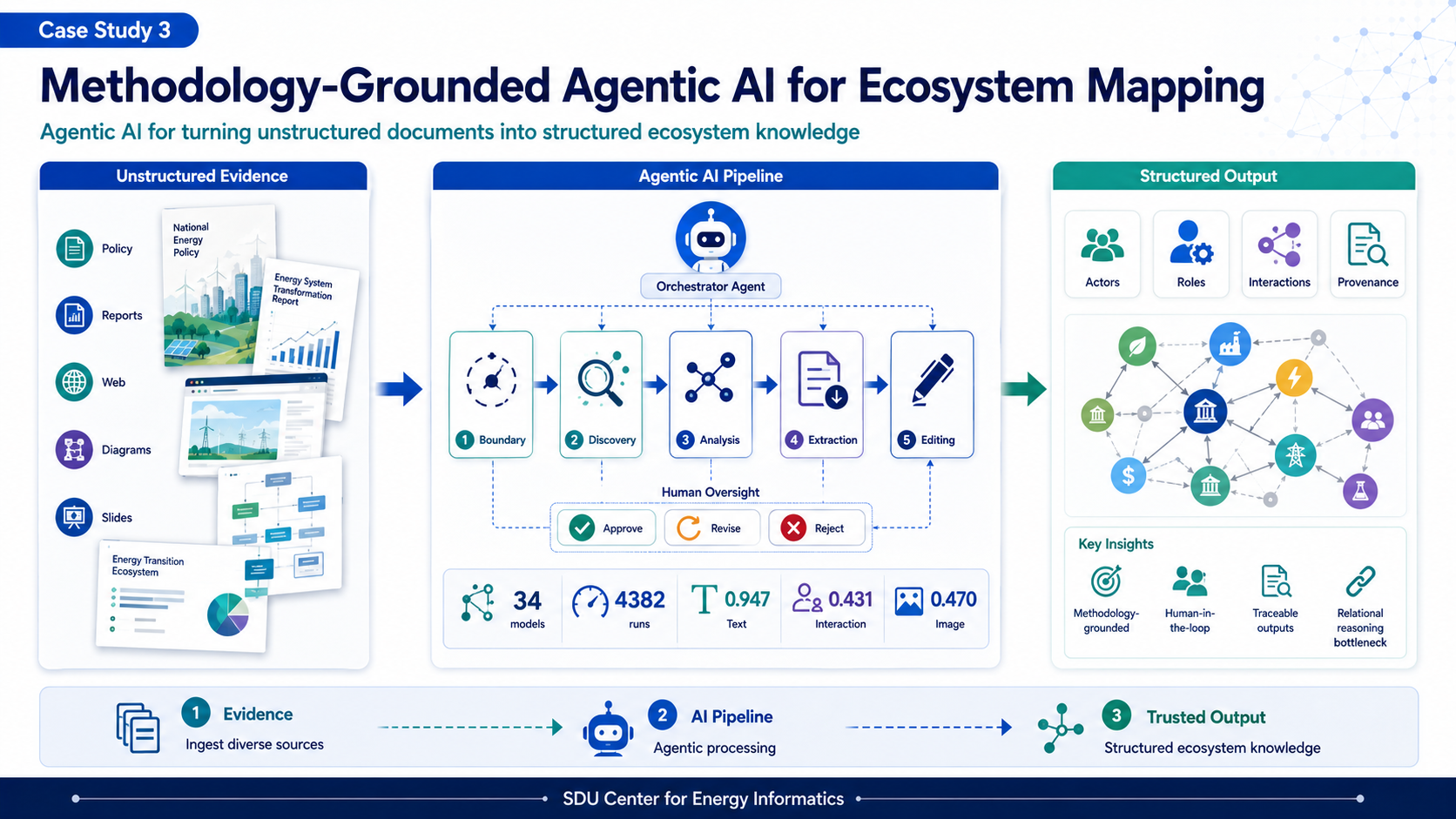
Methodology-Grounded Agentic AI for Ecosystem Mapping
Business ecosystem modelling requires analysts to transform heterogeneous and unstructured evidence, such as policy documents, reports, web resources, and diagrams, into structured representations of actors, roles, and interactions. This process is often labor-intensive, difficult to scale, and dependent on expert interpretation. Generative AI offers new opportunities to support this work, but it also introduces risks related to hallucination, inconsistency, weak traceability, and reduced human accountability.
This case study presents a methodology-grounded multi-agent AI pipeline for constructing structured business ecosystem maps from unstructured document collections. The pipeline decomposes the modelling process into specialized agent functions, including boundary specification, source discovery, document analysis, semantic extraction, and controlled model editing. A central orchestrator coordinates these agents, while ontological constraints ensure that extracted actors, roles, and interactions follow a formal modelling methodology. All proposed changes to the ecosystem map are staged for human review before integration, and each map element maintains explicit provenance links to the source material.
The study also develops a hybrid evaluation framework for assessing the reliability and correctness of generative modelling pipelines. The framework combines operational reliability metrics, semantic assessment using an LLM-based judge, and human agreement validation. Empirical evaluation across 34 generative models and 4382 experimental runs shows that text-based extraction can achieve high semantic match scores, while interaction extraction and visual diagram interpretation remain key bottlenecks. The findings highlight the importance of task-aligned model selection, methodology anchoring, human oversight, and provenance-aware governance for trustworthy agentic AI in structured knowledge construction.
Publication:
Gärdström, H. F., Jørgensen, B. N., & Ma, Z. G. (2026). Agentic Generative AI for Methodology-Grounded Modelling from Unstructured Documents: Design and Evaluation of a Multi-Agent Ecosystem Mapping Pipeline. Information, 17(6), 570. https://doi.org/10.3390/info17060570