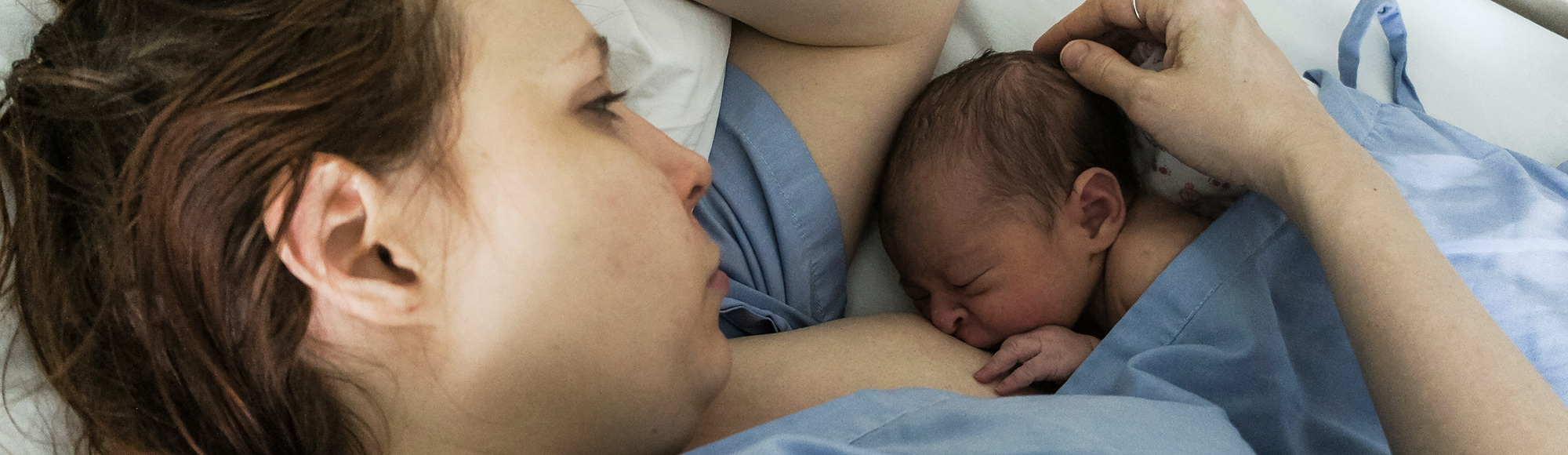
What is birth trauma?
A traumatic birth experience can affect not only the birthing parent but also the co-parent and the family as a whole. But how common is birth trauma, how can it be identified, and what do we know about its consequences? Associate Professor of Clinical Child Psychology Sille Schandorph Løkkegaard and psychology student Camilla Kolath Mortensen answer five key questions about birth trauma.
Many people associate birth trauma with a dramatic or life-threatening birth. However, a traumatic birth experience can also occur following a birth without serious medical complications. Research shows that both birthing parents and co-parents can experience trauma symptoms or develop birth-related post-traumatic stress disorder (PTSD).
1. When does a birth experience become traumatic?
Two people can experience the same birth very differently. A birth may be perceived as traumatic even when it proceeds without major medical complications. Birth trauma can arise when the birth is experienced as threatening, life-threatening or characterised by an overwhelming loss of control.
Facts about birth trauma
- Birth trauma is about how the birth is experienced, not only about what happened medically.
- Around one in four birthing parents experience birth-related trauma symptoms.
- International research shows that 3–4% of birthing parents develop birth-related PTSD.
- Birth trauma can affect parents, children and family life.
- Fathers and other non-birthing parents can also experience birth trauma.
- Birth-related trauma and PTSD often go unrecognised.
- An international screening tool for birth trauma is currently being evaluated among Danish parents.
2. How many people experience trauma symptoms or PTSD after giving birth?
International research suggests that around one in four birthing parents experience birth-related trauma symptoms. These may include recurring flashbacks, in which they vividly relive specific distressing events from the birth, or avoidance behaviours that make it difficult to process the birth experience and, in some cases, affect bonding with the baby.
Internationally, 3–4% of birthing parents and 1–2% of fathers develop birth-related PTSD. Based on the annual number of births in Denmark, this corresponds to approximately 3,400 Danish parents developing birth-related PTSD each year. Despite this, the extent of the problem has not yet been investigated in Denmark.
3. How can birth trauma affect parents, children and family life?
When a birth is experienced as traumatic, the consequences can extend far beyond the birth itself. Trauma symptoms in either the birthing parent or the co-parent may affect the relationship between the parents, the parent–child relationship and the wellbeing of the family as a whole.
Research has identified links between birth trauma and an increased risk of anxiety and depression, relationship conflict and potentially difficulties in early parent–child interactions. As a result, there is growing recognition of the importance of understanding birth trauma from a family perspective rather than solely as an individual problem.

Facts about the subject
Advice for parents who are struggling after childbirth
- Talk about how you are feeling. Share your thoughts and feelings with someone you trust – this could be your partner, a friend or a healthcare professional.
- Seek help if the birth experience continues to affect you. Psychological reactions after childbirth can vary. Contact a healthcare professional if it affects your daily life.
- You are not alone. Many parents experience psychological reactions after a traumatic birth.
- Do not wait too long to seek help. Getting support early can make a real difference.
- Help is available. Most people improve with the right support and treatment.
4. How is birth trauma identified?
Despite its far-reaching consequences, birth-related trauma and PTSD often go unrecognised. A well-established screening tool is now available to identify birth-related trauma and PTSD: the City Birth Trauma Scale (City BiTS), which has been evaluated in more than 40 countries, although not yet in Denmark.
Early identification is an important first step in ensuring that families affected by birth trauma receive the support and help they need. For this reason, we are currently investigating how the Danish version of City BiTS performs among Danish parents.
5. Can fathers and other non-birthing parents also experience birth trauma?
While most people understand that birth can be traumatic for the birthing parent, who may experience severe pain and a loss of control over their own body, it is easy to overlook that birth can also be a distressing and potentially traumatic experience for fathers and other non-birthing parents.
As a result, we know less about how birth trauma affects this group and how many develop trauma reactions or trauma-related symptoms following a birth.
Non-birthing parents are often overlooked in the aftermath of a traumatic birth. They are seen as supportive partners and a source of support for the birthing parent, rather than as new parents who may themselves have been traumatised by the experience of almost losing their child and/or partner.
There is also considerable evidence to suggest that co-parents themselves tend to downplay the impact the experience has had on them. As a result, their trauma often goes unrecognised until much later, which can have serious consequences for the individual, the family and the infant.
We see the same pattern in our own study of birth-related PTSD, in which we are evaluating the Danish version of a screening tool for birth trauma. So far, more than 400 birthing parents have taken part, while only five co-parents have completed the questionnaire. If we are to gain a better understanding of how the questionnaire works for co-parents, it is important that more of them participate.
Take part in research on birth trauma
Have you given birth within the past year? Or have you been involved in the birth as a father or another non-birthing parent?
The researchers behind the study are looking for birthing parents, fathers and other non-birthing parents who have been present at their child's birth within the past year.
The aim is to improve our understanding of how birth trauma and birth-related PTSD affect Danish families and how these reactions can best be identified.
Take part in the study here:
https://www.survey-xact.dk/LinkCollector?key=2LVQEA9HU6C6
Please feel free to share the study with other parents.
Meet the researcher
Sille Schandorph Løkkegaard is an associate professor of clinical child psychology at the Department of Psychology

Meet the researcher
Camilla Kolath Mortensen is a pregraduate psychology student at the Department of Psychology.