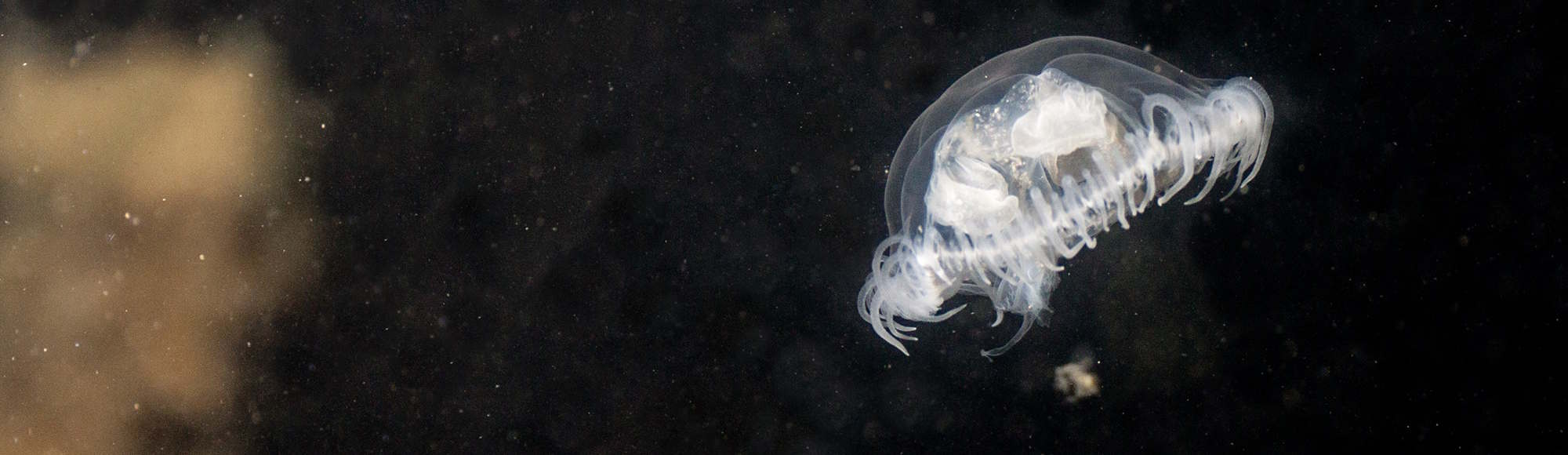
Freshwater jellyfish could threaten Danish lakes
Most jellyfish live in saltwater—but a tiny, almost invisible species inhabits freshwater. It has now spread to six continents and has also reached Denmark. The concern is that this invasive species may threaten life in our lakes.
You may have been near it without knowing. Most people are unaware that jellyfish can live in freshwater—and when you also learn that this one rarely grows larger than two millimetres, the chances of noticing it are quite small.
But Craspedacusta sowerbyi, as this tiny freshwater jellyfish is called, does exist. It likely originates from the Yangtze River in China and, aided by climate change, has now spread invasively to six continents—only Antarctica remains unreported. In Denmark, it has been confirmed in Lake Lyngby, but whether it exists in other lakes or in what numbers is, according to biologist and jellyfish expert Jamileh Javidpour from the Department of Biology, still unknown.
“I can conclude, however, that it is not yet present in large numbers in Danish lakes—otherwise we would have detected more of them in our water samples. That is encouraging, as it gives us a realistic opportunity to tackle them before they become too numerous and it is too late,” she says.
Reproduce when water temperatures exceed 20°C
The problem with these seemingly harmless mini-jellyfish is that they feed on fish eggs and compete with fish larvae for food. As a result, they can threaten—or even eliminate—a lake’s fish population.
“In Germany, they are now so widespread that removal is no longer realistic. When water temperatures exceed 20°C, they can reproduce and survive—in other words, establish stable populations. And since summers in Denmark are becoming longer and warmer, we must expect them to establish themselves here as well,” says Javidpour.
She therefore recommends initiating systematic water sampling in representative lakes. If freshwater jellyfish are detected, efforts should focus on removing them at the polyp stage.
How they spread from lake to lake
Freshwater jellyfish reproduce when the eggs of two mature individuals develop into a larva, which then turns into a polyp that attaches to surfaces such as plastic debris, stones, or floating algae. From these polyps, new jellyfish form by budding.
“I cannot guarantee that we can remove them entirely this way, but targeting the attached polyps would be the most effective approach,” says Javidpour.
The tiny jellyfish can spread from lake to lake in several ways: they may cling to canoes moved between lakes, hitchhike on fish or aquatic plants introduced into new waters, or even attach to birds visiting different lakes.
Denmark does not have the same focus
For Javidpour, it is problematic that the invasive freshwater jellyfish is largely unknown in Denmark. More broadly, she believes awareness of invasive species is insufficient:
“We do not have the same focus on invasive species as other countries. The comb jelly has also arrived in Danish waters, but we are not doing anything to remove it. That increases the risk of ‘jellyfication’—where jellyfish dominate to such an extent that fishermen catch little else because fish are outcompeted by massive jellyfish populations. We need a monitoring system in Denmark,” she says, pointing to Canada and Hawaii as examples of regions that are far more proactive, including by engaging the public.
“For example, in Canada boat owners must clean their boats before moving them between water bodies. That is not something we do in Denmark. We simply do not have that mindset,” she adds.
Mostly unknown in Europe
The lack of awareness in Europe has been documented by Javidpour and colleagues in a scientific study published in People and Nature (British Ecological Society).
In the study, Javidpour and colleagues from a number of Europea research institutions distributed questionnaires across their networks in 17 European countries. A total of 1,388 responses revealed, among other findings, that only 10% of respondents—mainly researchers and others expected to have above-average knowledge of aquatic environments—were able to correctly identify the freshwater jellyfish by its Latin name, C. sowerbyi.
Respondents were also asked where they had seen the jellyfish shown in the survey. Among those who believed they had seen it in nature, 49% said they had seen it in the sea, even though C. sowerbyi lives exclusively in freshwater.
“Despite being present on six continents, C. sowerbyi remains largely unknown to the general public in Europe. It is problematic that knowledge of less charismatic invasive species is so limited, as they make up a significant share of invasive species,” says Javidpour.
Other invasive species that, according to Javidpour, similarly go under the radar include the crustacean Hemimysis anomala, the water flea Bythotrephes longimanus, and the snail Pomacea canaliculata.
Meet the researcher
Jamileh Javidpour is a biologist and expert on jellyfish. She is an associate professor in the Ecology Group at the Department of Biology and the SDU Climate Cluster.