Does dark matter leave fingerprints on the Universe?
Dark matter may reveal itself through fingerprints left behind in galaxies and galaxy clusters. Physicists have now developed new tools to investigate what such signatures might look like, potentially bringing us a step closer to understanding the elusive nature of dark matter.
We cannot see or measure dark matter directly. Yet scientists are convinced that it exists and that it accounts for around 85 per cent of all matter in the Universe, including the matter that everything here on Earth is made of, from earthworms and mountains to seawater and washing machines.
A wealth of astronomical observations supports the existence of dark matter, but we cannot see it directly because it neither emits, absorbs nor reflects light. What scientists can do, however, is look for its indirect traces. That is what astroparticle physicist Martin Rosenlyst Jørgensen is working on. He holds a PhD in particle physics from SDU and is now conducting research at the MIT Kavli Institute for Astrophysics and Space Research, USA.
“If we can identify the fingerprints that different forms of dark matter leave on galaxies and galaxy clusters, we may be able to uncover which fundamental particles and forces are hiding in the dark sector of the Universe,” he says.
A new simulation code
Together with colleagues from the Massachusetts Institute of Technology and Harvard University, he has published a scientific paper in Monthly Notices of the Royal Astronomical Society. In it, the team presents a method that can help predict what such indirect signatures might look like.
The researchers have developed a highly flexible and efficient simulation code, making it possible to explore the particle physics of many different forms of dark matter and to incorporate new models more easily, without having to develop simulation methods from scratch each time. The simulation method itself is therefore the key new result, while the search for dark matter’s fingerprints is the scientific opportunity it opens up.
“We normally assume that dark matter interacts with other matter almost entirely through gravity. But why should dark matter necessarily be so simple? The visible matter that makes up us, the planets and the stars contains an entire world of different particles and forces. We know that. Perhaps dark matter also has unknown forces of its own that leave a kind of fingerprint on the Universe,” says Martin Rosenlyst Jørgensen.
4.000 years of computing
He believes that dark matter may be able to collide with itself. If it does, such collisions could, over billions of years, alter the way dark matter is distributed in structures such as galaxies. That could potentially give astronomers something to look for: fingerprints. But to know what those fingerprints might look like, physicists first need to simulate the process. That is precisely what Martin Rosenlyst Jørgensen and his colleagues are working on.
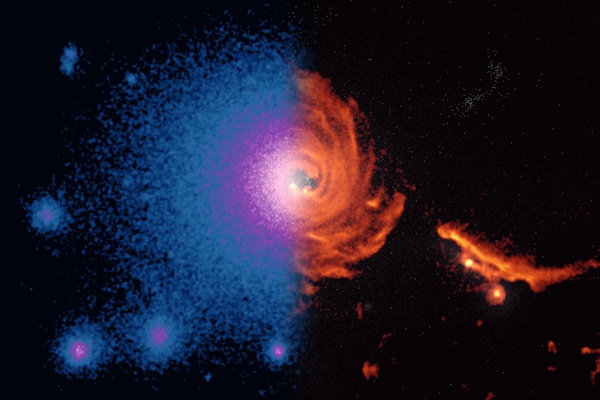
Their simulation tool can run different dark-matter models across a wide range of astrophysical systems, from small dwarf galaxies and satellite galaxies orbiting larger galaxies to colossal collisions between galaxy clusters.
For part of this work, the research team has been allocated 37 million CPU hours through the American ACCESS supercomputing programme. That is equivalent to more than 4,000 years of continuous computing on a single CPU core.
Must be able to explain all systems in the Universe
Finding a model that can explain dark matter in one system in the Universe, such as a dwarf galaxy, does not necessarily mean success. The model must also be able to explain all the other systems in the Universe. Dark matter cannot follow one set of rules in a dwarf galaxy and another in a galaxy cluster.
Dark matter gathers in vast, invisible structures around galaxies and galaxy clusters. These systems have very different densities and velocities, meaning that the same dark-matter model can produce very different effects.
“We are not simply trying to find dark matter’s fingerprints in one place in the Universe. The same theory has to be able to explain observations across very different systems, from ‘small’ dwarf galaxies to enormous collisions between galaxy clusters. By combining these tests, we can distinguish much more effectively between different dark-matter theories and potentially rule some of them out,” says Martin Rosenlyst Jørgensen.
One of the next challenges will be to connect the enormous volumes of data generated by the simulations with astronomical observations. Jørgensen expects artificial intelligence to become an important tool in this work.
The idea is to train algorithms on simulated universes, allowing them to learn to recognise the structural patterns produced by different models. They could then help determine which models best match observations of the real Universe provided by astronomers.
“By bringing particle physicists and astronomers together in this way, we can move from theories about invisible particles to concrete signatures that astronomers can actually look for in the Universe,” says Martin Rosenlyst Jørgensen.
Meet the researcher
Martin Rosenlyst Jørgensen holds a PhD in particle physics from the Department of Physics, Chemistry and Pharmacy, where he also supervises master’s students and thesis projects. He is a Carlsberg Internationalisation Postdoctoral Fellow at the MIT Kavli Institute for Astrophysics and Space Research, USA. His research combines particle physics with advanced cosmological computer simulations and uses AI to connect predictions from simulations with astronomical observations.