Ongoing Phd Projects
Description
The aim of this PhD project is to develop integrated modelling and control methods for industrial electromagnetic vibratory systems (EVS) used for conveying, separating, sorting, and weighing. An EVS combines an electromagnet, a spring mounted vibrating element, and an electronic driver circuit that injects controlled current pulses to excite mechanical resonance. The project develops linked models of the mechanical dynamics, the power electronics, and the digital control loops, including effects from load changes, ageing related variations in spring and damping parameters, and mechanical coupling in multi lane systems. The work includes optimization of cost-effective driver circuits under thermal and regulatory constraints such as EMI and EMC, conversion of mechanical models to electrical equivalents for co-simulation, and development of hierarchical control strategies that adjust pulse timing and phase between lanes to reduce coupling interference. Prototypes are built and experimentally validated on Newtec hardware.
Click here to see the poster.
Description
Aerial manipulation represents a significant advancement in robotics, integrating unmanned aerial systems with robotic end-effectors to enable physical interaction with the environment. Unlike conventional drones used primarily for observation, aerial manipulators can perform complex tasks such as grasping, transporting, and assembling objects in hard-to-reach or hazardous locations. This capability opens new possibilities in areas such as infrastructure maintenance, where tasks like inspection and repair can be performed more safely and efficiently.
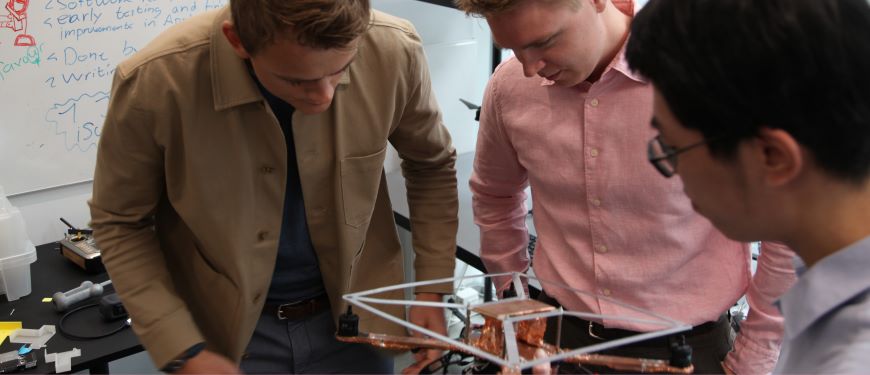
This research focuses on extending the capabilities of aerial manipulators to drilling applications - an area that remains largely unexplored. Central to this work is the development of an overactuated multirotor platform, designed to provide the enhanced control authority and stability required for interaction-intensive tasks. Two primary use cases are investigated: downward drilling and horizontal drilling. The project aims to develop a novel aerial system capable of downward drilling, while also improving the performance of horizontal drilling manipulators through faster electronics, more efficient computation, and advanced sensing solutions. Additionally, methods for tracking points of interest, such as drill targets, will be explored.
By addressing current limitations in mechanical design, control architectures, and system responsiveness, this research seeks to enable aerial systems to perform high-precision, high-force interaction tasks. Leveraging the advantages of overactuation - such as decoupled force and motion control - this work aims to expand the capabilities of aerial manipulation and unlock new applications in complex and demanding environments.
Click here to see the poster.
Description
The purpose of this PhD is to advance the development of autonomous unmanned aerial vehicles (UAVs) capable of extending their operational endurance through contactless, inflight energy harvesting from the electromagnetic fields surrounding powerlines. While prior research has explored UAV recharging by physically attaching to powerlines, such approaches interrupt mission continuity and limit efficiency. This work aims to overcome these limitations by enabling continuous inspection and simultaneous battery replenishment. The research will focus on designing and integrating lightweight, power-efficient hardware such as optimized electromagnetic coils and a custom electronic board combining neuromorphic and conventional processing systems. Event-driven vision and spiking neural networks will be leveraged to detect, track, and navigate along powerlines in real time. To achieve this, both real and synthetically generated event-based datasets will be used for training the models. By combining advanced sensing, adaptive flight control, and efficient energy harvesting, the project seeks to demonstrate a fully autonomous UAV system that can sustain longer missions without downtime.
Click here to see the poster.
Description
Modern high-voltage powerline networks depend on regular, manual inspection to ensure safe operation. This PhD project aims to develop an autonomous robotic system for inspecting powerlines and transmission towers to help prevent failures and improve infrastructure safety. The research focuses on a hybrid robot capable of both flying near powerlines and moving directly along them, enabling flexible and efficient inspection. By integrating onboard intelligence, safe autonomous operation, and energy harvesting from powerlines, the project seeks to enable long-term, low-cost, and scalable inspection of electrical grid infrastructure.
Click here to see the poster.
Former PhD projects
Description
The core aim of the PhD project is to research, implement, and evaluate technologies that as a system enable highly performing and reliable grasping of overhanging power cables by a UAV. Recent research and development conducted under the Drones4Energy project have provided insights into some of the challenges associated with such task. Among these challenges is the effect of wind on both the UAV and the cable to be grasped. The undertaken research aims to find ways to mitigate these challenges and thus make the system indifferent to these external disturbances. Positioned in proximity of an overhanging power cable, the UAV must be able to consistently approach and grasp the cable under various weather conditions in a real environment. To achieve reliable and robust approach of the cable as well as consistent perception of the cable, the UAV must be able to hover stably and react immediately to wind disturbance. Since unintended contact with high voltage power cables pose a risk of damage to the UAV, the UAV must be able to withhold desired attitude and position with only a minimal tolerable deviation. Research must be conducted exploring ways to ensure this. Subjects to consider are the physical structure of the UAV, including embodiment as a mitigating factor for stable hover under wind disturbance, as well as investigations of low-level control approaches.
Click here to see the poster.
Description
Power Line Detection for Autonomous Drone Navigation: The aim of this PhD project is to develop systems for detecting, categorizing, and pose estimating overhead cables with equipment onboard a UAV. This includes experimenting with different sensors, developing the necessary computer vision algorithms, implementing hardware acceleration to reduce latency and power consumption, and making it fit into a constrained power and weight budget. Building a fully autonomous system requires powerful hardware for sensing the environment, understanding and interpreting the incoming data, and calculating appropriate actions based on the perceived surroundings, for example which power line to fly to and land on.
Click here to see the poster.
Description
The aim of this PhD project is to develop an intelligent grasping system enabling a drone to land on and recharge the battery from the alternating magnetic field around the overhead power lines. Using drones for power line inspection has much more benefits than the traditional method of using helicopters. However, the short operating time is a challenging problem preventing drones from being used in long-range missions. The electromagnetic field around the energized power cable is a potential source to charge drones and thus extend the operating range as they do not need to return to the base station for swapping batteries or charging. An intelligent grasping manipulator will be developed in this project to help the drone take advantage of the magnetic field for two tasks: firmly grasp the cable and charge batteries. The grip will also be maintained regardless of the power line's current level.
Click here to see the poster.