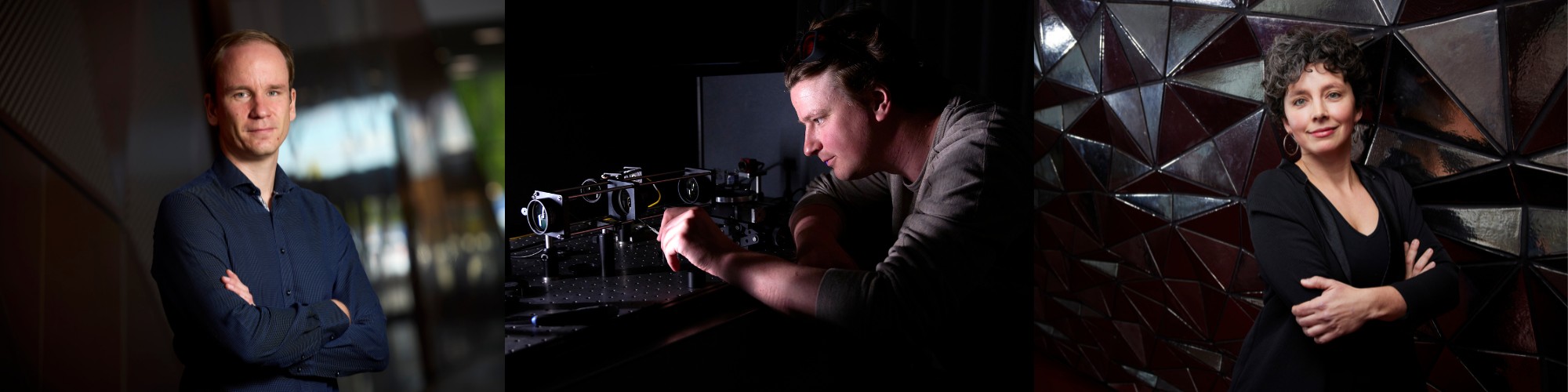
Spin-outs Denmark: 55 researchers have completed the programme – nine from SDU
More high-quality research need to move from universities into the market. 55 researchers have had that focus in the Spin-outs Denmark programme — and 20 of the projects have developed into companies
Since 2021, Spin-outs Denmark has been working systematically to equip early-career researchers with the skills and tools needed to take the leap into entrepreneurship.
The results after the programme’s first five years are significant.
- 55 researchers have completed the programme’s one-year course, and as many as 20 projects have now developed into companies, with more on the way, says Programme Director and Chair of the Steering Committee Søren E. Frandsen, who is also Vice Director for Research and Innovation at the University of Southern Denmark (SDU).
Spin-outs Denmark is organised as a joint national programme for all eight Danish universities and is coordinated from SDU.
A recalibrated business compass
Nine researchers from SDU have participated in the programme as translational postdocs. They have received teaching in entrepreneurship-related subjects, collaborated with mentors, and met investors.
”It has shifted my focus from proving what is possible to delivering something that is used.
Former participant Andreas Gejl Madsen is still well underway on his journey towards the market. He works with technology that uses holographic light to print everything from biological tissue to prosthetics, and he says that Spin-outs Denmark gave participants the freedom to shape the direction of their own projects.
- At the same time, we received honest and direct feedback from experienced profiles and investors, who clearly articulated what they are looking for. That has made us much sharper in terms of both our positioning and our next steps, he explains.
According to Programme Director Søren E. Frandsen, business clarification is one of the strengths of Spin-outs Denmark, where researchers gain access to business competencies, mentoring, and sparring much earlier in their careers than is normally the case.
A spin-out takes flight
Kristian Husum Laursen is SDU’s first participant in the programme. He has used it to take a leap and start his own spin-out: the drone company CODRONE. Here, Spin-outs Denmark has been a partner in the process of changing mindset.
”The programme’s deeper impact may lie in the growing understanding and acceptance that commercialisation of research results and the establishment of spin-outs are not a deviation from academia, but a possible extension of academic life without compromising scientific integrity.
As a researcher, you are trained to come up with new ideas and to have evidence for what you conclude. Kristian explains that there is a clear shift involved in making the jump from researcher to entrepreneur.
- Today, I run CODRONE, where we develop autonomous drone solutions for critical infrastructure, and that has made the transition from researcher to entrepreneur very concrete. It is no longer just about the idea, but about getting the technology to function reliably in real-life operations and creating value for customers with specific, immediate needs, says Kristian Husum Laursen.
- It has shifted my focus from proving what is possible to delivering something that is used.
Sparring matters
Not all SDU researchers go on to start companies. In several cases, researchers move on with important learning and a better understanding of business, which they can apply in other parts of their careers.
Facts: The Spin-outs Denmark programme
- Spin-outs Denmark is a one-year programme for junior researchers who dream of creating a company based on their own research (a spin-out).
- 55 one-year postdoctoral grants have been awarded to researchers from Denmark’s eight universities from 2021–2026.
- 20 of the supported researchers have established companies based on their research, which together have attracted approximately DKK 180 million in funding and investments for further development.
- In 2025, Spin-outs Denmark received the ASTP European Impact of the Year Award.
- With new funding of up to DKK 90 million – DKK 42 million from the Villum Foundation, up to DKK 46 million from Innovation Fund Denmark, and approximately DKK 25 million from the universities – the initiative is being scaled up and will continue.
Read more at spinouts.dk
Ïo Valls-Ratés participated in Spin-outs Denmark with a project she has chosen not to pursue further. Instead, the programme has resulted in her collaborating with a research colleague on his spin-out – thereby putting her learning into practice.
- It was crucial for my development to come together with other researchers who themselves had emerging startup ideas. Taking part in masterclasses with them made it interesting, because we could both get their input on our ideas and hear about their experiences, says Ïo Valls-Ratés.
Mentorship and peer-to-peer sparring are a central idea in the programme and are generally experienced as valuable among participants – even if the process does not result in a company registration number (CVR).
A change in culture
Programme Director Søren E. Frandsen sees that the programme has not only created companies – it has also shifted a culture.
- We have succeeded in creating a joint, national programme that has strengthened collaboration between the universities and clarified and reinforced systematic work with research-based spin-outs. This gives early-career researchers better opportunities to gain entrepreneurial experience early in their careers – experience that is crucial for the researchers of the future, he says, adding:
- The programme’s deeper impact may lie in the growing understanding and acceptance that commercialisation of research results and the establishment of spin-outs are not a deviation from academia, but a possible extension of academic life without compromising scientific integrity.
The work continues
Although the results speak for themselves, Søren E. Frandsen emphasises that the potential is far from fully realised. The work to create more research-based companies in Denmark therefore continues.
The first phase of the Spin-outs Denmark programme concludes in 2026 and will then continue in a new phase that includes the health sciences field, supported by both the Villum Foundation and Innovation Fund Denmark.
It remains a collaboration between all eight universities – this time with up to 82 grants.
SDU-postdocs in the programme and their focus
- Kristian Husum Laursen – drone surveillance and security
- Ïo Valls-Ratés – voice training using virtual reality
- Bhushan Patil – small solar cells to replace batteries
- Jesper Puggaard de Oliveira Hansen – adaptation of production machinery
- Nicolaj Haarhøj Malle – a flying drone tool
- Magnus Jensen – scanner for cancer surgery
- Adrian Radomski – sensor for cardiac patients
- Nathali Herold Solon Pilegaard – business in the worlds of fiction
- Andreas Gejl Madsen – instant 3D fabrication using holographic light