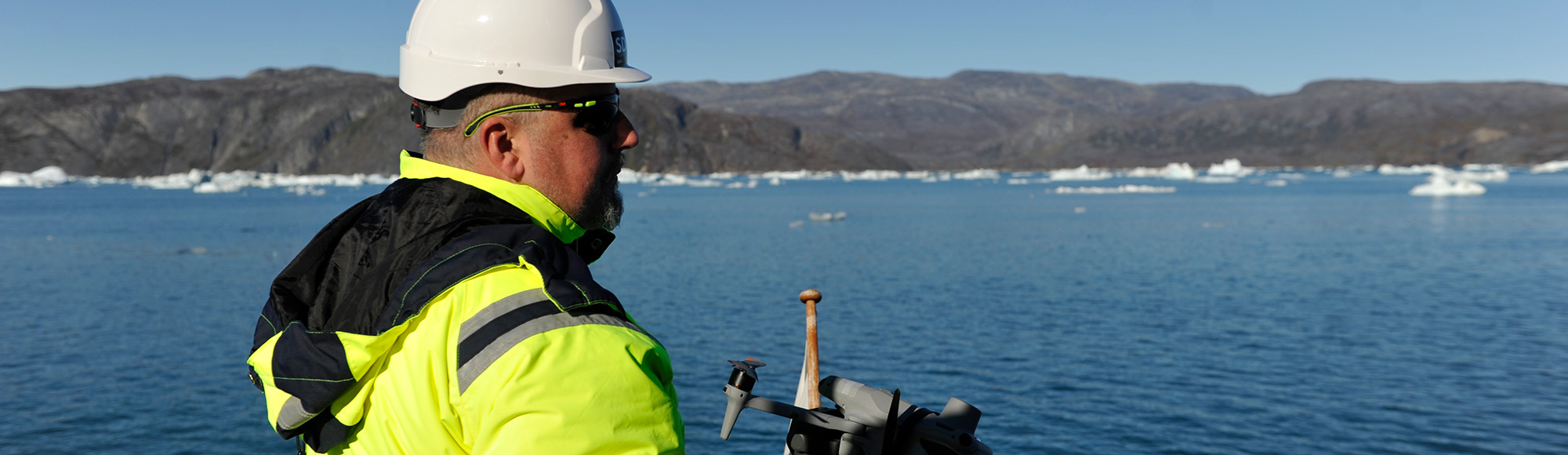
SDU tests rescue drones in the Arctic
Together with the Alexandra Institute and the Joint Arctic Command, drone researchers from the University of Southern Denmark (SDU) have tested drones for rescue operations in Greenland and collected data for AI models that can help locate people in distress.
Anyone who has seen the DR documentary series 'De arktiske reddere' knows that rescue operations in Greenland are relatively frequent, extremely serious, and that it can be surprisingly difficult to find those in need of help on the world’s largest island.
Within a few years, rescuers may perhaps get help from drones. At least, researchers from the SDU UAS Center and SDU Mechatronics, in collaboration with the Alexandra Institute and the Joint Arctic Command, have tested drones for use in rescue operations in Arctic areas in the ARCSAR pilot project.
- It is not new that drones can be used in rescue operations, but our aim was to investigate how commercially available drones perform under Arctic conditions, explains project manager Jussi Hermansen, who is a senior specialist at SDU’s drone centre.
- There are many places in Greenland where there is no stable GPS signal, the cold drains the battery more quickly, and ice and snow can settle on the rotor blades. All of this can be a challenge for the drones. By testing the drones in the actual environment, we can find out how to improve them.
AI as assistance
In addition to testing the usefulness of ordinary off-the-shelf drones in Greenland, the researchers also collected data from the drones’ sensors and thermal cameras. This will be used to train an AI model that can help locate people in distress.
- We wanted to know when our sensors work best and when they fail. Thermal cameras can easily miss someone, for example if the rocks behind them are warm, or if the water reflects the light. You can only find that out by testing it in real-life scenarios, says Jussi Hermansen.
Across 32 flights, a clear picture emerged showing that the thermal cameras work best in the morning and evening, when the sun does not interfere and the surroundings have cooled down, allowing human body heat to stand out more clearly.
With AI, it will be possible to partially automate search operations. The system itself will be able to analyse the images from the thermal cameras and identify the places rescuers should inspect.
Self-flying rescue drones
Overall, the ambition is that, over time, the drones should be able to fly more or less autonomously and send images and information back to the helicopter in real time.
The idea is also that the drones – inspired by technologies used in defence contexts – should be able to take off from the helicopter, search an area on their own, and then return safely to the helicopter via a net or a cable. In this way, rescuers would be able to cover a much larger area.
Potentially, the drones could also be used elsewhere in the world, for example in mountains or during forest fires, where there is a need to find people in difficult-to-access terrain or across great distances.
The flights took place in September 2025 just outside Nuuk and were part of a pilot project intended partly to collect data for the AI models and partly to gain experience of how both hardware and software in drones can be improved so that they can be used in Arctic rescue operations. The next step in the project will be to move from experimental flights to testing the systems in practice.