SDU technologies to equip ships and drones for extreme conditions
Optical sensors will provide ships with real-time data on stresses affecting their hulls, while a new 3D-printing technology could protect drones against extreme cold. Two inventions from SDU are now making their way towards the defence market in collaboration with Normark Defence and Omni Capabilities.
On 17 June 2013, the container ship MOL Comfort was sailing through the Indian Ocean when a crack developed amidships in its 316-metre-long hull. The vessel broke in two, and both sections later sank with thousands of containers on board.
The accident was an extreme example of the enormous forces exerted on a ship at sea. Waves and cargo cause the entire hull to bend and twist, yet the crew do not necessarily have a direct measurement of how close the structure is to its limits.
The TorsionTrack technology aims to change this. Using optical sensors, the system can measure the bending and twisting of a ship's hull in real time and provide the crew with a clear indication of the stresses it is experiencing.
TorsionTrack is one of two technologies from the Faculty of Engineering at the University of Southern Denmark that are now being developed for the defence market in collaboration with Normark Defence and Omni Capabilities. The other is TargetHeat, which enables 3D-printing of components with integrated heating – including structures around batteries that can keep drones operating in extreme cold.
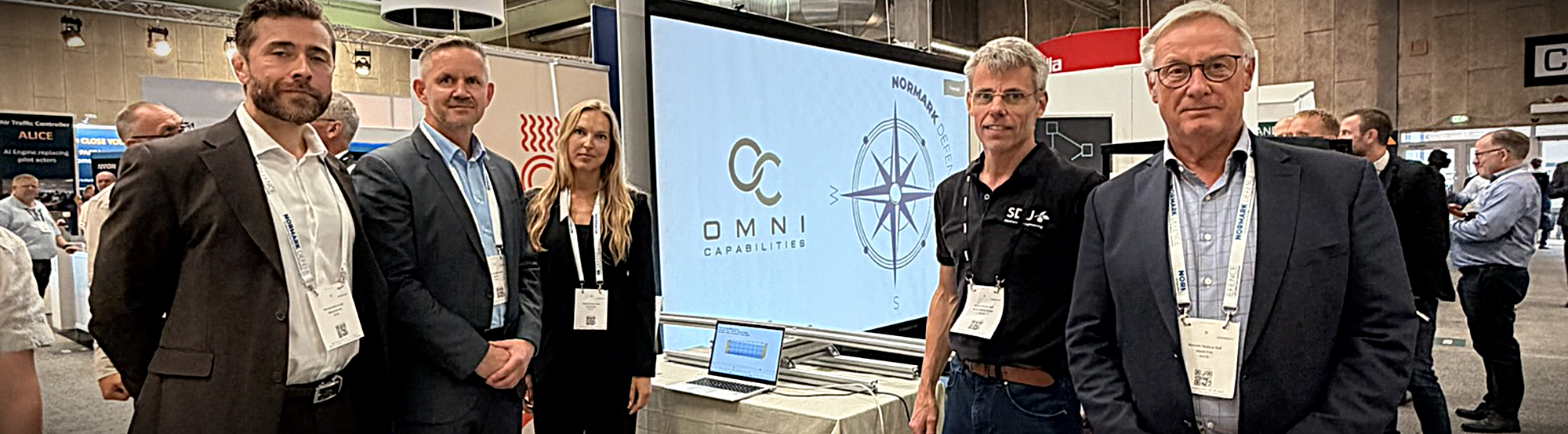
Both technologies were recently presented as technology demonstrators on a joint stand with Normark Defence and Omni Capabilities at DALO Industry Days in Herning. DALO Industry Days has become Scandinavia’s largest defence equipment exhibition, growing from 800 exhibitors in 2025 to 1,250 exhibitors at this year’s event, which was held at MCH Messecenter Herning for the first time.
- It is important for us to demonstrate that research can be translated into something tangible. We now have working demonstrators showing that these technologies can be developed into solutions for industry, says Professor Morten Hartvig Hansen from the SDU Centre for Industrial Mechanics.
A shared measure of stress on a ship
TorsionTrack was originally developed to measure bending and twisting in large wind turbine blades. Morten Hartvig Hansen and former SDU researcher René Lyne Eriksen, now Head of Development at Newtec Engineering, came up with the idea around eight years ago while discussing how the measurements could be performed quickly and accurately.
The system uses a light-sensitive sensor and two modulated light sources. Each light source emits light at its own frequency, enabling the system to distinguish between their positions and calculate both bending and twisting. The measurements are taken directly and therefore do not require subsequent processing of camera images.
In the maritime version, the system is installed between the ship's transverse bulkheads. It measures the angles that occur as sections of the hull move relative to one another. Measurements can be taken up to 50 times per second.
- Imagine a ship in heavy weather. From experience, the captain knows that it may be necessary to reduce speed or alter course in relation to the waves. TorsionTrack can provide the crew with a number on a screen showing the actual deformation of the hull as it happens, explains Morten Hartvig Hansen.
This can give different crew members a shared, more objective basis for assessing how hard the ship can be driven safely. The data can be linked to a digital twin of a new vessel or displayed directly on the bridge as bending and twisting measurements.
The system can also be used while a ship is being loaded. The distribution of heavy cargo affects the hull's deformation, so measurements can help ensure the cargo is positioned appropriately for the planned route.
Following a voyage, the data can also be used to assess the need for inspection and maintenance.
- If a ship has crossed the Atlantic in extremely heavy weather, the measurements may indicate that a thorough inspection is required. If the stresses have been low, it may be possible to avoid taking the vessel unnecessarily out of service. It is about both safety and making better use of time and resources, says Søren Lei, Head of Business Development at Omni Capabilities.
The current demonstrator is housed in portable cases, allowing the system to be brought on board and installed on an existing ship. Work is underway on both a retrofit solution and a version that can be integrated during the construction of new vessels.
The technology may also have applications beyond the maritime sector. The same principle could, for example, be used to monitor stresses on bridges and other long structures.
Components that can heat themselves
While TorsionTrack measures structural stresses, TargetHeat is designed to solve problems that arise when military equipment is used in extreme cold.
Bartosz Gackowski, postdoc at the SDU Centre for Industrial Electronics, developed the technology. It is based on a specialised hybrid 3D-printing method in which an electrically conductive material is precisely placed inside a plastic component. When an electric current passes through the material, the component generates heat.
- We can programme exactly where the conductive material should be positioned and where the heat should be generated. At the same time, the surrounding plastic protects the conductive material from chemicals and environmental exposure, explains Bartosz Gackowski.
He began developing the method during his PhD in Singapore, where he investigated new ways of manufacturing composite materials. Conventional methods can produce extremely strong materials, but require equipment such as moulds, ovens or autoclaves and can therefore be both time-consuming and energy-intensive.
Using 3D printing, Bartosz Gackowski instead sought to place different materials precisely where their individual properties were needed. After joining SDU, he developed the method further with support from Fabrikant Mads Clausens Fond and built a more accurate printer capable of working with multiple materials and producing larger components.
The technology has been tested at temperatures as low as -60 degrees Celsius.
Among the first potential use cases for drones are temperature control for batteries and the electronic components surrounding them. Batteries lose performance in extreme cold and must therefore be kept within a specific temperature range. With TargetHeat, heating can be printed directly into the structure surrounding the battery and, in the longer term, directly onto the battery cells to optimise temperature control, performance and service life.
The technology could also be used in moving parts around a drone’s gimbals, cameras and sensors. Frost and icing can impair the movement of mechanical components or cause them to fail. In the longer term, the principle may also be used to prevent ice from forming on drone wings and propellers.
- The major advantage is that the solution can be adapted to the specific task. We can determine exactly where the material and heating should be placed. At the same time, the components can be manufactured locally and automatically, reducing dependence on long and vulnerable supply chains, says Bartosz Gackowski.
From research idea to defence market
Normark Defence has entered into licensing agreements with SDU for the technologies and has helped identify potential applications in the defence sector, investigate the market and advance the solutions.
TorsionTrack is the more mature of the two technologies and is now available as a fully functioning technology demonstrator. Work on TargetHeat began later, but an initial demonstrator has also been produced to validate its underlying principle.
Further commercialisation will take place through Omni Capabilities, an independent company established to focus on four selected technologies emerging from Normark Defence's innovation activities. Among other things, the company will identify partners that can assist with further development, production, certification and marketing.
- Normark Defence’s task is to identify promising technologies at universities and determine whether they can solve specific problems in the defence sector. At Omni Capabilities, we then help develop them from technology demonstrators into solutions that can be tested, manufactured and brought to market, says Søren Lei.
Meanwhile, the SDU researchers can continue developing the research behind the technologies.
- As researchers, our primary task is to develop and mature the technology. This collaboration allows us to focus on what we do best, while Normark Defence and Omni Capabilities provide funding for the development work, project management and the entire go-to-market strategy and its practical execution. In this way, an idea conceived at a university can ultimately become a solution that is used in the real world, says Morten Hartvig Hansen.