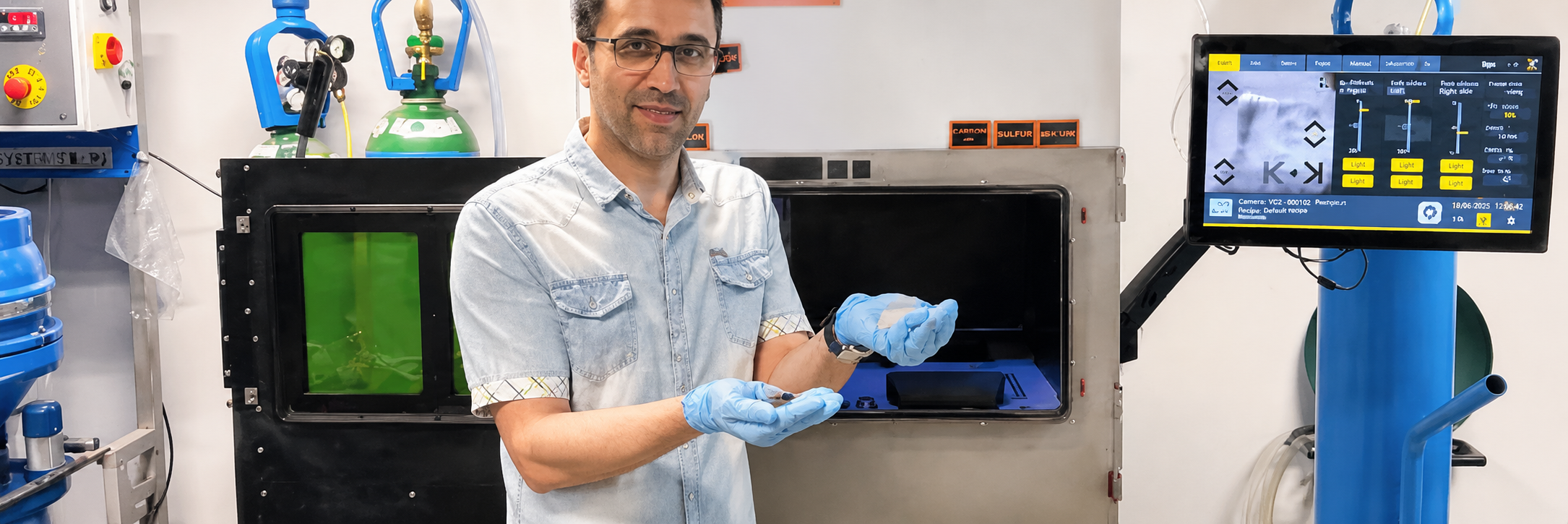
SDU researcher awarded major grant to turn metal waste into the raw materials of the future
A major grant from Independent Research Fund Denmark will enable SDU researcher Mohammad Malekan to investigate whether contaminated metal waste from industry can be reused directly in advanced 3D printing. If successful, the project could reduce waste, strengthen Europe’s supply security and make manufacturing more sustainable.
Every day, European companies generate large quantities of metal chips and metal scraps as by-products of manufacturing processes. For many businesses, these materials are simply waste streams that cost money to dispose of.
But what if waste is not waste at all?
That is the question Associate Professor Mohammad Malekan from the Institute of Mechanical and Electrical Engineering at the University of Southern Denmark will explore after receiving a Sapere Aude Research Leader grant from Independent Research Fund Denmark.
The aim is to develop new knowledge about how metal waste from industry can be transformed into metal powder and used directly in advanced metal 3D printing.
- Europe has limited access to raw materials, while at the same time producing large amounts of metal waste. We need to become better at viewing waste as a resource. If we can reuse materials that already exist within our industrial value chains, we can both reduce waste and decrease our dependence on imported raw materials, says Mohammad Malekan.
Challenging the conventional approach
Methods for recycling metal waste already exist. However, they typically require extensive cleaning processes because the materials are often contaminated with oils, lubricants and other residues from manufacturing.
This is precisely the approach Mohammad Malekan wants to challenge.
- What makes this project unique is that we are investigating whether these materials can be used without first cleaning them with large quantities of chemicals. If that proves possible, recycling could become simpler, cheaper and more environmentally friendly, he says.
The project focuses on metal chips generated through processes such as CNC machining, where large metal blocks are shaped into finished components. Although the leftover material often consists of valuable metals, it is typically treated as waste and sent to external recycling facilities.
The researchers will investigate how these so-called “dirty powders” affect the quality and performance of components produced through metal 3D printing.
Strengthening Europe’s resilience
The project comes at a time when access to raw materials and resilient supply chains has become a strategic priority across Europe.
Many of the metals required by European industry are imported from outside the continent. At the same time, interest is growing in creating more local and resilient manufacturing ecosystems.
If companies can increasingly reuse their own materials, it could contribute to both greater supply security and a more circular economy.
- Many companies are already working actively to improve sustainability and circular production. If we can develop solutions that transform waste into a valuable resource instead of a problem, the impact could extend far beyond the laboratory, says Mohammad Malekan.
Artificial intelligence will support the research
The project combines materials science, advanced 3D printing, numerical simulations and artificial intelligence.
The researchers will investigate how impurities affect material properties and how defects in finished 3D printed components can be predicted using machine learning.
The goal is to build a fundamental understanding of how recycled materials behave in advanced manufacturing processes and, ultimately, make them easier for industry to adopt.
An opportunity to build a research team
The Sapere Aude programme is among Denmark’s most prestigious research funding schemes and is awarded to talented researchers who are ready to establish and lead their own independent research groups.
For Mohammad Malekan, the grant provides an opportunity to bring together a team of researchers and pursue questions that would otherwise be difficult to investigate.
- I am both proud and grateful. The Sapere Aude grant gives me the opportunity to build my own research environment and pursue an idea that involves significant scientific risk, but also considerable potential. It is a unique opportunity to generate new knowledge that can benefit both research and industry, he says.
The grant will help fund a postdoctoral researcher, a PhD student and a research assistant, who will work together to develop and test the new methods.