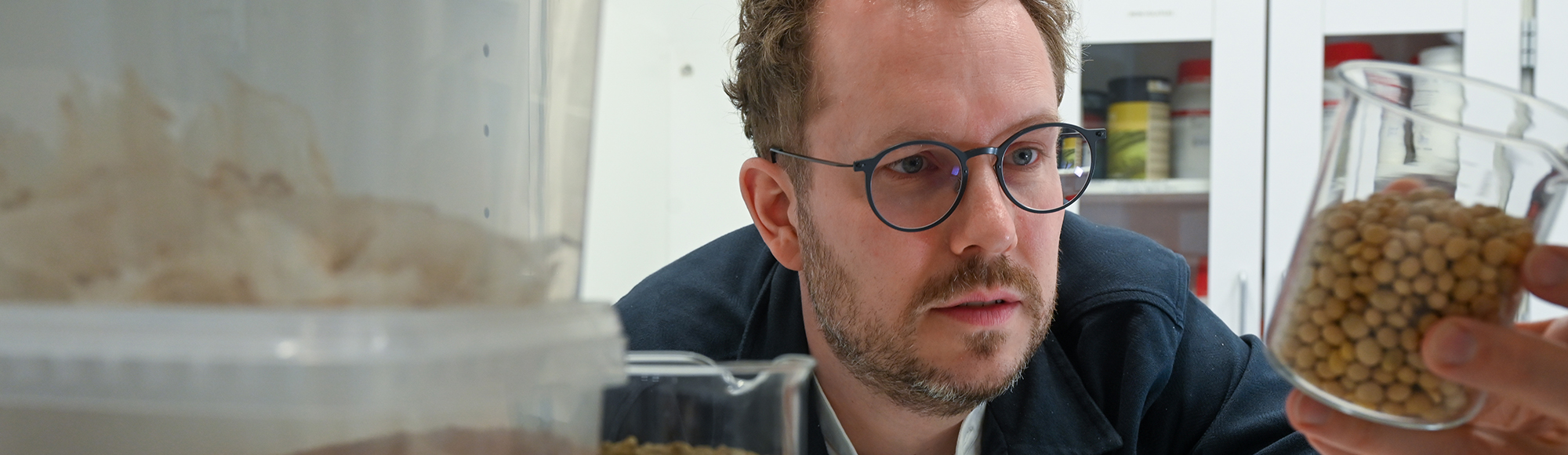
What actually happens when you boil a bean?
Researchers from SDU Food Matters at the University of Southern Denmark will spend the next five years studying how the natural microstructures of beans change during preparation, and how this knowledge can be used to develop better food packed with plants.
It seems almost banal. Most people who have spent even a little time in a kitchen know that beans become softer when you boil them.
But in fact, there is a scientific mystery hidden in the pot.
While a great deal is known about the chemical composition of beans – their protein content, fibre content, fat and starch, and so on – far less is known about how the components are organised inside the bean at microscopic level, and what happens to the structure during preparation.
A new research project at the University of Southern Denmark will now attempt to answer these questions. The project has received DKK 12.5 million from the Novo Nordisk Foundation through the Novo Ascending Investigator programme.
- The purpose of the project is to understand what happens inside the bean when we prepare it, says Mathias Porsmose Clausen, associate professor at SDU Food Matters and head of the project.
-If we can link the microstructure of beans to texture, flavour and eating quality, we can use that knowledge to develop more tasty food.
Linking microstructure to mouthfeel
The researchers will use advanced microscopy to study what happens to legumes when they are prepared under different conditions. Among other things, they will vary temperature, cooking time, salt content, pH, amount of water and flavourings.
At the same time, the researchers will link the microscopic analyses to measurements of the beans’ physical properties and sensory studies. This could include hardness, elasticity, mouthfeel and texture.
This knowledge can be used both in plant breeding and food innovation, and farmers and the food industry will therefore also be involved in the project.
- Once we know which structures inside the bean are important for flavour, texture and eating quality, plant breeders can begin to breed for those structures. And if the food industry has precise descriptions of the microstructure, it will be easier to predict how a particular bean will behave during production and preparation, says Mathias Porsmose Clausen.
The researchers will also draw on the expertise of chefs in the research project.
- I have no doubt that many chefs already know from experience how to prepare beans so that they achieve a particular texture. But they do not always know why what they do works. If we can understand the mechanisms behind it, we can begin to generalise that knowledge and use it in new contexts, says Mathias Porsmose Clausen.
Less processing
A great deal of research into plant-based foods today focuses on splitting plants into ingredients. Proteins, fibres and other fractions are extracted and then used to build new products, such as plant-based meat or cheese analogues.
The new project at SDU takes a different approach. Here, the starting point is that the bean already has a natural structure that may be used actively.
- When we split the bean into protein, fibre, fat and starch, we risk losing some of the functionality found in the overall structure. If, instead, we can understand and utilise the bean as a whole raw material, we can both improve the flavour and texture of the bean and perhaps also develop other plant-based foods with less processing and better texture, says Mathias Porsmose Clausen.
The project officially begins on 1 January 2027 and runs until 2032.