Border region aims to drive the future of energy systems
After years of close cross-border collaboration, the Interreg project SmartPowerConversion is now concluding with results that already point towards the next phase. Researchers and companies have developed new solutions for intelligent power management and energy storage – technologies that could become crucial as Europe faces growing pressure on its electricity grids.
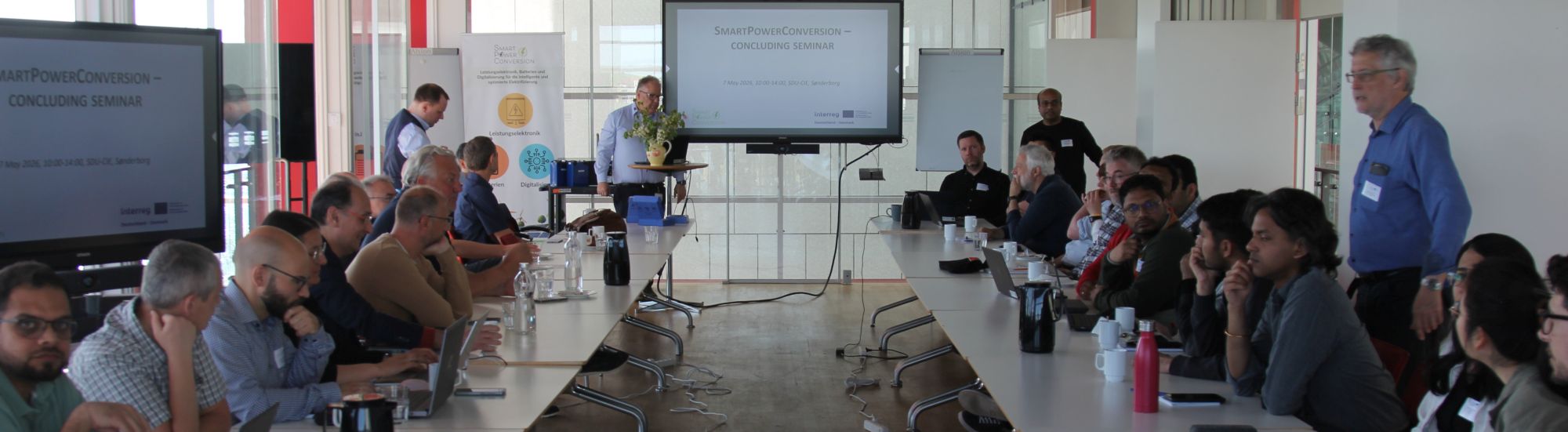
That is the ambition of Thomas Ebel, Head of SDU Centre for Industrial Electronics, following Thursday’s final seminar for the German-Danish Interreg project SmartPowerConversion.
Behind the statement lies several years of collaboration between researchers, companies and innovation environments in Denmark and Germany, focused on one of the major challenges of the green transition: how to make an electrified society work when industry, transport, data centres and energy-intensive technologies all require increasing amounts of electricity.
The answer is no longer simply about producing more energy. Increasingly, it is about using energy far more intelligently.
Over the past years, the project has developed new solutions in power electronics, energy storage, and the intelligent control of electrical energy. At the same time, collaboration between universities, companies, and innovation environments has far exceeded expectations.
According to Kasper Mayntz Paasch, Associate Professor at SDU Centre for Industrial Electronics and project manager of SmartPowerConversion, one of the project’s greatest strengths has been the close collaboration between research and industry across borders.
- We have brought together strong research environments and companies around some of the most important technologies of the green transition. This has made it possible both to develop new solutions and to test them close to real industrial needs, he says.
The project has brought together partners such as SDU, HAW Kiel, and CAU Kiel, as well as companies including Danfoss, Semikron, Linak, Converdan, Secop, EP, Litronic, and Motek.
According to the project partners, the original goal was to involve around 100 participants across the project activities. Instead, more than 500 participants have taken part in seminars, workshops and events throughout the German-Danish border region.
Smarter control of electricity
At the heart of SmartPowerConversion is power electronics – the technology that controls and converts electrical energy in everything from industrial systems and energy infrastructure to future electricity grids.
At the final seminar, project partners presented several new demonstrators developed in close collaboration with industry. Among them were solutions in which control systems are integrated directly into power modules, making systems more compact, energy-efficient, and robust.
Researchers have also developed new control strategies to improve grid stability as societies become increasingly electrified and pressure on energy systems continues to grow.
- One of the most important achievements has been our ability to transform research into concrete technologies together with industry partners, says Kasper Mayntz Paasch.
For Thomas Ebel, however, the development is about more than new technology.
He points out that energy systems are currently undergoing the biggest transformation in generations. Where the energy sector was once built around large centralised power plants, future systems will become far more complex, with renewable energy, electrified industry, battery storage and decentralised energy production all interacting simultaneously.
- Power electronics will become one of the key technologies of the green transition. If we are to succeed with the electrification of society, we need to be able to manage energy intelligently and efficiently, he says.
Giving batteries a second life
The project has also focused on battery technology and energy storage.
Among other things, researchers have worked with batteries from the electric ferry Ellen, where new analysis methods have helped extend battery lifetime and improve performance.
At the same time, the project has explored how used batteries can gain a second life as energy storage systems once they are no longer suitable for their original applications.
AI-based tools for faster battery analysis have also been part of the project – technology that could become increasingly important in future energy systems built around large-scale battery storage and decentralised energy management.
According to Thomas Ebel, the combination of intelligent control and energy storage will be essential in the years ahead.
- We are moving towards an energy system that is far more dynamic than before. That creates entirely new demands on both technology and collaboration between research and industry, he says.
The next step is already underway
Although SmartPowerConversion is now formally concluding, the partners are already working on new projects and new ambitions.
The goal is to bring the technologies even closer to industry, education and real-world energy solutions while strengthening the region’s position as one of Europe’s leading environments for power electronics and energy technology.
According to Thomas Ebel, the foundation has already been established.
- We have built a strong ecosystem within power electronics and energy systems. The next step is to take it to a higher level and ensure that the region remains one of the places in Europe where new energy technologies are developed, tested and transformed into real solutions, he says.