How can you protect your child’s eyesight?
More screen time and less time outdoors may have a negative impact on children’s eyesight. But what can you actually do as a parent? Ophthalmologist and researcher Marianne Juul-Dam explains what to look out for and what research tells us about myopia in children.
An increasing number of children around the world are becoming myopic, or short-sighted. This does not simply mean that they have blurred distance vision and therefore need glasses. In the vast majority of cases, myopia occurs because the eye grows too long. This changes the way light is focused on the retina, causing distant objects to appear blurred. And the longer the eye becomes, the greater the risk of serious eye diseases later in life.
There are indications, however, that childhood habits may influence the development of myopia.
Marianne Juul-Dam is an ophthalmologist and researcher at the Department of Regional Health Research at the University of Southern Denmark and the Department of Ophthalmology at Lillebælt Hospital. Here, she explains five things parents should know about their child’s eyesight.
1. How can I tell if my child is becoming short-sighted?
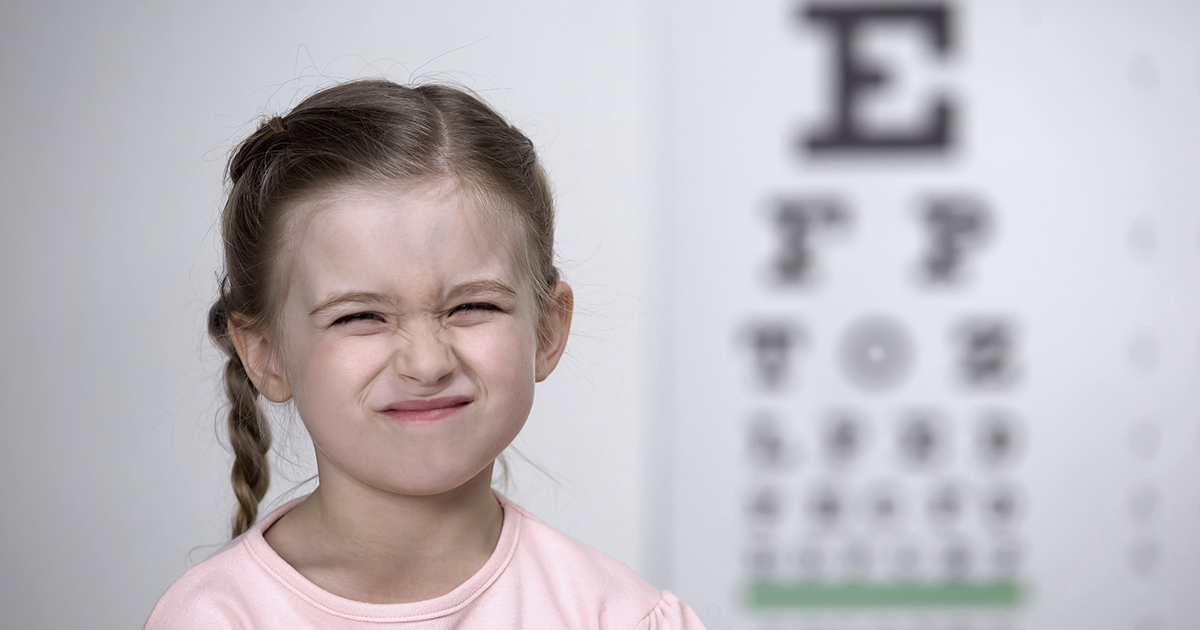
Signs of myopia may include holding things close to see them, having difficulty seeing the board at school or squinting to focus. Some children may also experience headaches or difficulty concentrating.
Children can easily be short-sighted without realising it themselves. They are good at compensating, and myopia often develops gradually.
The Danish Health Authority recommends vision checks as part of the regular childhood health examinations carried out by GPs and by school health services. If a vision problem is suspected, the child should be examined by an ophthalmologist.
Parents can also make an appointment directly with a practising ophthalmologist if they suspect that their child has impaired vision. Children over the age of 10 can be examined by an optometrist.
Facts
Five ways to protect your child’s eyesight
- Look out for the signs: Take action if your child has difficulty seeing the board at school, holds things very close, squints, has a squint or experiences headaches.
- Be particularly vigilant if you are short-sighted yourselves: A child’s risk of developing myopia is greater if one or both parents are short-sighted.
- Keep a distance of at least 30 centimetres: As far as possible, make sure your child keeps a distance of at least 30 centimetres from books, phones, tablets or anything else they are looking at close up.
- Take breaks from near work: Do not let your child read or use a screen at close range for more than 20 minutes at a time. Take breaks that allow the eyes to focus on something further away.
- Get your child outdoors every day: Aim for at least two hours outdoors in daylight every day – even when the weather is grey.
2. Why is myopia a problem – can’t my child just wear glasses?
Glasses or contact lenses can provide clear distance vision.
Not wearing glasses with the correct prescription may also cause myopia to progress more quickly than it would if the correct prescription were used.
What happens to the eye?
Children have relatively small eyes when they are born and are therefore long-sighted. Their eyes need to grow a little every year, just like the rest of the body. But in children with myopia, the eyes grow too much.
As the eye grows longer, its structure and shape change. This can increase the risk of other, potentially sight-threatening eye diseases later in life.
These include glaucoma, retinal detachment and damage to the light-sensitive cells in the macula. The risk mainly emerges in adulthood, particularly after the age of 60, and increases the longer the eye becomes.
Today, treatments are available that can slow the progression of myopia. So it is not only a question of correcting vision with glasses, but also of trying to slow the growth of the eye and preserve its natural shape.
What does it mean when the eye becomes too long?
A normal eye is approximately round. In the vast majority of cases, myopia develops because the eye grows too much in length – from the front of the eye towards the retina at the back.
This means that when you look at something in the distance, light is no longer focused correctly on the retina. Instead, it is focused in front of the retina, making distant objects appear blurred.
Glasses can correct the way light is focused so that the child can see clearly again. But glasses do not make the eye itself shorter. This is why researchers are also interested in ways of limiting excessive growth in the length of the eye.
3. How much does it matter if a parent is short-sighted?
Both genetics and environmental factors play a role in the development of myopia.
If one parent is short-sighted, the child has up to twice the risk of developing myopia compared with children whose parents are not short-sighted. If both parents are short-sighted, the risk is around three times as high.
4. Can too much screen time and reading make my child short-sighted?
Studies suggest an association between large amounts of near work and the prevalence of myopia. Near work refers to activities where the eyes focus at close range, such as reading, doing homework or using a screen. More specifically, it includes activities carried out within approximately an arm’s length.
The theory is that focusing at close range may cause increased growth in the length of the eye, although the exact mechanism is not yet known.
Is a screen worse than a book?
When it comes to viewing distance, there is essentially no distinction between a book and a screen. One concern about screens is that the content may keep children engaged for longer periods, thereby increasing the total amount of time they spend doing near work.
Does keeping your distance and taking breaks help?
A number of observational studies suggest that it may. However, there is not yet sufficient evidence to draw firm conclusions.
In a new project, we will study Danish schoolchildren in greater detail to investigate how factors such as viewing distance, screen time and breaks affect changes in their eyes associated with the development of myopia.
We will collect objective measurements and hope that the results will provide a basis for updated, evidence-based recommendations.
Where can you have your child’s eyesight tested?
Children can make an appointment with a practising ophthalmologist without a referral.
If the child is under the age of 10, a prescription from an ophthalmologist is required before an optometrist can provide glasses. Children over the age of 10 can get glasses from an optometrist without first seeing an ophthalmologist. The optometrist will refer the child to an ophthalmologist if necessary.
5. Why is spending time outdoors good for my child’s eyes?
Several studies show that time spent outdoors is an important factor in reducing the risk of developing myopia. Research has found, for example, that the eye grows less during summer than during winter.
Based on the results of several large studies conducted in recent years, both international and national guidelines recommend that children spend at least two hours outdoors every day.
Does a grey Danish winter day count too?
Yes. The recommendation to spend time outdoors also applies on a grey Danish winter day.
Time outdoors also has the added benefit that children are not spending that time in front of a screen or doing other forms of near work.
Why does daylight help?
We do not yet know the exact mechanism behind what happens in the eye when it is exposed to daylight. However, animal studies indicate that limited exposure to daylight facilitates eye growth, while daylight appears to have a protective effect. For example, we know that eye growth during summer is only around 60 per cent of that seen during winter.
Studies have ruled out physical activity itself as a factor affecting the degree of myopia.
New knowledge about the eyesight of Danish schoolchildren is on the way
In a new study, Marianne Juul-Dam and her colleagues are examining around 900 Danish schoolchildren. The children have been selected in collaboration with Statistics Denmark to ensure that they are comparable with children in the rest of Denmark.
The researchers will investigate how many children are short-sighted and map their habits in relation to near work and time spent outdoors.
To gain a more detailed picture of the children’s everyday lives, the researchers use a small sensor about the size of a USB stick. It is attached to the arm of the child’s glasses or to a pair of non-prescription glasses provided for the study.
The sensor records, among other things, how much light the child is exposed to, the distance to what the child is focusing on and how long the child maintains that focus. It can also record breaks from near work when the child looks at something further away.
This is different from previous studies, in which children and parents have typically reported in questionnaires how much time the children spent doing near work and how long they spent outdoors.
Among other things, the researchers hope to provide better answers about the role of near work in the development of myopia, whether short breaks from screens and books can make a difference, and how much daylight Danish children need.
Children in the first years of primary school will be examined again after three and six years. This will allow the researchers to follow how many develop myopia over time and whether changes in their habits are associated with the development of myopia.
The first results are expected to be available in 2028
Meet the researcher
Marianne Juul-Dam is an ophthalmologist and PhD Fellow at the Department of Regional Health Research at the University of Southern Denmark and the Department of Ophthalmology at Lillebælt Hospital. Her research focuses on myopia in children and the role played by factors including near work, screen habits and time spent outdoors.