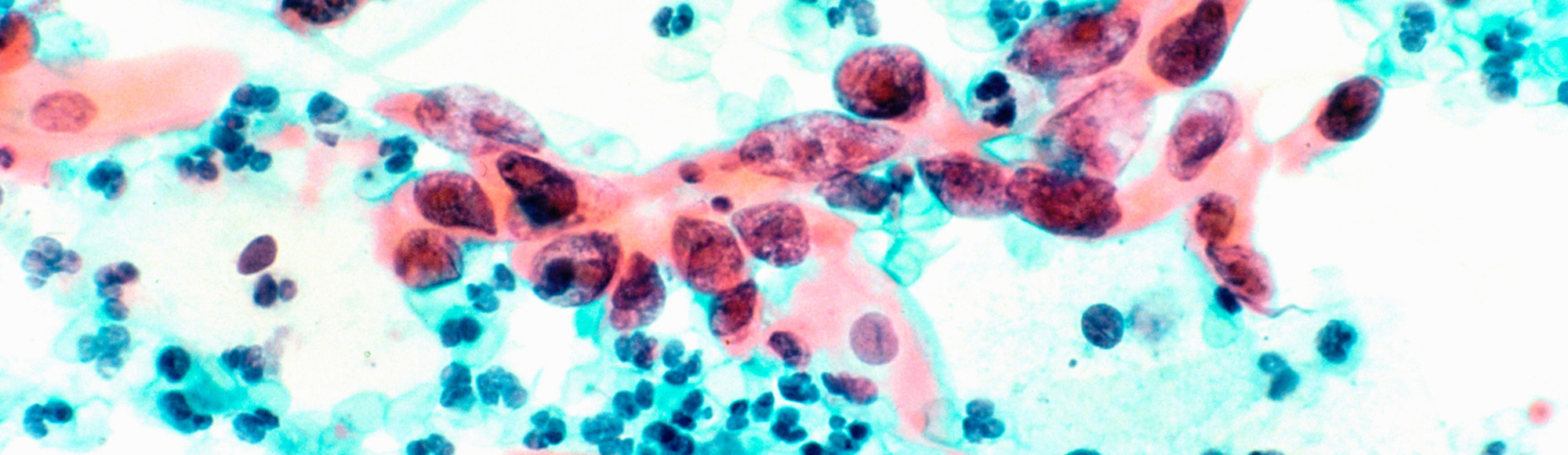
Technology and medical science can create groundbreaking treatment
An exemplary collaboration between OUH and the University of Southern Denmark (SDU) is opening up entirely new possibilities for fast and accurate diagnosis and treatment of cervical cell changes that may later develop into cervical cancer. After a successful testing period, the new technology will now be implemented at the hospital.
Cervical cancer is the fourth most common cause of death among women worldwide. Among women under 40, it is the second-deadliest cancer.
A promising partnership between the Department of Gynaecology at OUH and researchers at SDU could significantly improve the diagnostic and treatment process for women who are screened for cervical cell changes that may develop into cervical cancer.
An artificial intelligence algorithm has proved to be the key—benefiting staff, patients, and society at large. After an initial test phase, the next step is now underway, and it may become a major breakthrough, explains Lone Kjeld Petersen, Head of Research and Chief Consultant at the Department of Gynecology and Obstetrics.
“The technology examines the cervix through an advanced magnification device that allows us to capture images to identify potential cell changes. Together with the team of Applied AI and Data Science Unit at SDU led by Esmaeil S. Nadimi, we have developed a technology capable of analyzing these images and accurately detecting conditions that require closer examination by staff.
“The first model is incredibly accurate and can identify cell changes far better than the human eye. Now we need to test whether this holds up in practice—and if it does, it could make a tremendous difference,” she says.
Better diagnosis with fewer (or no) tissue samples
Today, examinations involve capturing images and taking four tissue samples, which are then sent for laboratory analysis. It takes 5–6 weeks before the woman receives an answer on whether she requires further treatment.
In the future, AI technology may detect treatment-requiring changes and deliver results immediately. This means the department can avoid both over- and undertreatment, as any necessary procedures can begin right away. The number of tissue samples may also be reduced to just one—or potentially none—if the technology proves reliable.
“It is a great relief for women to receive clarification quickly and avoid weeks of worry. They are either immediately reassured, or if something requires treatment, we can begin right away,” says Lone Kjeld Petersen.
Strong collaboration between university and hospital
Several years ago, Lone Kjeld Petersen and her colleagues reached out to CAI-X, a knowledge center that serves as a bridge between SDU, OUH, and industry partners in the development of AI-driven healthcare solutions.
“It’s truly unique. I didn’t know who at the university could help us, but the support we’ve received has enabled us to develop this technology over the past few years in collaboration with our skilled colleagues at the Faculty of Engineering,” she explains.
One of the researchers who has built and developed the algorithm from the ground up is Smith Khare, Assistant Professor at the Maersk Mc-Kinney Møller Institute. His work focuses, as he puts it, on developing AI algorithms for clinical challenges.
More than 98% accuracy in the developmental phase
Thanks to large volumes of image material with known outcomes (i.e., whether cell changes were present), the AI could be trained under optimal conditions—and the preliminary results speak for themselves, says Smith Khare.
“We have developed an algorithm that can identify whether a woman is at low or high risk of cell changes. In the developmental phase, it was correct in about 98% of cases, which is extremely promising. Combining technology and clinical expertise makes perfect sense, as it allows us to bring new treatments to patients and benefit society,” he says.
Will the technology replace clinical staff?
As a professor and senior consultant, Lone Kjeld Petersen is a leading expert in the field. Asked whether AI could replace clinical judgment, she emphasizes that such technologies should always be used as a supplement.
“We see the AI model as a tool to support clinicians—not replace them. There
are many aspects to consider, and we must protect the ethical dimension. The
AI highlights areas in the cervix that we, as clinical staff, should examine
more closely. We continuously evaluate the technology, and it is constantly
being refined to reach a level where it can be used as a clinical standard.
I have worked in this field for many years and have written the clinical
guidelines. I must simply acknowledge that we are not always as accurate as
we would like to be—hence the need for four tissue samples today. When our
algorithm can help deliver faster and more accurate diagnoses, it makes
perfect sense to use it—but always with care,” she says.
Can benefit women around the world
If the technology continues to develop and becomes fully implementable, Lone Kjeld Petersen believes it could have a profound impact on women’s health globally.
“Cervical cancer is one of the most common causes of death among young women worldwide. In many countries, the tools to detect cell changes in time simply do not exist, leading to countless cases of illness and death. If we continue to develop an effective technology, I truly believe we can improve diagnostics on personal, professional, and societal levels,” she concludes.
Further reading
Read the published scientific article at sciencedirect.com
About CAI-X
CAI-X is the Danish Centre for Clinical Artificial Intelligence - established by The Maersk Mc-Kinney Moller Institute at the University of Southern Denmark (SDU) and Odense University Hospital (OUH). It is a knowledge and competence centre that helps connect clinicians from the hospital with engineers and researchers at the university and private companies.
Meet the researcher
Lone Kjeld Petersen is a senior consultant at the Department of Gynaecology and Obstetrics at OUH and head of research at the Department of Clinical Research at SDU. In 2025, she and her colleagues received the Region of Southern Denmark's Audience Award for their work on the PEACE - Preventing Cervical Cancer project.
Meet the researcher
Smith Khare is an engineer and holds a PhD in Electronics and Communication Discipline. In addition to his role at CAI-X, he is an assistant professor at SDU at the Applied AI and Data Science research unit at The Maersk Mc-Kinney Moller Institute.